




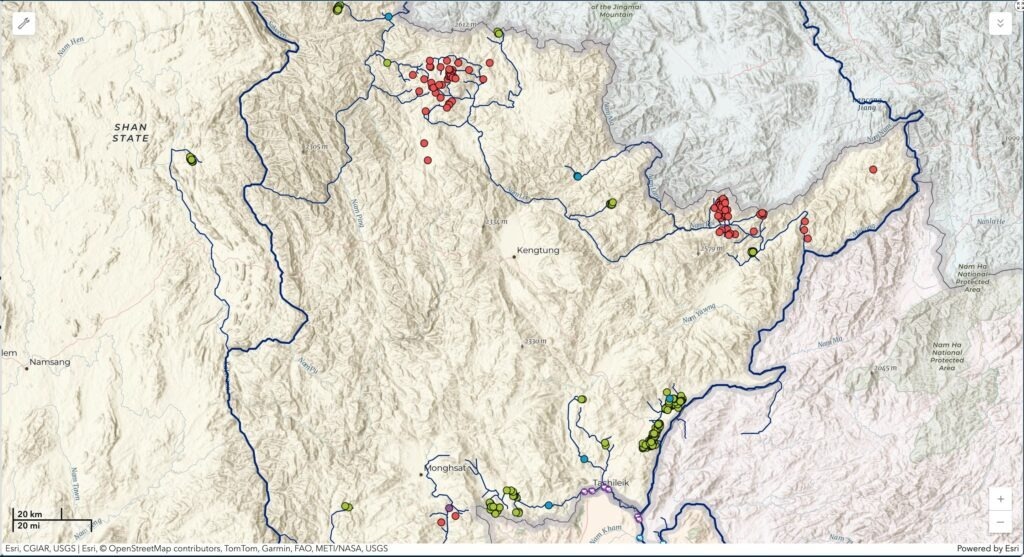
Rare earth mining operations in Shan State have expanded dramatically since the 2021 military coup, with satellite imagery and research by the Washington-based Stimson Center identifying at least 86 active mine sites across the state.
According to the Stimson Center, Myanmar is home to more than 600 rare earth mines, with operations in Shan State expanding rapidly. Rare earth elements are critical to the manufacture of electric vehicle (EV) batteries, smartphones, advanced electronics, and military equipment.
The report identifies the highest concentrations of rare earth extraction in Shan State in territories controlled by ethnic armed organizations and allied groups near the Chinese border:
- 39 sites in the Mong Pawk region, controlled by the United Wa State Army (UWSA).
- 33 sites in the Mong Yawng region, controlled by the National Democratic Alliance Army (NDAA).
- 12 sites in the Mantong region, controlled by the Ta’ang National Liberation Army (TNLA).
- 2 sites in the Mong Hsat region.
Almost all rare earth minerals extracted from these border areas are exported directly to China.
Data compiled by ISP-Myanmar shows that Myanmar exported more than US$4 billion worth of rare earth minerals to China between 2017 and 2024. A staggering 84 percent of that total—approximately US$3.6 billion—was generated after the 2021 military coup. In 2023 alone, exports reached a record US$1.4 billion, making Myanmar the primary supplier of rare earths to China and accounting for roughly two-thirds of China’s rare earth imports.
Mining operations predominantly rely on in-situ leaching, a technique in which chemical solutions, including ammonium sulfate, are injected directly into mountains to dissolve and extract rare earth elements. While relatively inexpensive, the process can contaminate soil and groundwater for decades, threatening agricultural land and drinking-water supplies. To evade satellite detection and scrutiny, operators have increasingly covered chemical leaching ponds with black roofing sheets, according to the report.
In Kachin State’s Pangwa region, residents are already experiencing severe environmental impacts from years of intensive rare earth mining, including massive landslides, contaminated water sources, and reported outbreaks of unexplained skin diseases. Environmentalists warn that similar impacts could now threaten Shan State’s mountain ranges and river systems.
The billions of dollars generated by largely unregulated rare earth mining are providing significant revenues to armed groups operating in Myanmar’s ongoing conflict. Meanwhile, local communities face the long-term environmental and social costs of the industry, with contamination and ecological damage potentially lasting for generations.








Leave a Comments