



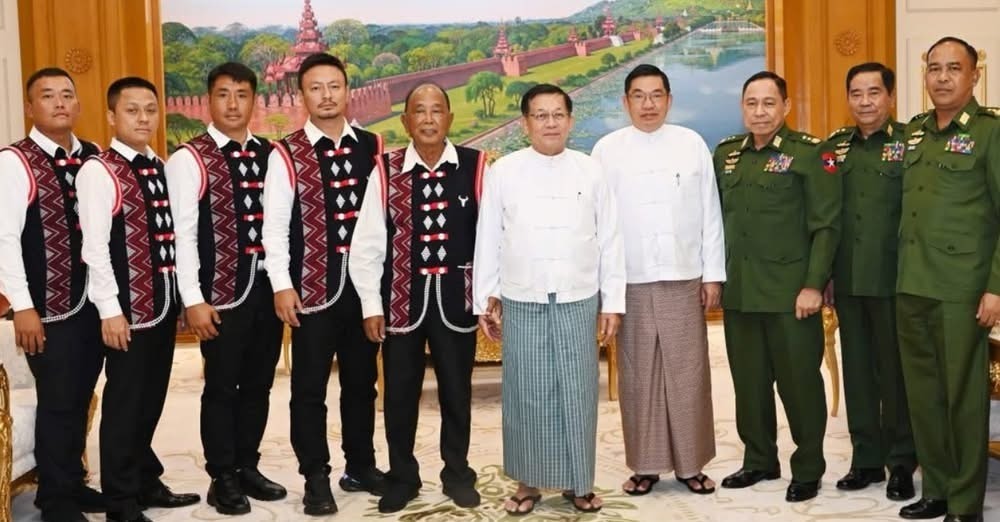
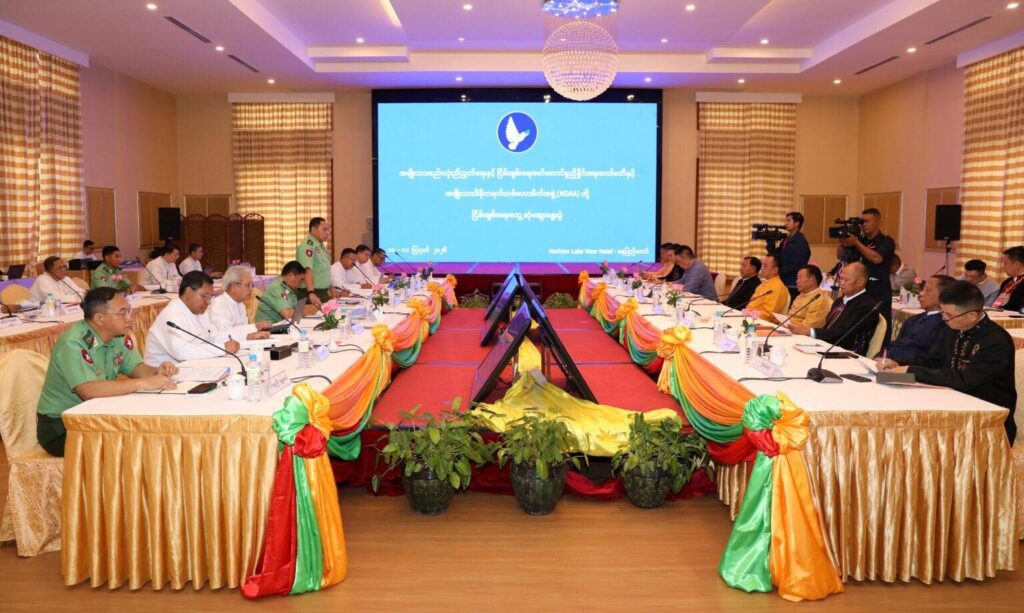
The Myanmar military-dominated, so-called quasi-civilian government led by Min Aung Hlaing, popularly known in Burmese as “Yway-Tu,” meaning “fakely-elected” regime, has been trying to court all five Federal Political Negotiation and Consultative Committee (FPNCC) members—though there are actually seven in total—to support its 100-Day Peace Initiative with help from China. While it’s still too early to predict how things will unfold, the other two FPNCC members, the Arakan Army (AA) and Kachin Independence Army (KIA), remain committed to establishing a genuine federal democratic union free from military dictatorship.
The Fractured FPNCC and the Two Strategic Blocs
The FPNCC has ceased to function as a unified front, splitting instead into two distinct strategic blocs that define the current trajectory of the Myanmar conflict. This division has rendered the committee unable to act as a single negotiating body, effectively undermining the military junta’s attempts to achieve a nationwide peace through its 100-Day Peace Initiative. The coalition now consists of the Accommodation Camp, which includes the United Wa State Army (UWSA), Myanmar National Democratic Alliance Army (MNDAA) or Kokang, Ta’ang National Liberation Army (TNLA), National Democratic Alliance Army (NDAA) or Mongla, and Shan State Progress Party (SSPP), and the Active Resistance Camp, comprised of the KIA and the AA. This schism reflects a fundamental divergence in goals, with the northern groups prioritizing survival and regional autonomy under Chinese pressure while the resistance factions remain committed to the total collapse of the military dictatorship and the establishment of a genuine federal democratic union.
The Accommodation Camp: A Frozen Northern Buffer
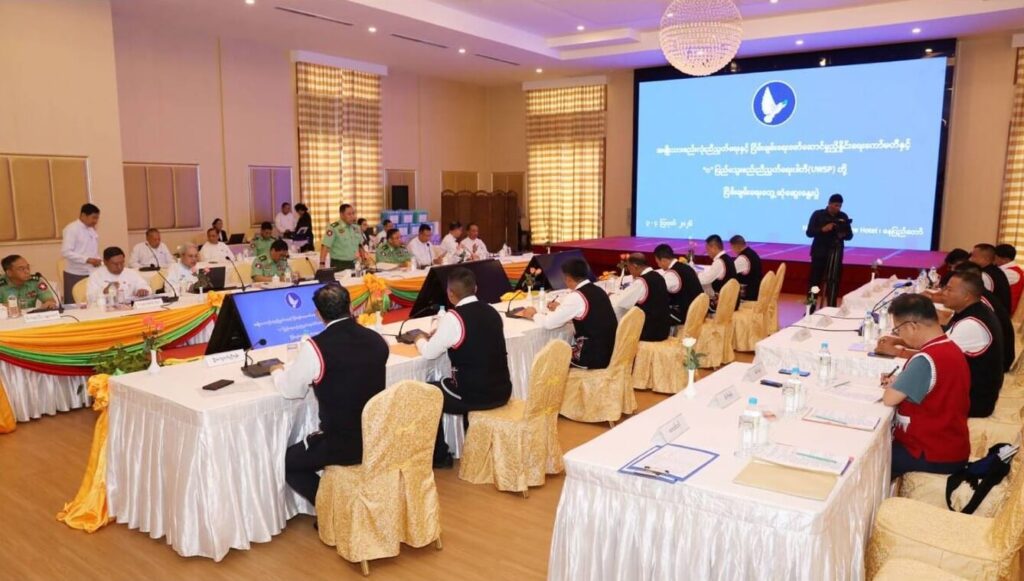
The five northern border groups have been forced by Beijing to shift from offensive military campaigns to diplomatic engagement and territorial consolidation. China, initially supportive of the offensive against cyber-scam networks, has pivoted to actively preventing the total collapse of the Myanmar state to protect its strategic investments and border stability. Through a combination of border gate closures, electricity cuts, and trade blockades, Beijing has compelled these groups to engage in bilateral talks with the junta. In exchange for ending hostilities, groups like the UWSA and TNLA are demanding formal statehood or special autonomous regional status within the constitutional framework. This strategy has created a de facto buffer zone along the Chinese border where these groups function as quasi-independent entities, ignoring Naypyitaw while refusing to support the broader democratic resistance. The result is a frozen conflict in the north where economic stability and self-rule take precedence over national revolution.
The Active Resistance: The Unstoppable Western Front
In stark contrast to their northern peers, the KIA and the Arakan Army have rejected all ceasefires with the military-backed government and continue to wage high-intensity conventional warfare. These groups operate in tight alignment with the National Unity Government and the Steering Council for the Emergence of a Federal Democratic Union (SCEF), executing a coordinated strategy to evict the junta from their respective states. The Arakan Army has already captured the vast majority of Rakhine State and is now focused on seizing the final three townships of Sittwe, Kyaukphyu, and Manaung, with a declared goal of total liberation by 2027. The KIA continues to expand its control over northern trade routes, jade mining hubs, and rare earth elements mining along Kachin-China border effectively severing the regime’s economic access to the upper half of the country. Unlike the northern EAOs, these groups are less vulnerable to Chinese economic pressure because they operate along the coast and the Bangladesh border, allowing them to maintain their offensive momentum despite Beijing’s anxieties.
The Geopolitical Stakes: China’s Dilemma at Kyaukphyu
The Arakan Army’s advance toward Kyaukphyu presents a critical geopolitical challenge for China. This coastal township is home to the Deep-Sea Port and Special Economic Zone, a vital asset that allows China to bypass the Malacca Strait for its energy imports. The proximity of heavy combat to these multi-billion dollar installations risks physical destruction and operational halts, forcing Beijing into an uncomfortable position. While China relies on the weakened junta to guarantee the security of its infrastructure, the military is losing ground rapidly. Simultaneously, China cannot easily strangle the Arakan Army through border closures as it does with the northern groups. This has led to a pragmatic but tense dynamic where the Arakan Army promises to protect foreign investments while demanding recognition of its sovereignty, leaving Beijing to navigate a delicate balance between propping up the regime and negotiating with an unstoppable rebel force.
The Emergence of Three Distinct Realities
The divergent paths of these two factions point toward a future where Myanmar solidifies into a permanently partitioned state rather than a unified nation. The country is increasingly dividing into three distinct governance zones. The first is the Northern Buffer, a string of heavily armed, Chinese-influenced autonomous confederacies that maintain a tense truce with the regime. The second is the Revolutionary West and Frontier, comprising Rakhine, Kachin, and parts of Chin and Karen states, which function under independent revolutionary governance aligned with the NUG. The third is the Truncated Junta Heartland, where Min Aung Hlaing’s regime is compressed into the central dry zone and major cities like Yangon and Mandalay. This central enclave survives not through military strength but through defensive entrenchment, foreign hardware, and China’s refusal to allow a complete state collapse.
Redefining Federalism to Reunite the North
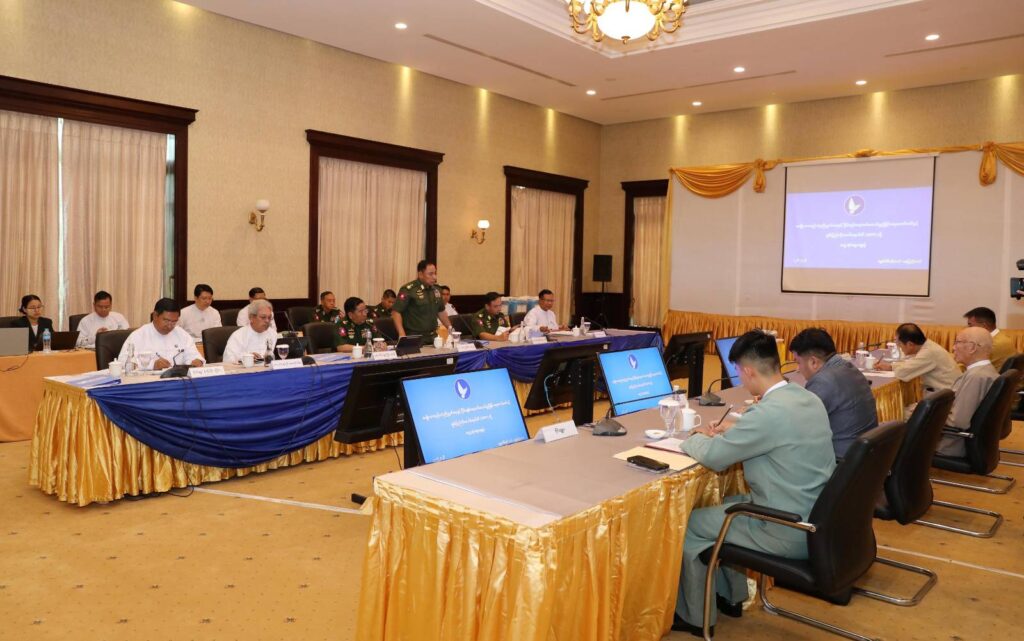
To keep Myanmar from solidifying into these three permanent, disconnected zones, the immediate priority must be a fundamental shift from winning the conflict to restructuring the state. The primary obstacle for the northern groups is the fear that a centralized state will erase their autonomy. To bring them back into the fold of a unified Myanmar, the concept of federalism must be redefined to allow for extreme decentralization. The Special Autonomous Region status they demand must be translated into a constitutional reality that grants them genuine control over their own security, taxation, and resource management, without requiring them to answer to a central military command. This requires the National Unity Government and the resistance forces to move beyond the rhetoric of total victory and offer a political settlement that recognizes these groups as sovereign partners within a confederation rather than subordinates. The accommodation camp needs a guarantee that their ethnic identity and economic interests are protected by law, not just by the threat of Chinese force.
The Resistance and the Imperative of Dismantling the Junta
For the Active Resistance Camp to accept a unified state, the military junta must be completely dismantled as a political entity, not just militarily defeated. The resistance’s demand for a Federal Democratic Union is non-negotiable for them, and any peace deal that leaves the military with political power will fail. However, to maintain the nation-state, the resistance must also be willing to engage in a transitional justice process that integrates their forces into a new, unified national defense structure under civilian oversight, rather than maintaining independent armies indefinitely. This requires a shift from a revolutionary war mindset to a nation-building mindset, where the AA and KIA accept a role in a broader coalition government that includes the NUG and eventually, the accommodation camp.
The Role of China and the International Community
China’s role is pivotal but currently counterproductive to unity. Beijing’s strategy of stabilizing the junta while simultaneously propping up the northern buffer zones creates a contradiction that prevents a unified peace. To preserve Myanmar as one country, China must pivot from a strategy of divide and rule to one of facilitated integration. This means using its immense leverage over the northern groups to push them toward a genuine federal negotiation with the NUG, rather than forcing them into a bilateral deal with a weakened junta. The international community, including ASEAN and Western nations, must also stop treating the NUG and the EAOs as separate entities. A unified peace conference that includes the NUG, the FPNCC, and representatives of the civilian population is essential. This conference must be held outside of China’s direct control to ensure that the terms of the new federal union are not dictated solely by Beijing’s strategic interests.
A Path Forward: The Transitional Confederation
The most viable path to keeping the country in one piece is the establishment of a Transitional Confederation. This interim government would recognize the de facto autonomy of the northern and western zones while establishing a central council responsible for foreign policy, currency, and national defense. The military would be disbanded and replaced by a new, ethnically integrated defense force under civilian command. This structure would allow the accommodation camp to maintain their local control while gradually reintegrating into the national economy, and it would allow the resistance to build their federal institutions without fear of military reprisal. The key is to create a political space where all parties can see a future where they are partners in a unified state, rather than enemies in a zero-sum war.
Conclusion: The Choice Between Unity and Balkanization
Ultimately, maintaining Myanmar as a nation-state requires a new social contract that is built on trust, not fear. The current conflict has eroded trust to the point where no party believes the other will keep their word. Rebuilding this trust will require a long-term process of dialogue, truth-telling, and reconciliation. It will require the military to accept that its days of political dominance are over, the northern groups to accept that their autonomy must be balanced with national cohesion, and the resistance to accept that a federal union requires compromise and shared governance. This is a difficult and painful path, but it is the only alternative to a permanent partition that would leave Myanmar vulnerable to foreign domination and internal chaos. The window for a unified Myanmar is closing, but it has not yet closed. By redefining federalism to accommodate extreme decentralization, dismantling the military’s political power, and engaging in a genuine, inclusive dialogue facilitated by the international community, it is still possible to weave these fractured zones back into a single tapestry. The alternative is a permanent balkanization that will serve the interests of regional powers but destroy the hopes of the Myanmar people for a free and united nation. The choice lies in the hands of the leaders of the FPNCC, the NUG, SCEF and the international community to choose unity over partition.





Leave a Comments