




The death of a 16-year-old girl at a bar in Taunggyi has sparked renewed concern over child labor, workplace abuse, and the lack of protections available to children and young workers in Myanmar.
“When I came out of my room, I found her slumped over a table,” recalled Su Myat (pseudonym), a friend and co-worker of the victim. “I tried to wake her, but she wouldn’t respond.”
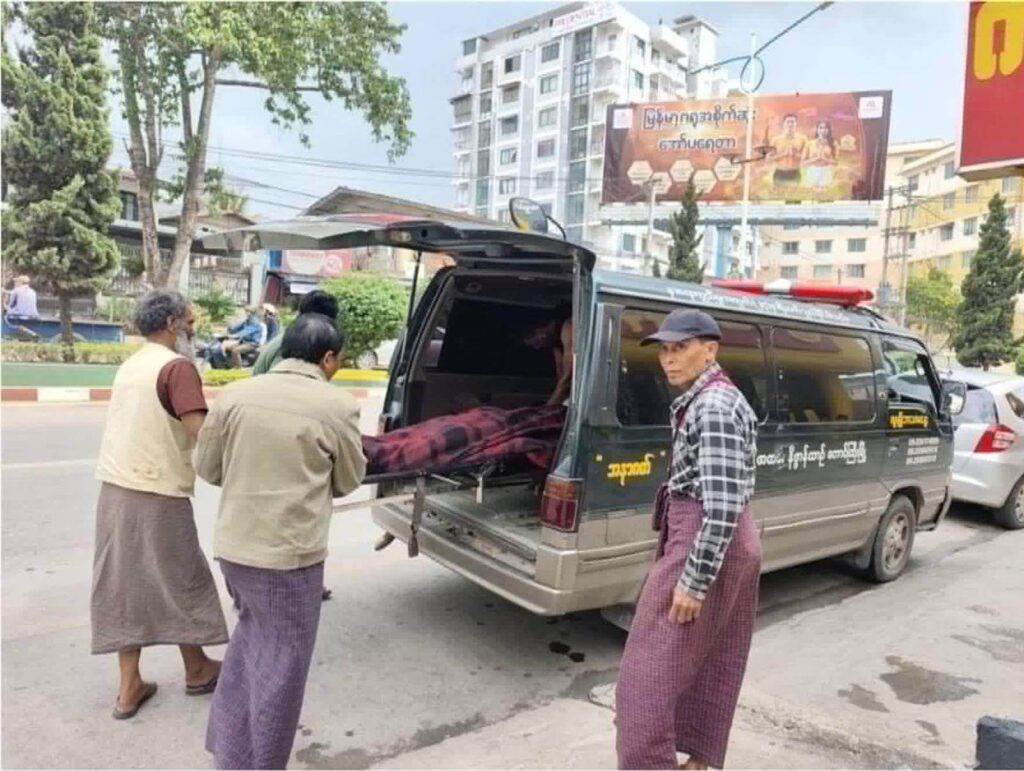
The victim, 16-year-old Ma Phu Pwint Wai, died on May 5 following an alleged assault at a bar on Bogyoke Aung San Road in Taunggyi, southern Shan State. Her friend, who was also working at the establishment, said she had been confined in a separate room during the incident and was unable to help.
A Summer Job Ends in Tragedy
Ma Phu Pwint Wai and Su Myat, both from Min Chaung Village in Yawnghwe (Nyaungshwe) Township, took jobs at the bar during their school break after completing their Grade 8 examinations.
According to local sources, the two girls began working on April 9 and were promised a monthly wage of 180,000 kyats. Their families hoped the work would allow them to earn income during the summer vacation.
Instead, their employment ended in tragedy just days before they were due to complete their first month of work.
Su Myat told SHAN that the dispute allegedly began after a customer gave Ma Phu Pwint Wai 5,000 kyats. She said the bar owner became angry and accused the teenager of failing to inform him about the money.
According to Su Myat, the girls were later separated and locked in different rooms.
“I was frightened and couldn’t sleep,” she said. “I could hear her crying from the next room, but I couldn’t do anything.”
Su Myat said she remained confined throughout the night and was unable to check on her friend.
When she was allowed out the following morning, she found Ma Phu Pwint Wai unresponsive.

Investigation and Arrest
According to local residents, the bar owner, Aung Myo Thu, also known as Peter, left the premises in the early hours of May 5.
Family members were initially told that the teenager had died after slipping in a bathroom. However, police later opened an investigation after identifying suspicious circumstances surrounding her death.
Authorities subsequently confirmed the case as a homicide.
After funeral arrangements had been completed and the family had returned to the Inle region, they were informed that Aung Myo Thu had been arrested in eastern Shan State.
“He has been caught and is being held at Taunggyi No. 1 Police Station. He has been charged with both murder and violations of the Excise Act,” said Ko Hein (pseudonym), a relative of the victim.
According to local sources, Aung Myo Thu was arrested on the afternoon of May 6 in Mong Peng Township, Kengtung District, eastern Shan State. He was later transferred to Taunggyi for further investigation.
He is currently being prosecuted under Section 302 of the Penal Code (Murder), Sections 100(a) and 101(b) of the Child Rights Law, and Section 74(d) of the Excise Act. The bar where the incident took place was temporarily sealed by Taunggyi police on May 11.
SHAN attempted to contact Taunggyi No. 1 Police Station for comment but was unable to reach officials.
Family Seeks Justice
Ma Phu Pwint Wai’s funeral was held on May 6. Relatives said they were devastated by her death and shocked by the injuries she had sustained.
Family members are calling for justice and accountability through the legal process.
“We want the maximum penalty permitted under the law,” said a young resident of the Inle region. “We do not want him to be released early through any form of amnesty.”
Residents said the two girls accepted the job because they believed the workplace was trustworthy and were familiar with the owner through local connections in Yawnghwe.
Several community members told SHAN that the owner was widely known in the area and that concerns about his behavior had circulated among some residents in the past. However, despite those concerns, the girls and their families did not anticipate that such a tragedy could occur.
In a statement issued on May 7, the Inle Women’s Union (IWU) called for accountability and urged community members, women’s groups, and civil society organizations to continue advocating for justice in the case.
Rights activists argue that violence against women and children is often enabled by deep-rooted gender inequality, weak legal protections, and a deteriorating rule of law.
Child Labor and Workplace Safety Concerns
The case has drawn widespread attention from local rights groups and community organizations, which argue that the tragedy reflects broader failures to protect children from exploitation and abuse in the workplace.
Rights advocates say the case underscores the vulnerability of children who enter informal employment due to economic hardship, conflict, and limited educational opportunities.
They argue that stronger safeguards are needed to prevent children from being exposed to unsafe working conditions, exploitation, and violence.
“We know these aren’t safe places, but with no other options, many young girls face serious risks while working in KTV lounges and bars,” a Shan women’s rights activist told SHAN. “These are among the many consequences communities have faced since the military takeover.”
Growing Risks for Children and Youth
Child rights advocates warn that economic instability, displacement, and conflict have pushed increasing numbers of children into hazardous forms of labor across Myanmar.
According to a United Nations report released in April 2025, violations against children have risen sharply since the 2021 military takeover. The report documented 5,141 verified violations affecting 4,089 children between July 2020 and December 2023.
An International Labour Organization (ILO) report published in September 2024 found that child labor had increased significantly in several parts of Myanmar, including Mon, Karen, Karenni, and Shan states. Rights groups say worsening economic conditions have pushed growing numbers of children into the workforce, including sectors that expose them to exploitation and unsafe conditions.
A United Nations Development Programme (UNDP) report released in October 2025 found that millions of young people in Myanmar face limited access to education, training, and employment opportunities. Among 7,000 young people surveyed, three out of four people aged 18 to 24 were not engaged in education or training, while one in four was unemployed.
Advocates say young women face some of the greatest barriers, making them particularly vulnerable to exploitation and abuse.
For many in Shan State, the death of Ma Phu Pwint Wai has become a painful reminder of the dangers faced by children who enter the workforce without adequate safeguards.
Noted: This article was originally written by Sai Harn Lin for SHAN’s Burmese-language service and translated into English by Eugene.








Leave a Comments