



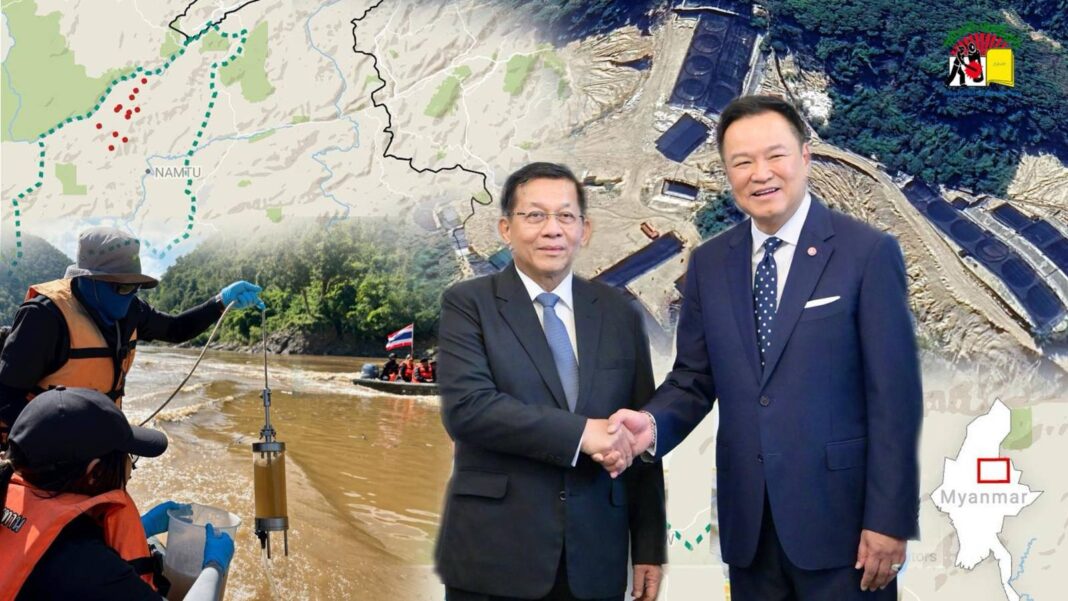
Inside Bangkok’s opulent Queen Sirikit National Convention Center, Myanmar’s military junta leader and Thai government officials smiled as they signed a series of bilateral agreements. The two sides signed four separate pacts covering trade promotion, labor affairs, and cross-border river pollution management.
However, just outside the venue, in front of the United Nations office, a crowd of Myanmar exiles and local Thais staged protests, voicing strong condemnation.
The cross-border river water quality management agreement signed during the summit could have profound consequences for communities living downstream along shared waterways in northern Thailand and Shan State. Yet in reality, much of the toxic pollution contaminating these border rivers originates from rare earth mining operations deep inside territory controlled by the United Wa State Army (UWSA) in eastern Shan State.
The military regime’s administrative authority does not extend into Wa territory. Consequently, the Shan Human Rights Foundation (SHRF) says the bilateral agreement lacks any practical enforcement mechanism.
“If nothing is done on the ground and it remains only on paper, this agreement will be like a chronic illness quietly torturing locals,” SHRF spokesperson Sai Hor Hseng told SHAN. He added that permanently shutting down the extraction operations driving the river pollution remains the only effective solution.
Profiting from Resources Amid Civil War
Although Myanmar’s military leader has traded his olive-green fatigues for civilian attire, neither the dictatorship nor the civil war has abated. Political analysts warn that pursuing economic normalization amid such intense political instability could bring the public far more suffering than benefit.
“Min Aung Hlaing has simply traded his dictatorial military uniform for civilian clothes. The public continues to endure the misery caused by the coup, and the fires of war are still blazing. How on earth can investments be peaceful under such conditions?” Sai Hor Hseng said.
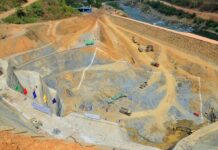
At the center of this crisis is the global scramble for rare earth elements—critical minerals indispensable to electric vehicles and high-tech devices worldwide. Myanmar has become the world’s third-largest producer of rare earths, with neighboring China serving as its primary market.
To circumvent stringent environmental regulations at home, Chinese commercial interests increasingly source these raw materials from conflict-ridden territories in Myanmar controlled by armed groups.
Billions in Revenue, Devastated Environments
According to data compiled by ISP-Myanmar, Myanmar exported more than $4 billion worth of rare earth minerals to China between 2017 and 2024. A staggering 84 percent of that revenue—some $3.6 billion—was generated after the February 2021 military coup. In 2023 alone, export values peaked at a record $1.4 billion, making Myanmar the primary supplier and accounting for two-thirds of China’s rare earth imports.
These lucrative mineral extraction operations have become a vital financial lifeline not only for the military junta but also for ethnic armed organizations (EAOs) seeking to sustain their administrations.
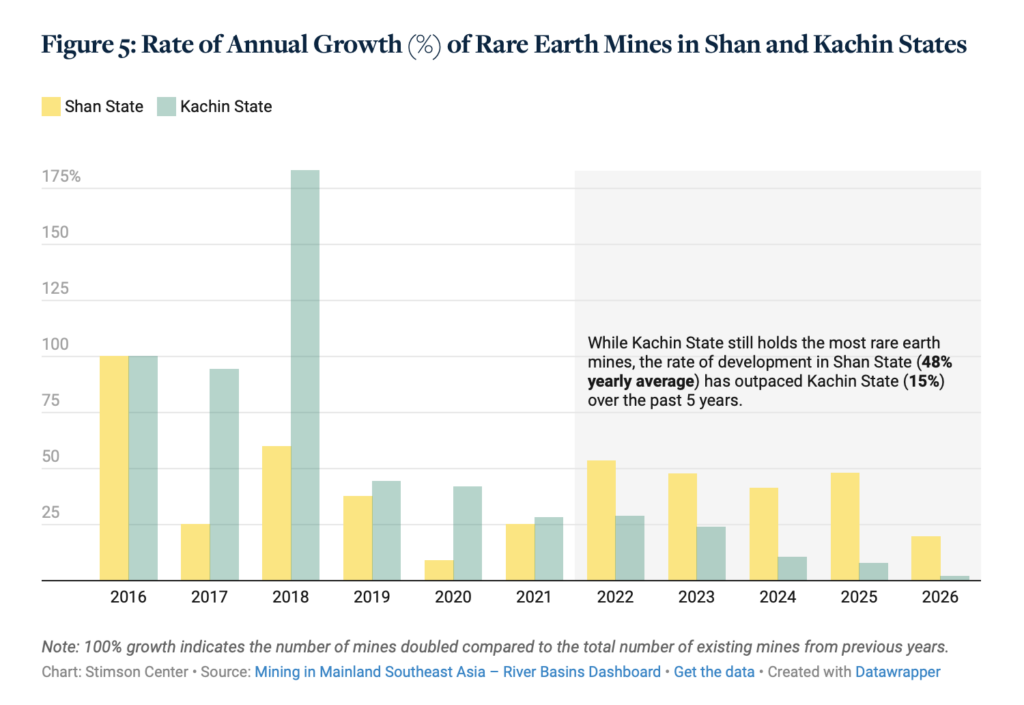
A July 2026 report by the U.S.-based Stimson Center found that rare earth mining has expanded beyond Kachin State into territory controlled by the Ta’ang National Liberation Army (TNLA) in Mantong Township, northern Shan State.
Satellite imagery indicates that at least 12 new rare earth mining sites have emerged in Mantong Township since November 2025. Analysts suggest the TNLA may have turned to rare earth extraction to offset revenue losses following the loss of ruby-rich Mongkut (Mogok), which the group was forced to cede back to the military under an October 2025 ceasefire agreement.
SHAN repeatedly attempted to contact TNLA spokesperson Lway Yay Oo regarding the expansion of rare earth mining in its territory but received no response. However, the Stimson Center notes that operations on the ground are heavily supported by technical and financial partnerships involving UWSA-linked companies and Chinese entrepreneurs.
A Toxic Legacy for Future Generations
Extracting and separating rare earth elements requires massive quantities of hazardous chemical solvents. In Kachin State’s Chipwi region, where the number of mining plots stood at around 100 before the coup, the figure has surged by 194 percent to 357 plots, accompanied by more than 2,500 chemical leaching ponds that contaminate local water sources, according to ISP-Myanmar.
Researchers warn that the devastating ecological collapse already witnessed in Kachin State—marked by massive fish kills, widespread skin diseases, and livestock miscarriages—threatens to spread to the Shweli (Ruili) and Myitnge river basins in northern Shan State. Yet the river conservation pact signed in Bangkok offers no enforcement mechanisms, clear accountability frameworks, or strategies to mitigate chemical pollution.
As the military regime and various armed factions race to exploit natural resources to fuel their war efforts, accountability for public health and environmental protection remains largely absent. For local communities, the ultimate legacy of the rare earth boom will not be economic prosperity but permanent ecological ruin and poisoned waters that may never be restored.
This article was originally written by Sai Harn Lin in the Burmese Section and translated into English by Eugene.








Leave a Comments