

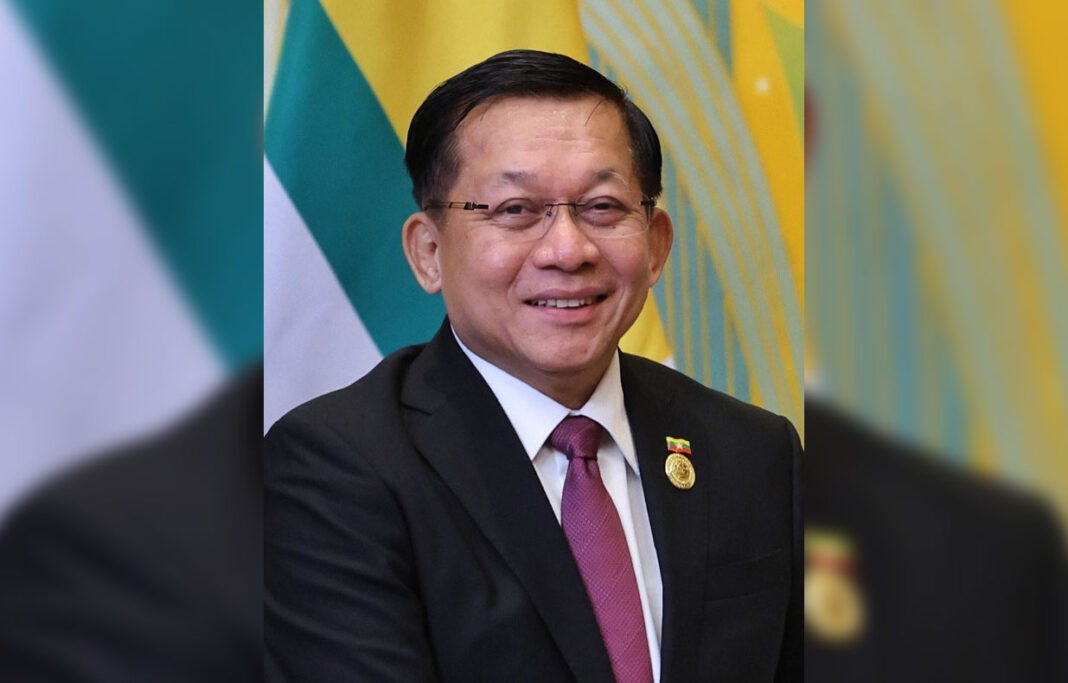
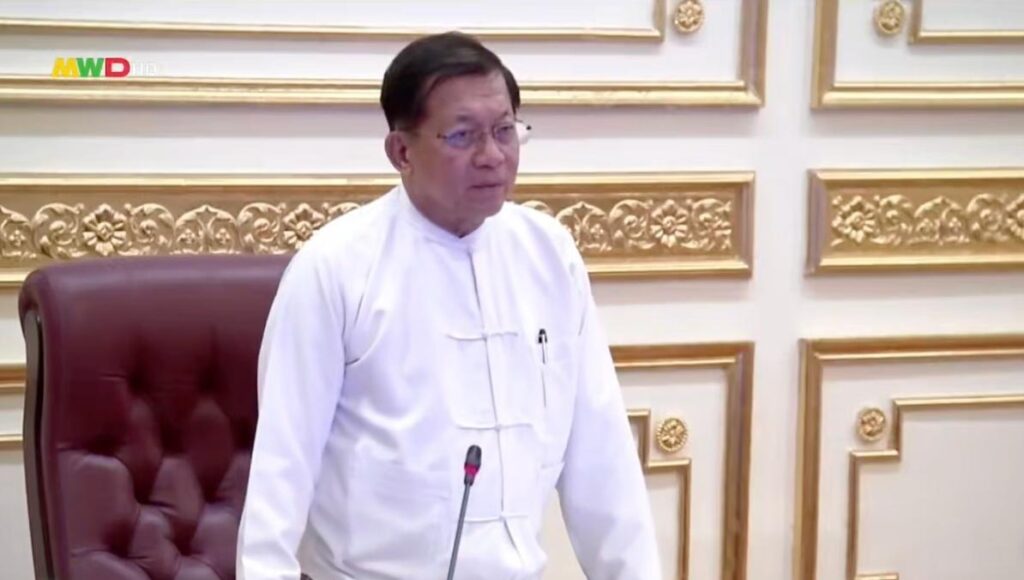
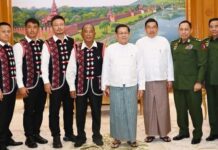
On the afternoon of June 26, at the Presidential Palace in Naypyitaw, Myanmar junta leader General Min Aung Hlaing addressed the Central Committee for the Development of Border Areas and Ethnic Groups. There, he issued a fresh invitation for peace talks, claiming to speak with urgency and sincerity.
Reiterating a previous promise, Min Aung Hlaing stated, “When I spoke about the 100 days, I made an invitation for peace. I now reiterate it again. Regarding the peace that our government is offering, there are no prior preconditions for any ethnic armed organization. I simply invite them to come and discuss peace.” He emphasized his personal commitment, adding, “I invite you to peace talks. Come, do it; I really want to do it. I am trying to get it through every channel I have. I will do whatever it costs to achieve this peace. I want the country to prosper. We have been left behind. Think about it.”
Using a vivid metaphor to describe the military’s perceived constraints, he explained, “When we say we have taken a step forward, we are actually moving forward with a constrained step. In fact, we have not gone anywhere. The current constraint is a confinement by problems and difficulties. We have no freedom. In other words, we want to rush out like a horse galloping out of a stable. We want to move out like this, but we cannot do it now because there are obstacles. These obstacles are conflicts—political conflicts and armed conflicts. We need to clear them up. So, I want to tell these ethnic armed groups: if you really want peace, please come. We will discuss it without any preconditions.”
While Min Aung Hlaing’s recent overtures have sparked speculation about a potential resolution to Myanmar’s deepening civil war, a closer examination of the junta’s history, rhetoric, and strategic objectives reveals that this initiative is not a genuine attempt at national reconciliation. Instead, it is a calculated maneuver designed to legitimize military rule under a civilian guise, secure China’s geopolitical interests, and ultimately force the surrender of the resistance rather than share power.
To understand the futility of this peace push, one must look at its origin. In February 2021, Min Aung Hlaing orchestrated a military coup against the democratically elected National League for Democracy-led government. The military justified this with baseless claims of vote rigging in the 2020 election, despite international observers and domestic monitors finding no evidence of fraud that would alter the outcome. The coup was not merely about election results; it was a fundamental rejection of any governance structure that did not guarantee the military’s absolute dominance. Even the 2008 Constitution’s quasi-civilian framework, which granted the military a 25% unelected parliamentary bloc and veto power over constitutional amendments, was deemed insufficient by the military elite. The coup shattered the illusion that the military could ever coexist with a truly civilian-led government, demonstrating that the Tatmadaw’s primary loyalty is to its own institutional supremacy, not to the will of the people.
Min Aung Hlaing’s current invitation to talk without preconditions is a strategic pivot, not a policy shift. Nowhere in his recent speeches has he mentioned withdrawing the military from politics or committing to a federal democracy. On the contrary, his rhetoric reinforces the military’s self-appointed role as the guardian of the nation. The junta’s endgame is a military-led government disguised as a civilian administration. By inviting ethnic armed organizations to talks while simultaneously demanding the People’s Defense Forces surrender, Min Aung Hlaing is signaling that the only acceptable outcome is the subjugation of the opposition to a system where the military remains the ultimate authority. While the junta parrots the language of federal democracy, it has no intention of implementing it. The 2008 Constitution, which the junta claims to uphold, is structurally designed to prevent genuine federalism by concentrating power in the hands of the military and the central government.
China is the primary driver behind this latest peace initiative, but its motivations are geopolitical, not humanitarian. China needs a stable Myanmar to secure its Belt and Road Initiative projects, protect its border security, and ensure the flow of trade. A prolonged civil war threatens these interests. By pushing Min Aung Hlaing to engage in peace talks, China aims to rebrand the junta as a legitimate government. This allows China to maintain government-to-government relations with the military, shielding it from international sanctions and isolating the National Unity Government (NUG) and the Steering Council for the Emergence of a Federal Democratic Union (SCEF). The SCEF is a united front comprising six key members: the Kachin Independence Army (KIA), the Karenni National Progressive Party (KNPP), the Karen National Union (KNU), the Chin National Front (CNF), the National Unity Government/ People’s Defense Force (NUG/PDF), and the Committee Representing Pyidaungsu Hluttaw (CRPH). While the Arakan Army (AA) is not a formal member of the SCEF, it fights militarily alongside the council in the Magwe, Sagaing, Ayeyarwady, and Bago regions, as well as in Chin and Kachin states, creating a de facto operational alliance that the junta and its Chinese backers seek to fracture. China’s influence at the UN Security Council ensures that any resolution threatening the junta’s survival can be blocked. This emboldens the military to continue its peace theater without fear of international consequences.
The contradiction in Min Aung Hlaing’s strategy is glaring. He invites ethnic armed organizations to talk but demands the People’s Defense Forces surrender. This is not a path to negotiation; it is a unilateral demand for capitulation. The majority of the resistance, including the NUG and most ethnic armed groups, has made it clear that there will be no talks without the end of military rule. They will not negotiate with a regime that refuses to acknowledge its own illegitimacy or the people’s right to self-determination. As long as the military insists on its leading role, the war will continue. The peace Min Aung Hlaing offers is not a political settlement; it is a surrender ultimatum, or more accurately, a call for “negotiated surrender.”
Min Aung Hlaing’s peace initiative is a strategic illusion designed to legitimize the junta, divide the resistance, and secure Chinese interests. Without a genuine commitment to withdraw from politics, hold free and fair elections, and transition to a federal democracy, this initiative is doomed to fail. As the resistance has shown, the people of Myanmar will not accept a peace that is merely the silence of the grave for those who refuse to surrender. As long as the military clings to power, the fire of conflict will continue to burn. The path to genuine peace lies not in the hands of a junta that refuses to let go, but in the resilience of a people who demand a future by the people, for the people.


Leave a Comments