



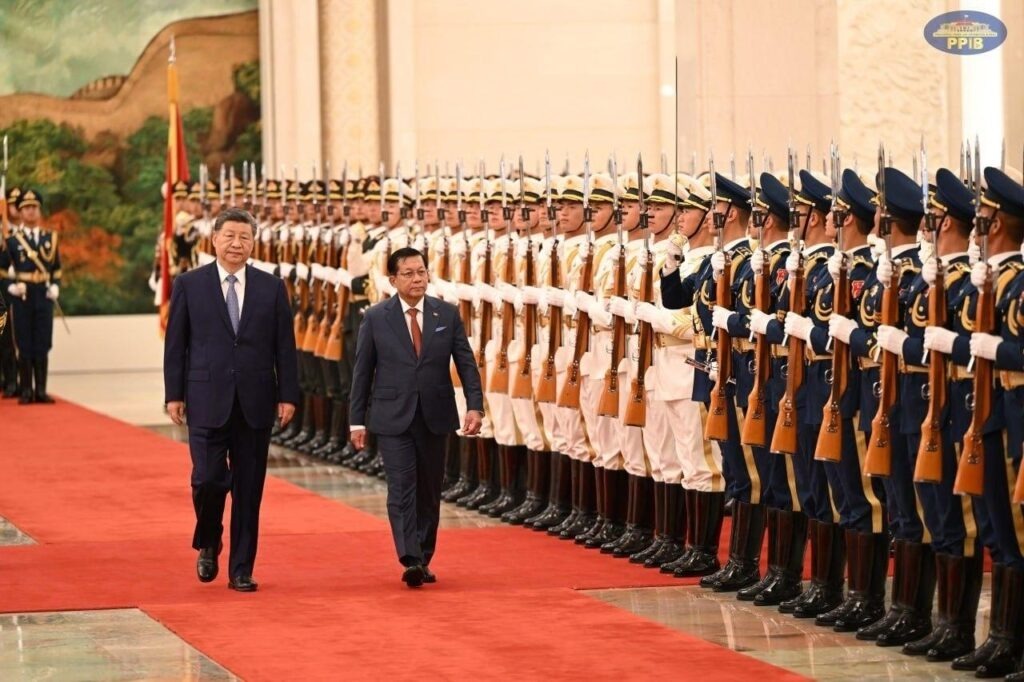
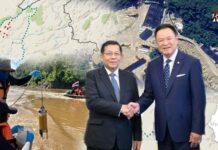
Fresh from a diplomatic visit to India, Myanmar military leader Senior General Min Aung Hlaing traveled to China this week for his first official visit to Beijing as head of the junta’s administration.
Although Min Aung Hlaing has visited China numerous times during his tenure as Commander-in-Chief of Myanmar’s armed forces, the trip marked his first appearance in Beijing as the leader of the military-backed government that seized power in the 2021 coup.
He was accompanied by a large delegation that included six Union ministers, the chief ministers of Kachin and Shan states, senior military officials, and diplomatic representatives.
For Beijing, the visit underscored the importance of maintaining relations with its neighbor at a time of deepening instability along the Myanmar-China border. Yet analysts caution that diplomatic gestures and high-level agreements do little to address the realities on the ground.
“China extending a state-level invitation is effectively a form of recognition of the military government,” veteran Shan political analyst Sai Wan Sai told SHAN. “However, there remains a significant gap between the diplomatic messages conveyed in Beijing and the realities unfolding in Myanmar’s border regions.”
Diplomacy, Agreements and Strategic Interests
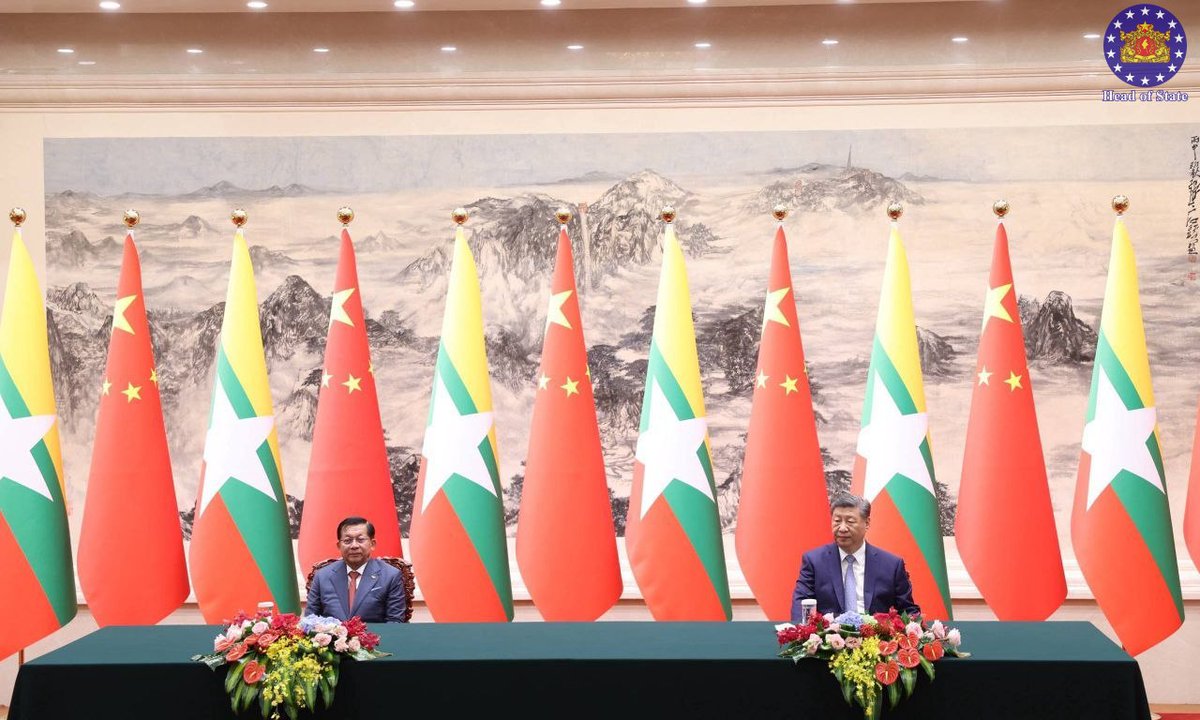
During a June 16 meeting at the Great Hall of the People, Chinese President Xi Jinping welcomed Min Aung Hlaing and reaffirmed Beijing’s support for Myanmar’s sovereignty and stability.
Min Aung Hlaing, in turn, expressed support for several Chinese-led international initiatives, including the Global Development Initiative, Global Security Initiative, Global Civilization Initiative and Global Governance Initiative.
The visit resulted in the signing of 18 Memorandums of Understanding covering sectors such as agriculture, trade, human resource development, media cooperation, humanitarian assistance and technology.
Chinese and Myanmar state media also highlighted a symbolic moment during the meeting when Xi presented Min Aung Hlaing with a Huawei smartphone, portraying the gesture as evidence of close bilateral ties.
Behind the symbolism, however, were more practical concerns. China pressed the junta to accelerate implementation of projects under the China-Myanmar Economic Corridor (CMEC) and the Belt and Road Initiative (BRI), while also urging greater efforts to stabilize border areas, reopen trade routes and combat online scam operations along the frontier.
Min Aung Hlaing responded with a five-point commitment that included protecting Chinese investments and supporting efforts aimed at restoring peace and stability.
Yet analysts question whether the junta possesses the capacity to fulfill those commitments.
“Min Aung Hlaing cannot provide practical guarantees because he does not control large parts of the territory concerned,” Sai Wan Sai said. “He will continue making these assurances, but the realities on the ground remain very different.”
For Beijing, the stakes are considerable. Myanmar provides China with strategic access to the Indian Ocean through projects such as the Kyaukphyu deep-sea port and related transport infrastructure. Delays or disruptions to the China-Myanmar Economic Corridor affect broader Chinese economic and geopolitical interests in the region.
These concerns have contributed to China’s repeated efforts to facilitate ceasefires and negotiations among armed actors operating in northern Myanmar.
Border Trade Remains Paralyzed
Despite agreements reached in Beijing, traders and residents in northern Shan State say cross-border trade remains severely disrupted.
According to local sources, the main obstacle is no longer government policy but the fragmented control of territory along key transportation routes.
The strategic highway connecting Hsipaw, Lashio and Muse passes through areas controlled by multiple armed organizations, including the Myanmar National Democratic Alliance Army (MNDAA), Kachin Independence Army (KIA), Shan State Progress Party (SSPP), Ta’ang National Liberation Army (TNLA) and Arakan Army (AA).
Without coordination among these groups, residents say meaningful trade resumption will be difficult.
Local merchants estimate that it could take several months of negotiations before normal commercial traffic can resume.
Meanwhile, the cost of imported goods has risen sharply.
“Items that once sold for 1,000 kyats now cost several times more,” a Muse resident told SHAN. “The increase is largely driven by numerous checkpoints where various authorities collect transit fees, pushing up transportation costs.”
Traders also report that restrictions introduced under the junta’s recently announced “100-Day Plan” have further complicated the movement of goods, with cargo shipments facing additional inspections, delays and financial burdens.
At the same time, the balance of power along the northern trade corridor has shifted significantly.
The MNDAA now exercises substantial influence across key sections of the Muse-Lashio route. Following its takeover of Kutkai in March, the group and its allies have strengthened their position along strategic transportation networks linking northern Shan State with China.
Reports from regional media outlets indicate that authorities in Chinshwehaw are expanding border infrastructure, including upgrades to existing crossing points and preparations for additional facilities, signaling efforts to increase their role in managing cross-border commerce.
International Criticism and Future Challenges
Min Aung Hlaing’s visit also drew criticism from rights groups.
Justice For Myanmar (JFM) argued that China’s continued military and economic engagement with the junta risks strengthening a regime accused of widespread human rights violations.
The group has repeatedly called on Beijing to halt support for military-linked entities and to suspend transfers of military equipment to Myanmar.
For Myanmar’s resistance movement, China’s continued engagement with the junta presents a complex challenge.
Sai Wan Sai argues that opposition forces may need to pursue dialogue with Beijing while simultaneously seeking support from other international actors.
“The National Unity Government and revolutionary forces need to engage China on issues related to border stability and security,” he said. “At the same time, they must continue building relationships with regional and international partners.”
While Min Aung Hlaing may portray the visit as a diplomatic success, analysts say the ultimate test lies not in the agreements signed in Beijing but in developments along Myanmar’s contested frontiers, where conflict, fragmented authority and economic disruption continue to shape the country’s future.
This article was originally written by Sai Harn Lin for SHAN’s Burmese Section and translated into English by Eugene.


Leave a Comments