

Very recently, the Myanmar military-dominated regime of General Min Aung Hlaing told the Ta’ang (Palaung) National Liberation Army (TNLA) to withdraw from four captured towns in northern Shan State, retreating back to its originally allotted two townships within a month. The demand was made during talks in Kunming, arranged by China.
According to recent reports from the Shan Herald Agency for News (SHAN), representatives of the TNLA and the military met in Kunming on May 12 and 13, with Chinese mediation. This was the 11th meeting between the TNLA and the military since the start of the “1027 Operation.” Military sources say the military demanded that the TNLA withdraw from four more towns within a month, including Nam Kham, Nam Tu, Mong Long, and Mong Ngaw.
“I heard the military has asked the TNLA to withdraw more troops this time,” said a Shan State military and political expert. “They are asking for the return of four towns in Namtu, Namkham and Kyaukme, including Mong Long and Mong Ngaw. They will accept the TNLA as they were in 2008. The fact that they are giving it one more month also coincides with the 100th day of the peace invitation, so we have to wait and see what happens.”
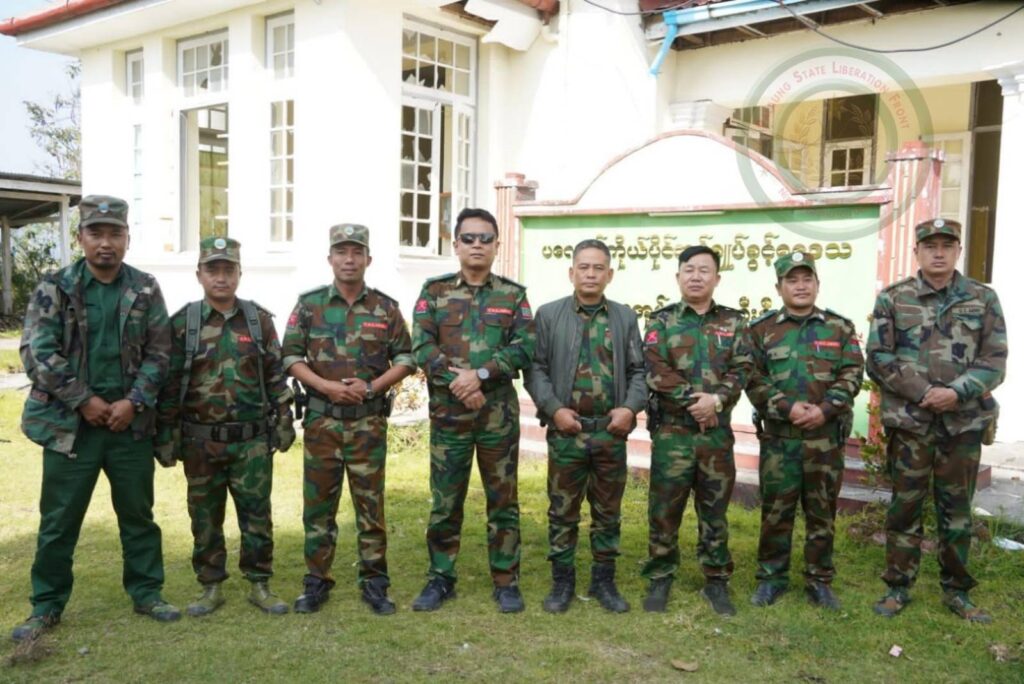
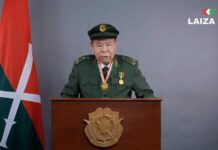
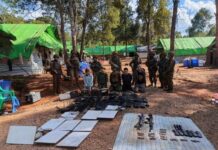
Representatives from the military, led by Lieutenant General Ko Ko Oo, and top TNLA leaders attended the Kunming meeting. Similarly, in April, military and TNLA representatives met at the Two Elephants Hotel in Lashio. After that meeting, more than 100 prisoners of war captured by the TNLA during the fighting were handed over to the military in Kyaukme in early May.
Before this latest demand, the TNLA had tried to curry favor with the military—releasing a statement recognizing the Min Aung Hlaing regime—in hopes of being left alone, avoiding airstrikes and offensives, and securing continued regional economic and trade activities in northern Shan State. But the strategy seems to have backfired. Instead of securing a ceasefire, the military interpreted the gesture as weakness.
The hard reality is that the Three Brotherhood Alliance (3BHA), made up of Arakan Army (AA), TNLA, and Myanmar National Democratic Alliance Army (MNDAA), which once dominated northern Myanmar’s battlefield, has fractured. By mid-2026, the AA emerges as the sole surviving rebel force making significant territorial gains, while the TNLA has retreated under Chinese pressure. Meanwhile, the Myanmar military has begun reclaiming lost ground across northern Shan State, Sagaing, and Mandalay regions.
The MNDAA, for its part, has acted aggressively as China’s favorite proxy in seeking to reopen the long-closed land-border trade and facilitate China’s Belt and Road Initiative (BRI) and China–Myanmar Economic Corridor (CMEC) projects—though it is unclear whether this is following Beijing’s direct directive.
Keen observers note that the MNDAA (Kokang) is expanding Chinese-language administration and economic control in northern Myanmar’s border areas: signage, IDs, household registers, and yuan-only transactions. Since January 2026, it has reopened Chin Shwe Haw and Kyinzitkaung gates, with more than 300 cargo trucks crossing daily, boosting border trade and Chinese commercial influence. Chinese businessmen and workers are now moving into Shan townships—Hsenwi, Kutkai, Namtu, Namkham—buying farmland and shifting local demographics; analysts compare the effect to prior migrant influxes.
Analysts warn that this not only empowers armed groups like MNDAA and TNLA along trade routes, but may be driven by local MNDAA initiatives rather than direct Beijing orders. They urge Myanmar’s government to respond quickly.
According to a recent report by Friends of Moemaka, rebel forces claim to have captured 106 towns nationwide. In 2025, due to Chinese military support, government forces forcibly recruited new soldiers but had to withdraw from seven towns during offensives. Chinese intervention in Lashio forced MNDAA units to withdraw without fighting. So far, only seven towns have been handed back; in 2026, six more towns from Mandalay and Sagaing regions were surrendered, along with Hpakant in Kachin State.
Rebel forces still firmly control about 90 towns and continue intense offensives—including ambushes and raids—alongside AA, KIA, and other ethnic armed groups across Sagaing, Mandalay, Magway, Bago, and Ayeyarwady regions. In Kachin, Chin, and Rakhine ethnic areas, government attack units launch offensives using large manpower and weapons, but most government positions have fallen. KIA/AA and PDF joint forces hold many captured camps and bases across Kachin, Magway, Bago, and Ayeyarwady.
In Kachin’s Mohnyin and Bhamo areas, government forces can briefly retake camps when they reinforce, but KIA+PDF joint forces counterattack and recapture them. Over 2,000 newly conscripted government soldiers who were forcibly recruited in 2025 have defected, deserted, or surrendered; many more conscripts continued to flee in 2026.
New government conscripts lack the will to fight and are demoralized compared with rebel fighters. Although some rebel units have also fractured internally—with fighters disarming themselves and quietly returning home after surrendering their weapons—the broader resistance remains in play.
Given such circumstances, the civil war or internal armed conflict will likely continue. Recently, Malaysia’s foreign minister Mohamed Hasan flew to Naypyitaw and met his counterpart Tin Maung Swe, reporting that the Myanmar military is now open to an all-inclusive peace negotiation process—a stance it has long rejected. How this initiative will pan out remains to be seen.
Domestically, the Three Brotherhood Alliance can be considered fractured and in no condition to launch another 1027 Operation-like offensive as in 2023–2024. In other words, TNLA and MNDAA won’t be within the Spring Revolution fold or the nationwide revolutionary trend.
In contrast, the AA is militarily cooperating with other ethnic resistance organizations (EROs) in different ethnic states and with the National Unity Government (NUG)/People’s Defense Forces (PDF) in the Dry Zone or Anyar. Thus, it could be said that AA is becoming more intertwined with the Steering Council for the Emergence of a Federal Democratic Union (SCEF)—made up of Kachin Independence Organization (KIO), Karenni National Progressive Party (KNPP), Karen National Union (KNU), and Chin National Front (CNF), plus NUG/PDF.
Another emerging force, the Spring Revolutionary Alliance (SRA), is likely to become part of the SCEF or conduct joint activities militarily and politically. Officially announced on December 15, the SRA brings together 19 member groups, including independent regional forces from various parts of the country. Alongside newer rebel factions formed after the coup, it also includes some of the powerful forces that fought with the 3BHA during Operation 1027, which began on October 27, 2023.
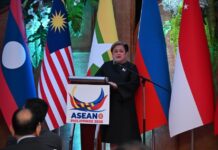
For now, military pressure will continue on the TNLA, and the nationwide civil war will go on unabated. The anti-military forces will fend off—and also conduct offensives—while the military does the same. Moreover, ASEAN and the international community will try to find a way out to end the conflict, half-heartedly, as every nation has its national interest priorities during this Middle East–infused energy scarcity. Myanmar’s issue will still be a back-burner, whether we like it or not.

Leave a Comments