


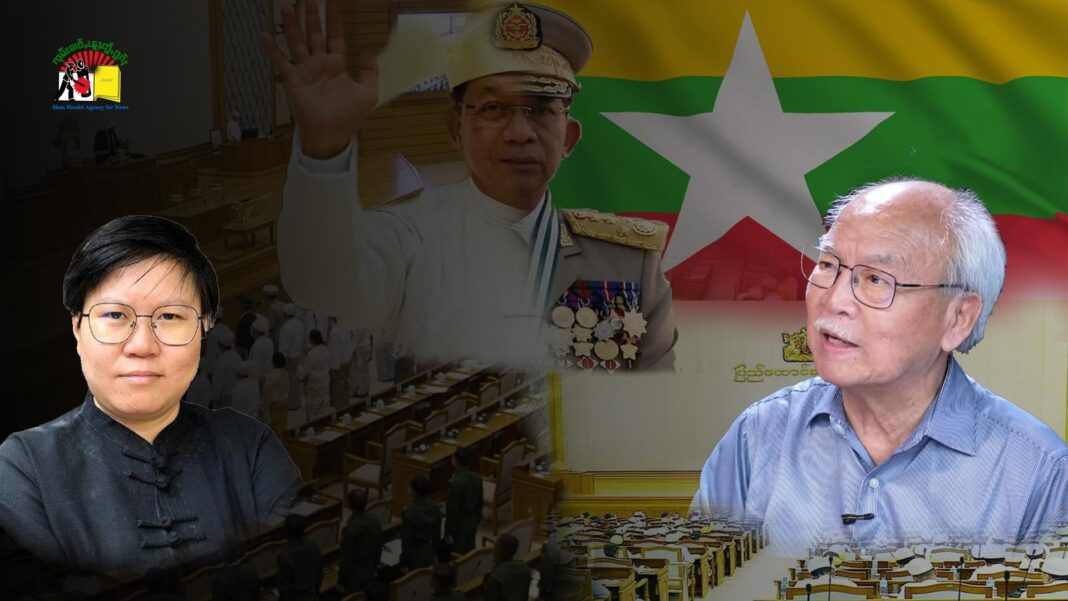
As Myanmar’s military transitions to a new “civilian” government five years after the 2021 coup, questions remain over whether the shift signals meaningful change or simply a continuation of military rule under a different name.
In an exclusive interview with the Shan Herald Agency for News (SHAN), Burmese Desk Editor Nang Seng Nom spoke with veteran political figure Sao Harn Yawnghwe, who said he has little confidence in the transition, citing ongoing violence, deep mistrust, and a widening divide between the military and its opponents.
Nang Seng Nom:
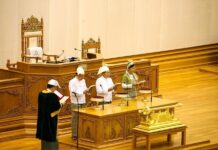
Today marks the swearing-in of a president as part of the transition from military to civilian rule. What are your expectations?
Sao Harn Yawnghwe:
“My position is simply to wait and see what he actually does. I do not have high hopes. Although the ‘government’ has changed, nothing has changed for the people. In fact, the situation appears to be worsening. People are being bombed every day and are suffering greatly. Because of that, I have no expectations at this stage.”
Nang Seng Nom:
During the ceremony, there was an emphasis on rejoining ASEAN. Given the military’s failure to implement ASEAN’s Five-Point Consensus, what is your view?
Sao Harn Yawnghwe:
“Rejoining ASEAN is actually not that difficult. The military leader himself was present when the ASEAN decisions were made. The three main points were to reduce violence, open humanitarian access for the suffering public, and seek a political solution through inclusive dialogue rather than combat.
If they truly want to rejoin ASEAN now, they simply need to stop bombing people and using violence against them. That can be done easily. Regarding aid, the international community wants to help, but the military is blocking access. If they open those routes, stop the bombings, and engage in dialogue with opposing groups, I believe ASEAN would welcome them back.”
Nang Seng Nom:
You witnessed the transition in 2010. How does the current shift compare?
Sao Harn Yawnghwe:
“There are clear differences. During the era of Thein Sein, the 2008 Constitution was used to move toward the next stage of democracy and to negotiate ceasefires. But now, it is the opposite. Min Aung Hlaing is not moving toward democracy; he is moving backward to entrench the 2008 Constitution. He wants to permanently solidify the military’s role in politics. That is a complete reversal.
Furthermore, during U Thein Sein’s time, the fighting was not as widespread. People welcomed the move because they wanted a democratic transition. Now there is fighting and bombing every day. The question is: who would even come to the table for dialogue under these conditions?”
Nang Seng Nom:
In the past, around 2015, you were denied a visa to enter Myanmar even under the NLD-led government. Given that the environment was already restrictive then, how do you expect the situation to be now? And what are the prospects for peace talks such as the NCA?
Sao Harn Yawnghwe:
“The period from 2011 to 2015, under U Thein Sein, was different from the period between 2016 and 2020 under the National League for Democracy (NLD). In the earlier period, there were genuine negotiations. They were effective, and there was coordination between the military and ethnic armed groups.
From 2016 to 2020, that coordination stopped. Dialogue continued, but the parties were unable to reach an agreement.
Now, the current government is trying to further entrench the military’s role in politics, which the opposition completely rejects. The gap between the two sides has become too wide.
To begin any dialogue, you need at least one or two points of common ground. Without that, it is impossible to start.”
Nang Seng Nom:
Do you see any genuine prospects for peace talks under the current government?
Sao Harn Yawnghwe:
“In my view, if you want to talk and find a solution, you must build trust. Right now, no one trusts them. No matter what they say, no one believes them because the bombings are still happening. Who would believe in peace talks while being bombed?
The government must prove its sincerity. If they truly want a solution, they must stop the violence. This is not a demand; it is simply the reality of the situation. No one can trust someone who is striking them while asking to talk.
Stopping the violence must be the first step, and we have not seen that yet. If they actually stop and issue an invitation, then it becomes something worth considering, and the groups currently fighting may think about it. But if the armed groups do not trust the process, dialogue is impossible, no matter how much we may want it.”
Nang Seng Nom:
After more than 70 years of conflict, what must change for real progress?
Sao Harn Yawnghwe:
“Those who want to fight will keep fighting. The military will fight to stay in power. But the ones who truly suffer are the people and the country. If both sides keep fighting indefinitely, will there even be a Myanmar left?
As the fighting continues, the economy, health system, and education system are all being destroyed. The country will continue to collapse. If both sides can see this and realize they must find an answer, there is hope. If that realization is not there, nothing can be done.”
Nang Seng Nom:
What is your message to the new government and members of parliament?
Sao Harn Yawnghwe:
“For the MPs: if this is truly a democratic system, you must have the right to speak. Even if you disagree with the government, you should be able to say so without being arrested. I want to see whether those elected individuals have the courage to speak up for what is needed. They should speak bravely.
To the military and government side: if you keep fighting merely to hold onto power until the country no longer exists, that power is meaningless. Look at the country. Look at the people. Only then can we move forward.”
Nang Seng Nom:
Do you have any final thoughts?
Sao Harn Yawnghwe:
“I am deeply saddened by the current situation. When you look at other countries, they are all progressing. We used to be better off than many others, and now we have become a country in such ruin. It breaks my heart to see the people suffering so much. I want to urge both sides: would it not be better to find a solution?”
Sao Harn’s reflections underscore a central dilemma facing Myanmar today: without trust, dialogue remains out of reach; yet without dialogue, the conflict has no clear end.
Nang Seng Nom:
Thank you very much, Sao Harn, for taking the time to speak with the Shan Herald Agency for News.
Noted* This was conducted in Burmese and was translated into English by Eugene.



Leave a Comments