



The vehicle came to an abrupt stop on a dusty road at a Thai military checkpoint along the Myanmar–Thailand border.
“Everyone, please step out of the vehicle.”
The instruction, delivered in Thai, immediately shifted the mood inside the car. One by one, we stepped out. The sight of uniformed soldiers stirred a familiar unease—an instinct shaped by years of crossing borders in a region defined by conflict.
In Myanmar, such encounters often provoke fear:
Will they search us? Question us? Detain us?
But this time, the reality was different.
We lined up quietly as Thai soldiers photographed us and checked our documents. At this final checkpoint, passports and identification cards were collected—not as a form of intimidation, but as a routine security measure.
“This is for security, so they can verify who you are when you re-enter Thailand,” the driver explained.
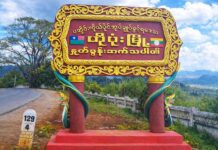
It was the last layer of control before entering Loi Tai Leng—the mountain headquarters of the Restoration Council of Shan State/Shan State Army (RCSS/SSA), perched more than 5,000 feet above sea level.
The Road to the “Mountain of Shan Light”
I arrived in early February, traveling from Chiang Mai through Mae Hong Son toward the border.
In the Shan language, Loi means mountain, Tai means Shan, and Leng means light.
The journey is long and winding, cutting across endless mountain ranges. On the Thai side, the roads are unexpectedly smooth, weaving through valleys, forests, hillside farms, and quiet villages.
At times, construction crews worked along the roadside—subtle signs of expanding connectivity in an otherwise remote region.
But as we approached the border, the asphalt disappeared.
The road turned to dust.
Clouds rose behind the vehicle as we climbed toward the ridge, where security tightened and the landscape grew harsher.
At this altitude, the air remains cool year-round. In winter, temperatures can drop to near freezing. From the ridge, mountain ranges stretch endlessly into the distance, fading into layers of mist.
Despite its isolation, Loi Tai Leng is not entirely cut off. A route connects it directly to Mong Pan in southern Shan State.
“It only takes about four to five hours to reach Mong Pan from here,” the driver said, hinting at the area’s strategic significance.
Yet in another sense, the headquarters feels removed from the outside world.
Since June 2025, Thai authorities have cut mobile and internet signals along parts of the border to disrupt online scam networks. As a result, Loi Tai Leng now relies largely on Starlink satellite connections.
When the signal drops, the mountain falls silent—disconnected.
A Gathering Above the Clouds
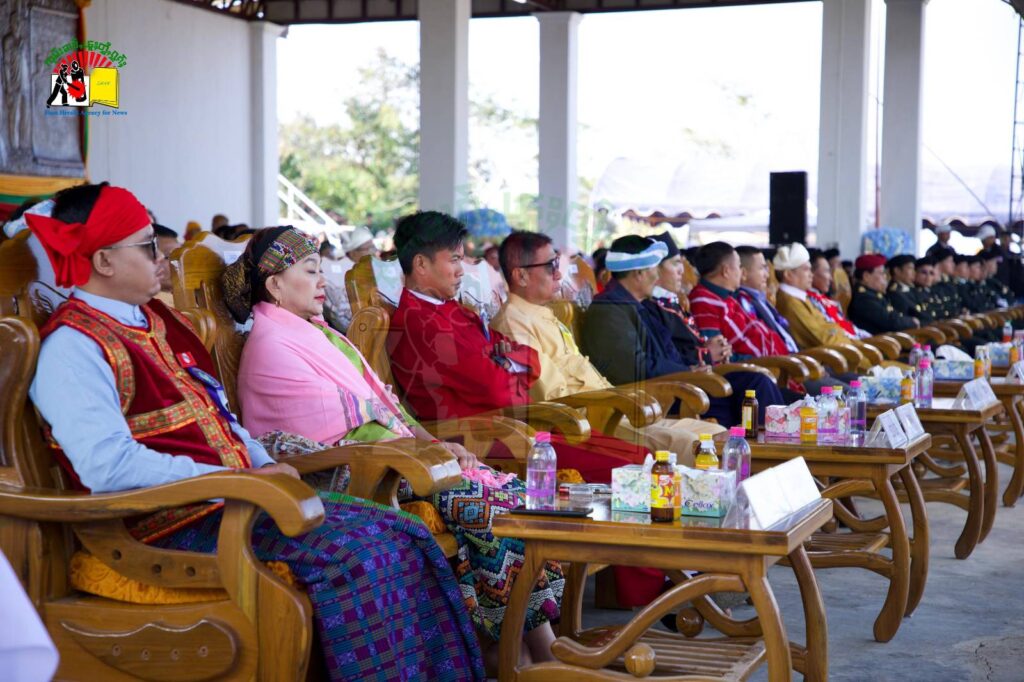
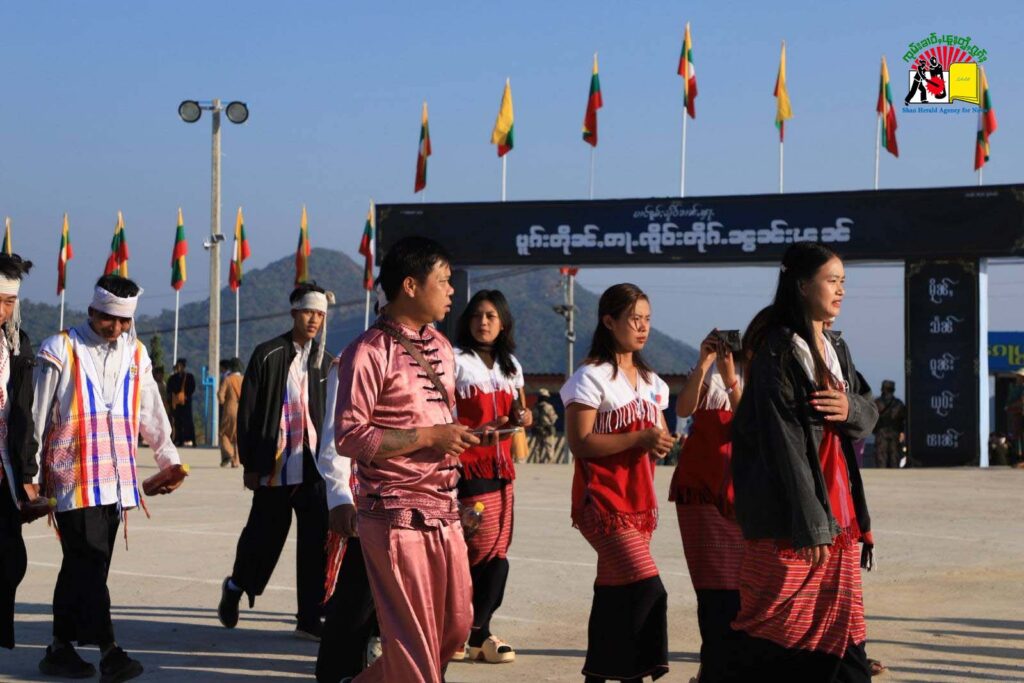
Every year on February 7, Loi Tai Leng hosts Shan State National Day, a major event that draws participants from across ethnic and political backgrounds.
This year marked the 79th anniversary. Two of us from SHAN were there to report.
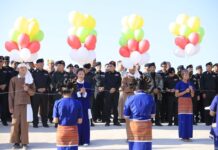
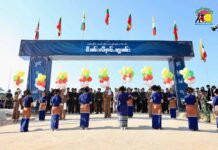
The celebration transformed the quiet mountain base into a gathering ground of soldiers, civilians, and political representatives.
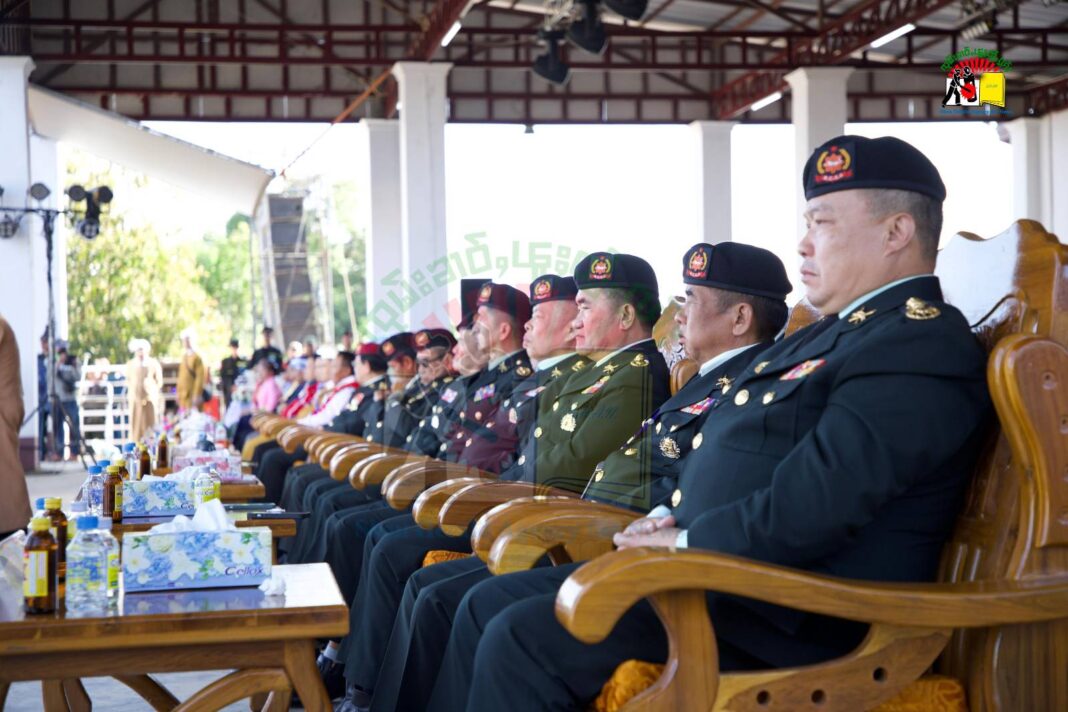
More than 1,000 RCSS/SSA troops marched in formation during the military parade.
Delegations from multiple ethnic armed organizations attended, including the United Wa State Army (UWSA), National Democratic Alliance Army (NDAA–Mong La), Chin National Front (CNF), Democratic Karen Buddhist Army (DKBA), Lahu Democratic Union (LDU), Pa-O National Organization (PNO), Shanni Nationalities Army (SNA), and Southern Shan National Defense Force (SSNDF), alongside civil society groups.
For many attendees, the day carried a deeper meaning.
“Shan State National Day isn’t just for one ethnicity. It shows that diverse ethnic groups can stand together,” said Sai Sam, a Lisu participant.
History, Identity, and an Unfinished Promise
The roots of the celebration trace back to the 1947 Panglong Conference, where the Shan flag and national identity were formally recognized.
Nearly eight decades later, however, the promises of Panglong remain unfulfilled.
In his address, RCSS Chairman General Yawd Serk reflected on this unresolved history.
“It has been 78 years since independence, yet our country has not developed like our neighbors because national leaders have strayed from the middle path,” he said.
He called for a renewed political direction grounded in dialogue, self-reflection, and mutual trust.
Among his proposals was the formation of a Federal Army, alongside a broader commitment to building a federal democratic system.
Between Dialogue and Conflict
Five years after the military coup, the RCSS occupies a complex position in Myanmar’s fractured political landscape.
Unlike many armed groups that have resumed full-scale conflict, the RCSS continues to pursue negotiation.
When asked about the military’s planned elections, General Yawd Serk was direct:
“It has nothing to do with us.”
“We are not siding with anyone. We are simply observing how this government proceeds.”
At the same time, he acknowledged the human cost of the ongoing war, particularly the impact of airstrikes on civilians.
In an interview with Reuters, he noted that more than 1,000 civilians have been killed in aerial attacks, while the international community has failed to respond effectively.
Building a Political Framework
Just days before National Day, Loi Tai Leng hosted the first Shan State National Convention.
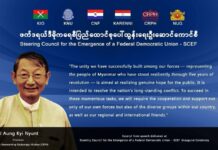
Held from February 2 to 4, the gathering approved 33 federal principles and established a Shan State Federal Steering Council.
“The NUCC is aimed at the whole Union. We are working specifically for Shan State,” General Yawd Serk said.
The move reflects a growing emphasis on state-level self-determination, even as broader national frameworks remain uncertain.
While some analysts question how these principles will be implemented, many agree that such forums are essential in shaping future political pathways.
Unity, Division, and Ground Realities
Despite calls for unity, tensions remain.
Clashes between the RCSS/SSA and the SSPP/SSA have yet to be resolved. According to General Yawd Serk, discussions are still at the “negotiation stage.”
At the same time, the RCSS reaffirmed its long-term priorities during its 26th Annual Meeting and 4th Congress (February 16–18, 2026), including:
- pursuing political solutions through dialogue
- implementing federal principles
- supporting internally displaced people
- combating drug production and trafficking
These priorities reflect both governance ambitions and the realities of operating in a conflict-affected region.
The RCSS has long been a key actor in Myanmar’s peace process. It signed state- and union-level ceasefire agreements in 2011 and 2012, before joining the Nationwide Ceasefire Agreement (NCA) in 2015 alongside seven other ethnic armed groups.
Following the NCA, the group expanded into northern Shan State—strategically contested areas also linked to China’s Belt and Road Initiative (BRI). This expansion brought it into conflict with other armed groups, including the Ta’ang National Liberation Army (TNLA) and the Shan State Progress Party (SSPP).
After years of clashes, the RCSS withdrew from most of its northern positions and refocused on southern Shan State.
A Leader Shaped by War
General Yawd Serk’s trajectory mirrors that of modern Shan politics.
Once a commander under Khun Sa’s Mong Tai Army, he refused to surrender after its collapse in 1996. Instead, he rebuilt his forces, eventually forming the RCSS in 2000.
Hope Above the Clouds
As evening fell, the mountains around Loi Tai Leng turned gold.
The setting sun illuminated bamboo houses scattered across the slopes, while soldiers moved quietly through the fading light.
From the ridge, the Myanmar side of the border stretched into the distance—still, layered in mist.
But beneath that calm landscape lies a different reality: displacement, conflict, and uncertainty.
A cool wind swept across the mountain.
And with it came the memory of Sai Sam’s words:
“No matter how much the enemy tries to divide us, as long as there is unity, they will never be able to tear us apart.”
*This feature was originally written in Burmese by Sai Harn Lin and translated into English by Eugene.



Leave a Comments