




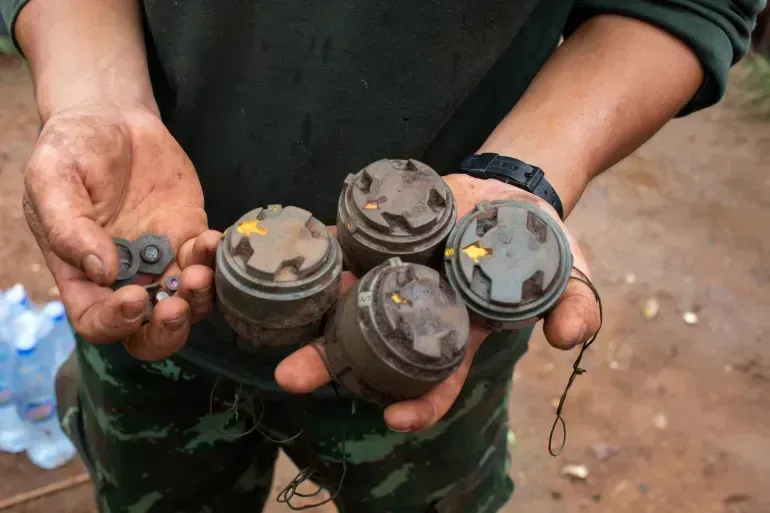
A man was killed in Kyaukme Township, northern Shan State, after an unexploded ordnance (UXO) device he had collected reportedly exploded while he was attempting to dismantle it for resale.
The incident occurred at around 5:30 p.m. on May 11 in Pang Haik Village, part of the Nar Aik Khant village tract. The victim, identified as Sai Tun Han, 33, died at the scene.
Local sources said the device was believed to be an RPG-type explosive remnant that the victim had found near his farm and brought back to his home.
According to residents, the explosion occurred while he was attempting to dismantle or inspect the device, reportedly with the intention of selling it to support his family.
Witnesses said nearby residents narrowly escaped injury because they were standing some distance away when the blast occurred.
Locals say worsening economic hardship and limited job opportunities following Operation 1027 have pushed some people to collect and sell explosive remnants left behind by years of conflict.
“Administrators warn people not to touch mines or shells, but many do not report them,” a local man from Kyaukme Township told SHAN. “One shell can sell for 200,000 to 300,000 kyats, so some people take the risk.”
According to local accounts, unexploded devices are sometimes sold to armed groups or repurposed for illegal blast fishing.
Kyaukme Township was the site of intense fighting between military forces and the Ta’ang National Liberation Army during clashes in 2023. Locals say many areas remain contaminated with landmines and unexploded ordnance.
Despite the absence of recent fighting in Pang Haik Village, residents say no major clearance operations have been carried out to remove remaining explosive hazards.
According to UNICEF Myanmar, Shan State recorded 245 landmine and UXO casualties in 2025, accounting for more than one-third of all such casualties nationwide.
Residents and local advocates continue to urge communities not to handle suspicious objects and instead report explosive remnants to relevant authorities rather than bringing them into residential areas.










Leave a Comments