




The crux of the problem in Burma or Myanmar today is the deeply seated political power monopoly urge of the successive military class that transformed the country into militarization process mode.
It all started in 1962 with the military coup reportedly claiming to safeguard the country from disintegration, due to Shan government-led Federal Proposal to make the country more federal, as Burma was only federal in name but unitary in practice.
From then on the country’s ethnic conflict and rebellion have not gone away until today. In addition, there were also ideological conflict even before the Independence from the British in 1948, but these came to an end in 1989 when the Communist Party of Burma disintegrated.
To make the long story short, the decades-long ethnic conflict goes on unabated in all ethnic states of Shan, Karenni, Karen, Mon, Arakan or Rakhein, Chin and Kachin states.
The successive military junta on its part employed “divide-and-rule” policy quite effectively, as the ethnic armed organizations (EAOs) or ethnic resistance Organizations (EROs)weren’t able to work in unison in delivering the fight against the military establishment. But this is to change drastically after the military junta led by Gen. Min Aung Hlaing staged a coup in February 2021.
The tenure of Daw Aung San Suu Kyi-led National League for Democracy (NLD) government from 2016 to 2021, and five years prior under President Thein Sein, in total 10 years had given the population a taste of freedom, freepress, and democratic rights and so on to a certain degree, even though the system was a quasi-civilian rule, with the military having 25% appointed seats in the Parliament.
Thus, the military coup was rejected by the whole country, especially the younger generation Z, as they refused to go back under the military rule and rather fight to defend their freedom and democracy.
As the mass protest spread across the country the brutality of the military junta also increased, killing demonstrators randomly by shooting in the heads. Arrests become widespread and most NLD top members were rounded up.
Then the generation Z and other older generations decided to make the move to the EROs’ areas to start the armed struggles, as they foresee no other options left for them.
And that was the start of the whole Bamar people revolutionary zeal, which has taken over the whole country with burning desire to strive for change of the country without the military dictatorship system, and the establishment of a genuine federal democratic union.

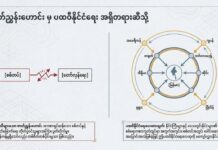
Two trends of militarization
This ushered us into the state of militarization with more intensity in ethnic states, as the new recruits arriving in thousands to Chin, Kachin, Shan, Karenni, Karen, Mon and Rakhein states boosted the strength of the ethnic resistance Organizations (EROs) to combat the junta in a large scale.
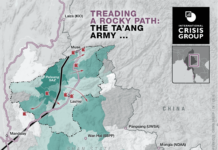
The case in points are the Karen National Union (KNU), Karenni National Progresive Party (KNPP), Kachin Independence Army (KIA), Ta’ang National Liberation Army (TNLA), Myanmar National Democratic Alliance Army (MNDAA), and Arakan Army (AA).
We may term this as a positive militarization as the aspirations and motives are waging a just war to uproot the tyrannical military dictatorship system and to establish a free federal democratic union.
In contrast, the forced recruiting of military junta may be taken as unjustly pressuring the whole civil population to defend its oppressive regime, which the population , in fact , hated it to the core. This junta’s act can be labeled negative militarization.
Present situation
In all ethnic states, Chin, Kachin, Karenni, Karen and Rakhein revolutionary tide is on the rise gaining ground and momentum, so much so that the captured towns countrywide are now 91 already.
According to a BBC report, the combined anti-junta resistance forces controls 42% of the country’s areas, while the junta just 21%, in central lowland big cities.
Quite recently, AA took Ann City and junta’s Western Military Command, making it the second military command to fall, after Lashio North Eastern Military Command a few months ago to the MNDAA or Kokang.
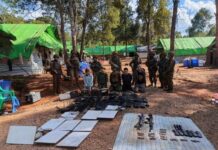
The junta troops have already lost the will to fight, according to the battle field reports surrendering in hundreds in northern Shan State, Kachin State and also Rakhein State recently in Ann and elsewhere within the state.
Now AA needs only to advance to Kyaukpyu, Manaung and Sittway, the three remaining towns to capture. It is only weighing on how to handle, as Kyaukpyu has large Chinese economic interest.
The KIA has taken over border gates and borderland areas rich in rare earth elements along China-Myanmar, which the Chinese badly needed, and now advancing to take Bhamo, the second largest city in Kachin State.
Reportedly some border gates are reopened and others are to follow suit, which indicates that the Chinese are relaxing its sanctions on the KIA and in Kachin State as a whole. Clearly the Chinese are making a deal with the winning KIA, which it will surely extend it to the AA soon.
Likewise, Chin Brotherhood took Mindat City in Chin State recently and continue to battle the junta troops all over the state, with success.
In Karen State theater National Liberation Army (KNLA) took Maneplaw, the former Karen National Union headquarters which has historical significant by the Brigade 7.
The junta on its part is having difficulty to fill the needed quota for it forced conscription. Militarily it mostly can only use airstrikes and artillery bombardment, as it lacks troops that are experienced, under strength or thinly spread across the country , it sends in small raid units into Anyar and burned down villages, of which many were militarily engaged and annihilated by the National Unity Government/People’s Defense Force (NUG/ PDF).
Militarization good or bad
“Militarization is the intentional cultural, symbolic, and material preparation for war, influencing various aspects of societies and cultures by transforming civilians into soldiers and shaping social structures to support the military,” according to International Encyclopedia of Social & Behavioral Sciences (Second Edition), 2015.
It further explains, “Militarization programs often trade in and promote ideas about innate violence and the naturalness of military values; while sociobiological notions of ‘natural’ soldiers are politically convenient, these arguments sidestep analyses of power and process, and can be used to naturalize and depoliticize militarization processes and war as a way to make them seem inevitable.”
Whatever the argument, questions arise whether the militarization is a good or bad for the country and its population, the general assessment of the situation isn’t affirmative.
But in Myanmar or Burma case, the population has been pushed to the brink to choose sides, either the military junta or the anti-junta ethnic-democratic forces.
While the junta’s unjust recruiting using forced government conscription laws it isn’t legitimate, as it is an illegitimate coup regime, only to defend its oppressive tyrannical rule, the ethnic-democratic forces recruitment is largely voluntary, with some exceptions within ERO ranks, which also enforced compulsory conscription from the very outset, within their areas.
Thus, the bulk of Bamar revolutionary groups fighting together with the EROs are voluntary young recruits and have nothing to do with the forced conscription. Many still fight with the EROs to gain combat experience but a lot also already entered the Anyar, Dry Zone area where the majority Bamar population lives and carrying out the revolution to uproot the military dictatorship system in their homestead.
Thus, for the first time in modern history the military establishment is denied support from the Bamar population of Anyar. Moreover, they have turned against the military and joined the EROs in a common cause to fulfill the aspirations of the people, which is uprooting the military dictatorship system and establishment of a genuine federal democratic union.
The militarization of Burma comes about naturally due to the heavy oppressive nature of the military class to permanently monopolize the political power by all means, which in turn has been rejected by the bulk of the population and transformed into Spring Revolution that has morphed the EROs with the lowland Bamar people into a popular uprising. In other words, the launching of the revolution or Spring Revolution is a kind of militarization by the people, so to speak.
In sum, it is hard to definitely say if militarization is good or bad for the country, as the transformation comes automatically due to the oppression which breeds people’s hatred of the military junta and commitment to resist it by all means.



Leave a Comments