

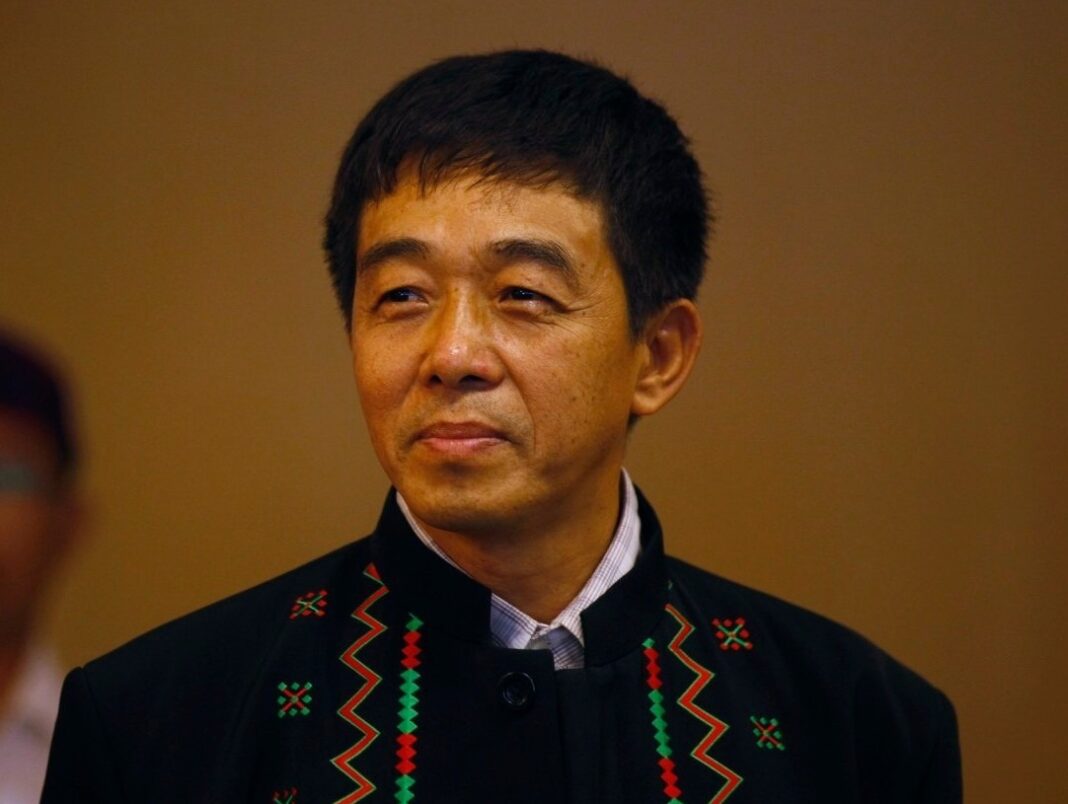
Lieutenant General Gun Maw, Vice Chairman of the Kachin Independence Council (KIC) and a leader of the Kachin Independence Organization/Kachin Independence Army (KIO/KIA), said that 2026 is expected to be a year of significant change and effort.
Speaking online at the Kachin Independence Day ceremony on February 5 in Texas, USA, he outlined the KIO’s military and political activities, as well as its goals.
He shared that since February 1, 2021, the organization’s Central Committee has committed to working with pro-democracy forces to oppose the military coup.
He also mentioned that the organization is working closely with forces that arose from the Spring Revolution.
Lieutenant General Gun Maw shared that the KIO was founded to free everyone from oppression, arising from the failure of the Bamar political and military elite to honor the Panglong (Agreement) Commitment. He added that the KIO’s political aim is to completely topple governments that rule in a colonial manner or colonial possession (of the non-Bamar ethnic states).
The aim is to build a federal democratic state where people live together in equality and hold sovereignty. To reach this goal, the people must move forward with their strength, ensuring politics and the military are balanced for true victory, said Lieutenant General Gun Maw. Without this balance, peace may be possible, but not a true victory.
KIO joins forces with the democratic movement
On the morning of February 1, 2021, the day of the military coup, the KIO held a central meeting at 9 am. and decided to join forces with the democratic movement.
“On February 2, we met with the Chinese special representative. We were very open. We said that there could be a conflict and we will have to fight with the democratic forces that will arise. The Chinese government told us not to fight, but we said that we won’t be able avoid it and that we have to fight with the democratic forces. Especially in Sagaing Region, which is the gateway to our home, we told the forces in Sagaing Region and we Kachins on February 2 that we must ensure the security of our gates. They (the Chinese) did not believe us,” said Lieutenant General Gun Maw.
After further discussions within the Central Committee and coordination upon the arrival of forces, the goal was set for the democratic forces to establish a strong presence in the three Ka areas: Kaw Lin, Katha, and Kan Ba Lu (key districts/townships in northern Sagaing Region).
The area is often called “Ka-Thone-Lone” (Kanbalu–Kawlin–Katha) in military strategy. The Kachin Independence Army (KIA) has focused on securing these areas, particularly focusing on controlling Katha, then moving to Kawlin, and Kanbalu to the south.
It was also noted that the Interim Kachin Political Cooperation Group (KPICT), which includes the KIO, signed an interim agreement with the Union Parliament Representative Committee (CRPH) on March 27, 2021.
The agreement covers plans for forming an interim Kachin State government, with the KIO taking responsibility for defense and security in the Kachin region while coordinating with the CRPH as needed. Other significant issues not covered in the agreement will be addressed in future discussions. The agreement remains in effect until the interim period ends, and KPICT representatives are actively participating in the NUG.
The interim period refers to the time from when the military takes control until a stable government is established in the Union. The KIO has stated from the start that this phase will last at least 4.5 to 6 years.
“The interim period is a time of struggle. It’s not the end of the road. From the coup until a strong government is in place, that’s the interim period. During this time, there may be periods of war, discussions, and transitions. Progress will be gradual, and success will come only by balancing military and political efforts,” said the KIC Vice Chairman.
“On the military side, the KIO is responsible for defending and securing the entire Kachin region while engaging in battles against other forces. The fight for Bhamo includes all ethnic groups. The term ‘Union Army’ might exist on paper, but here, we fight together, win together, and make sacrifices together across different areas,” added Lieutenant General Gun Maw.
Importance of the battle of Bhamo
The Battle for Bhamo brought together all ethnic groups and was fought out of necessity, despite the heavy costs involved. While preparing for operations in Myitkyina and Waingmaw, battles were launched along the Maykha River to secure control of it, leading to the fight for Bhamo.
This battle has been ongoing for over a year, requiring significant resources. Every ethnic group in Myanmar is involved—PDF, Gorkha, Shan, Chin, Naga, Yaw, Saw, and more.
Some ask why it has taken so long, but the truth is we are fighting with what we have. I sometimes joke that while KIA/PDF has been at it for just over a year, the British took more than five years to capture Bhamo. We’ve invested heavily in this fight because it’s necessary.
Taiwan example
China and Taiwan were brought up as examples in response to recent questions from Chinese officials about the possibility of defeating the military.
Lieutenant General Gun Maw recounted a meeting with a senior Chinese official in early 2026, where he was asked if they could overcome the military council with their current resources.
He replied by pointing to China’s own history, noting that those aided by the US and Russia eventually fled to Taiwan and were defeated by those who had no outside help. The official stayed silent, acknowledging the truth of the remark.
“Last month, during a meeting, a senior Chinese official asked if we thought we could defeat the military council with the resources we had. I told him that if you look back at China’s history, those aided by the US and Russia eventually fled to Taiwan and were defeated by those who had no outside help. I posed this to him, but he stayed silent—it was the (historical) reality,” explained Lieutenant General Gun Maw in his recent online account.
Gun Maw also emphasized that support from neighboring and other countries is crucial in securing rightful claims. Without such backing, he likened the struggle to a boxing match without a referee, adding that if Myanmar’s affairs were fairly judged, the outcome would have been decided long ago, yet the Spring Revolution has now lasted five years.
Five Revolutionary groups meeting
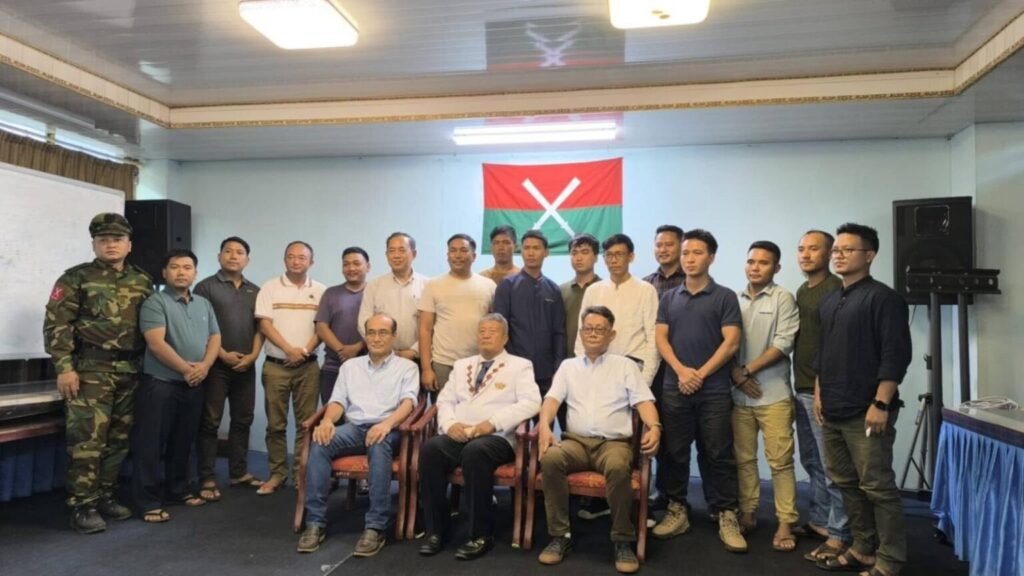
In early February, the National Unity Government (NUG) met with the Karen, Kachin, Karenni, and Chin ethnic armed groups to talk about the progress of the revolution, according to Lt. Gen. Gun Maw.
He said the five groups—NUG, KNU, KNPP, CNF, and KIO—also held online meetings to reunify and regroup, focusing on strong leadership and the Federal Leadership Council, which remains an ongoing discussion rather than a confirmed body.
“We’re discussing how to carry out the revolution to its fullest potential,” he explained, stressing the need for unity, mutual respect, and staying on the right path. Revolutionary forces, he added, aren’t just about armed struggle but include everyone committed to the cause.
When asked about the revolution’s success and end, Gun Maw said it’s a question for all, urging people to reflect on their commitment, spirit, and resources.
He emphasized that aligning military and political efforts with wise leadership is crucial, and success depends on the people’s support, understanding, and cooperation.
KIO not accepting bilateral talks with resistance groups
He said that unity (among anti-junta groups) is needed and that the country needs to be united. He emphasized the multilateral talks that involved all ethnic resistance organizations (EROs) if ever peace negotiation process is to take place, in which he made it clear in his speech.
“The policy we have been following until now is to work with the revolutionary forces. We have told the Naypyitaw government openly. It cannot talk to the KIO alone. We have openly asked the Naypyitaw if it is willing to talk to the NUG. The KIO will not accept the approach of talking bilaterally and have already told all the international community and neighboring countries (of our negotiation stance),” he also expressively said.
KIA attacks on junta’s positions
KIA has targeted a military radar in Myitkyina and destroyed seven tanks over the past two months.
Lieutenant General Gun Maw explained that the KIO often delays releasing news, including reports of attacks on military aircraft and trucks, to avoid giving the military an advantage in psychological warfare.
He noted that while they regularly carry out such operations, they share limited details publicly. Just yesterday, they destroyed a radar at the Myitkyina air base and a tank in Bhamo, marking significant recent actions.
The liberation of Chin State is seen as vital for the entire country. Efforts are underway to address the Chin State issue, with the belief that its resources could contribute to nationwide success. He explained that the Kachin Unit, Naga Unit, Chin Unit, and NUG Sagaing Region in the upper north are working towards stability, which would make controlling the lower regions easier—a key military goal. This is why there’s a strong focus on fully liberating Chin State. He mentioned meeting with the Chin State Council (CC), Chin Nyi Naung (CB) groups, and noted visits from KIO/KIA officials to Chin State. The KIA and allied forces have taken control of much of Kachin State, are fighting to capture Bhamo, and are attacking military posts in Hpakant and Tanin. They are also engaged alongside the PDF in battles in Sagaing and Kachin border areas like Katha, Htei Chin, and Kaw Lin.
Chin State liberation
The liberation of Chin State is seen as vital for the entire country. Efforts are underway to address the Chin State issue, with the belief that its resources could contribute to nationwide success.
He explained that the Kachin Unit, Naga Unit, Chin Unit, and NUG Sagaing Region in the upper north are working towards stability, which would make controlling the lower regions easier—a key military goal. This is why there’s a strong focus on fully liberating Chin State.
“We have the Kachin Unit, Naga Unit, Chin Unit, and NUG Sagaing Region in the upper areas, all working toward stability. I believe this is achievable. If the entire upper north becomes stable, we can easily control the lower region. This is our military goal. I also believe the resources of Chin State will contribute to overall success, which is why both Chin State and we are working hard for its complete liberation,” he said.
He mentioned meeting with the Chin State Council (CC), Chin Brotherhood (CB) groups, and noted visits from KIO/KIA officials to Chin State. The KIA and allied forces have taken control of much of Kachin State, are fighting to capture Bhamo, and are attacking military posts in Hpakant and Tanin. They are also engaged alongside the PDF in battles in Sagaing and Kachin border areas like Katha, Htei Chin, and Kaw Lin.
Analysis
General Gun Maw’s recent speech can be seen as a rare KIO’s policy declaration of the contemporary Burma’s conflict politics.
In his some 50 minutes speech, he mentioned KIO’s general political stance; its joining forces with the democratic movement; the importance of the battle of Bhamo; China and Taiwan comparison in independence struggle; meeting with the five revolutionary groups; KIO not accepting bilateral but multilateral talks; making public of KIA attacks on junta’s positions; and the issue of Chin State liberation.
General political position of KIA is that it has decided to side with the people’s uprising and later armed struggle from day one, which can be seen as a correct political decision and on the right side of the history.
Its decision to join force with the democratic movement is also in line with the KIO’s general political stance.
The importance of the battle of Bhamo is because it is considered to be strategically important for both the KIA and junta regime’s forces because it sits at the crossroads of southern Kachin and northern Shan states, offering easy access to the Mandalay and Sagaing regions. It lies 118 miles (190 km) south of Myitkyina, the Kachin State capital, and 56 miles (90 km) southwest of Laiza, the KIA headquarters.
Besides, it’s politically significant and meaningful, as nearly all ethnic groups, including the Bamar PDF, are working together to drive out the military junta troops in a unified, federal army-like fashion. This is viewed as a precursor to forming a federal army, which would be a key institution supporting the much-anticipated federal democratic union that everyone hopes for.
General Gun Maw’s comparison of the independence struggle to the China-Taiwan situation is a clever and eloquent move, effectively countering the Chinese assumption that their backup military junta would be difficult to remove. He also demonstrated unwavering determination to fulfill the people’s aspirations, despite China’s disapproval, making it clear that the people’s mandate is what truly matters.
The meeting with the five revolutionary groups shows that most of the EROs and NUG are committed to fighting for the people’s second liberation, determined to break free from the grip of military class tyranny and oppression at any cost.
The KIO’s refusal of bilateral talks aligns with their stance against one-on-one negotiations with the junta, instead favoring multilateral discussions involving an international mediation team. This position has been consistently accepted by all anti-junta stakeholders.
Publicizing KIA attacks on junta positions aims to dispel doubts among the people about its military efforts to gain the upper hand and push back junta troops where possible. However, battle news is shared selectively because the junta uses such reports in false propaganda to discredit the KIA and its allies.
The Chin State liberation issue is considered crucial as it forms part of the effort to secure the entire northern region of Burma or Myanmar, enabling further progress into the south once stability is achieved. The northern theater includes the Kachin Unit, Naga Unit, Chin Unit, and NUG Sagaing Region in the upper areas, with Chin State expected to play a key role in the overall success, according to General Gun Maw.
In sum, as General Gun Maw said in his speech, if we fight, we fight together, and if we need to talk, we shouldn’t do it alone, but speak together to advance the aspirations of the people—that should be our motto.



Leave a Comments