



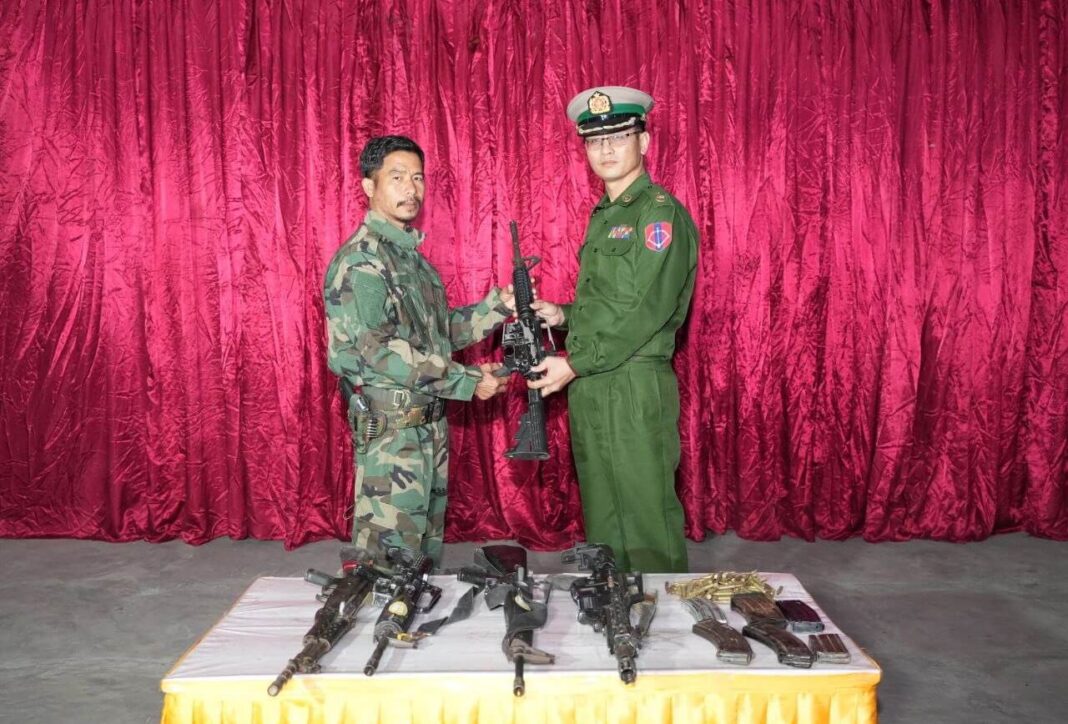
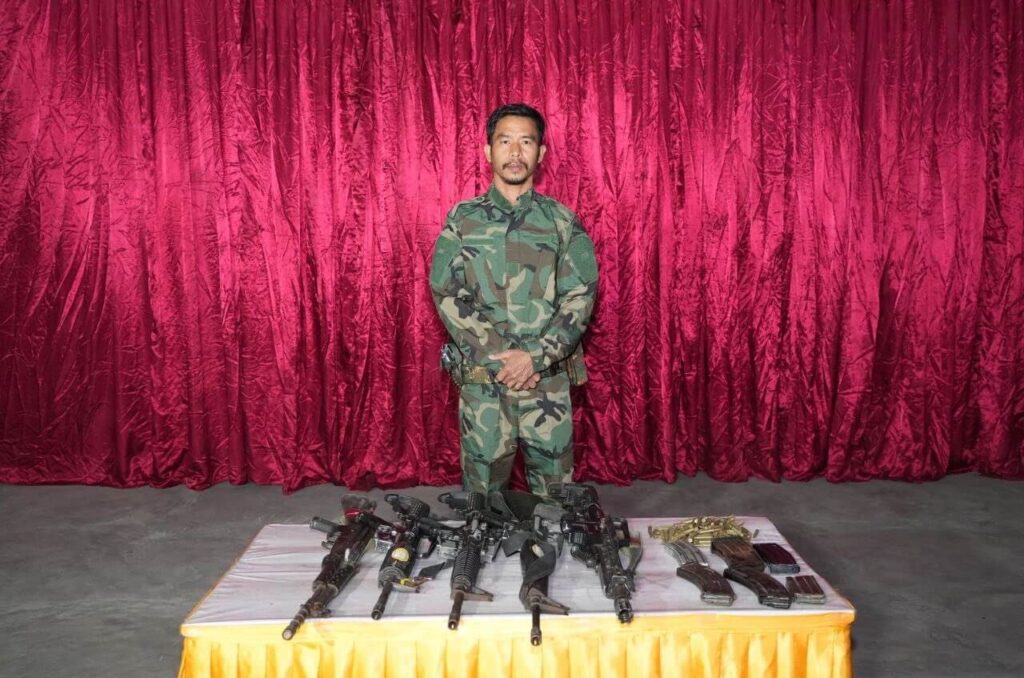
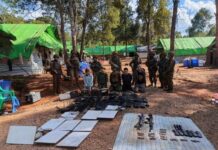
The surrender of Bo Nagar, leader of the Burma National Revolutionary Army (BNRA), to the Myanmar military junta on February 18, 2026, has profoundly unsettled the political climate and armed resistance movements within Myanmar. His defection, publicized by military-controlled media, occurred during heightened clashes between his forces and those loyal to the National Unity Government (NUG), which operates as a parallel government opposing the junta.
On February 17, 2026, significant assaults were launched by the NUG on BNRA positions in Pale Township, intensifying the ongoing conflict. Allegations of extrajudicial killings and various other crimes by the BNRA had severely damaged relations between the two factions.
Following his surrender, Bo Nagar and his family were airlifted to safety under junta protection, raising concerns about potential pre-existing ties between him and the military regime.
Bo Nagar’s defection poses significant threats to resistance forces. His in-depth knowledge of BNRA operations may allow the junta to more effectively target other resistance elements.
This incident is perceived as a severe setback for the BNRA, leading to internal divisions. Reports indicate that approximately 150 BNRA members have since expressed a desire to surrender to the NUG, suggesting a potential loss of personnel and morale.
The junta is likely to capitalize on these internal rifts among resistance groups, further reducing the chances of a cohesive opposition against military rule.
Broader political landscape
The NUG has framed its actions against the BNRA as a necessary step to enforce accountability for alleged crimes, emphasizing the rising tensions within anti-junta factions.
There is a blend of shock and skepticism in the revolutionary community regarding Bo Nagar’s choice. Many view his decision as a betrayal that undermines the sacrifices made by resistance fighters against the military dictatorship.
Bo Nagar’s surrender not only alters the tactical dynamics of armed resistance in Myanmar but also highlights deeper divisions within anti-junta movements. The junta’s potential advantages from this defection expose the vulnerabilities of the current resistance efforts and complicate prospects for a unified opposition against military governance.
Potential actions by the Junta following Bo Nagar’s surrender
The Myanmar military junta is expected to strategically leverage Bo Nagar’s surrender to bolster its power and undermine resistance efforts. Historical behaviors indicate a variety of tactics will be employed to maximize both political and military advantages from this event.
The junta will likely capitalize on Bo Nagar’s defection as a propaganda tool, aiming to propagate the narrative that resistance is futile. State media will probably emphasize his surrender to discredit the BNRA and other opposition groups.
Showcasing the defection of such a prominent figure can project an image of strength and control, potentially swaying other factions to reconsider their resistance.
Bo Nagar’s insights into BNRA tactics, troop movements, and logistical operations can be critical. This intelligence may facilitate more effective military operations against remaining insurgent groups.
Armed with this information, the junta is likely to escalate operations against BNRA holdouts and other opposition factions, potentially achieving significant victories that could further weaken the resistance.
The junta may promote the notion of surrender as a viable option for other insurgents, offering potential amnesties or protection to encourage further defections.
Emphasizing existing divisions within the opposition may allow the junta to manipulate tensions among various factions, weakening their collective resistance against the military.
The junta might propose conditional amnesty to other factions or individuals within the resistance, positioning itself as a benevolent authority willing to negotiate peace on its terms.
The junta could seek to incorporate surrendered factions into national security forces, which would reduce armed insurgency through co-optation.
The junta may ramp up military operations in areas previously held by the BNRA, establishing a stronger foothold to secure vital resources and territorial control.
Gaining control over BNRA strongholds can open access to local resources, enhancing the junta’s capabilities while diminishing the economic power of the opposition.
In summary, the junta’s response to Bo Nagar’s surrender is poised to be multifaceted, focusing on propaganda, military intelligence, and strategic manipulation of opposition factions. By capitalizing on this shift, the junta aims to consolidate its control and deepen divisions within resistance movements, employing historical tactics that have previously destabilized opposition efforts in Myanmar.
Potential success of NUG/PDF and ethnic armed groups in northern Myanmar
The coalition formed by the National Unity Government (NUG), People’s Defense Forces (PDF), and several ethnic armed groups—including the Kachin Independence Army (KIA), Karenni National Progressive Party (KNPP), Karen National Union (KNU), and Chin National Front (CNF)—shows significant promise against the junta, especially in Military Region 1. Their collective efforts, further strengthened by the recent involvement of the Arakan Army (AA), present both opportunities and challenges in their quest to secure northern Myanmar and advance southward.
Factors supporting potential success can be listed as below:
- Unified Front: The diverse coalition enhances military and political alignment, improving their operational effectiveness and resource consolidation.
- Local Knowledge and Support: Ethnic groups possess strong local ties and community backing, facilitating recruitment, supply chains, and intelligence operations.
- Adapting Strategies: The coalition can tailor tactics to leverage each group’s strengths, enabling effective guerrilla warfare and coordinated attacks against larger junta forces.
- Increased Pressure on the Junta: Multi-front offensives could stretch junta resources, weakening overall control and disrupting their operations.
Challenges to overcome are:
- Coordination Difficulties: Differences in agendas among the coalition members may complicate collaboration, communication, and supply chain management.
- Junta’s Counteroffensive: The junta is likely to respond with aggressive military force, risking heavy bombardments that could inflict significant casualties and diminish the coalition’s capabilities.
- Public Perception: Varied community support may arise, with some fearing prolonged conflict. Civilian casualties might also turn public sentiment against anti-junta forces.
- International Support: The coalition’s effectiveness may hinge on external backing for resources, training, and recognition, influenced by international responses to the conflict.
The alliance between the NUG/PDF and ethnic armed groups poses a strong challenge to the junta’s authority and has substantial potential for success in northern Myanmar. However, overcoming coordination issues, military counteractions from the junta, and public sentiment will be crucial. While the outcome remains uncertain, the coalition’s combined strength could significantly shift the balance of power in Myanmar’s ongoing struggle.

Recent happenings
According to Mizzima report of February 25: “In Pale Township, Sagaing Region, the Military Commission troops are advancing, leading to significant disruption and looting of property. Approximately 100 troops are reported to be active in Chin Pyit Kyin and Nwe In villages. Local armed group members, loyal to the junta, known as Pyu Saw Htee have been seen taking consumer goods from affected villages, operating with military support.
Witnesses describe a convoy of 30 carts and vehicles involved in the looting, with food, motorcycles, and livestock being seized. Additionally, around 1,200 households from seven villages are now displaced, facing threats from the military to return under the menace of heavy weapon attacks.
Displaced individuals have managed to take some food supplies but are likely to struggle with long-term access to food and medical needs. Drones are being employed for surveillance, and there was a recent drone strike on an unoccupied People’s Defense Force base.
The military’s increased activities follow the recent surrender of Colonel Naga, leader of the Burma National Revolutionary Army, and his followers on February 18.”
According to Khit Thit Media report of February 24: “Nearly 400 people flee as army burns down Chin Pyit Kyin village in Pa La Township, 2 injured in army shelling in Chaung U township.
Local sources said that the military council troops entered Chin Pyit Kyin village in the southern part of Pa La Township, Sagaing Region, on the afternoon of February 24 and are burning down houses.
This morning, a military column of about 250 troops entered Pa La Township in two groups and launched a full-scale offensive. The column entered Chin Pyit Kyin and Nwe In villages simultaneously, and at 11 am. today, the army began burning down houses in Chin Pyit Kyin village.”
A local said, “All the residents of Chin Pyit Kyin and Nwe In villages fled when the military column of about 250 troops entered. The village is now being burned down. We can only watch from a distance as the village burns down.”
Analysis
There is no doubt that the BNRA’s surrender to the junta represents a significant setback for the Anya resistance forces, affecting all anti-junta alliances. A crucial lesson here is the importance of avoiding conflict among revolutionary forces at all costs.
While the NUG may have valid concerns about Bo Naga’s conduct and the alleged crimes and human rights violations committed by his forces, launching an offensive under the guise of reinforcing law and order is not appropriate, according to many supporters of the revolutionary movement.
The damage inflicted has already benefited the junta, as evidenced by recent attacks in the Pale area that have harmed civilians. The immediate concern now is to minimize the damage and learn from the mismanagement of this situation. The revolution still enjoys popular support, and stakeholders should not take that for granted.
Certainly, the junta will do everything in its power to maintain its grip on political authority. Simultaneously, the anti-junta must dismantled the military dictatorship, which is the ultimate goal of revolutionary groups.
In practical terms, the people’s desire to end military rule and their deep-seated resentment toward the junta provide critical advantages for the anti-junta alliance. This public support can facilitate resource mobilization, strengthen intelligence operations, and bolster the morale of resistance fighters. However, sustaining this momentum is essential; resistance groups must remain attuned to the evolving sentiments and conditions within the populace. If handled effectively, the socio-political commitment of the public could shift the balance against the junta, indicating a viable path towards a more democratic future for Myanmar.





Leave a Comments