





“When there are raids in Tachileik, they cross over to the Lao side. When there are raids in Laos, they come back here.”
Nang Tip*, 23, describes the pattern with the calm certainty of someone who has watched it repeat for years. A resident of Tachileik — the border town where Myanmar, Thailand, and Laos converge — she has spent nearly three years inside the online scam industry. Long enough, she says, to understand a simple rule: enforcement does not dismantle the networks. It displaces them.
Across the Mekong River, about 45 minutes away by boat, lies Ton Pheung District in Laos, home to the Golden Triangle Special Economic Zone (GTSEZ). Established in 2007 under a Lao government concession granted to the Chinese-owned Kings Romans Group, the zone presents itself as a development project. At its center stands the King’s Romans casino, catering primarily to Chinese clientele. Chinese dominates public signage, and the yuan functions as the operating currency, giving the enclave the feel of a Chinese frontier city rather than a Lao jurisdiction.
Behind its illuminated skyline, however, authorities and analysts have long linked the zone to organized crime networks, including narcotics trafficking, human exploitation, and large-scale online fraud.
“It looks modern from the outside,” Nang Tit says. “The buildings are huge, and the lights are always on. But it’s full of casinos and scam centers.”
She worked there for roughly two months, living in employer-provided housing and earning about 3,000 yuan per month.

A Borderless Industry
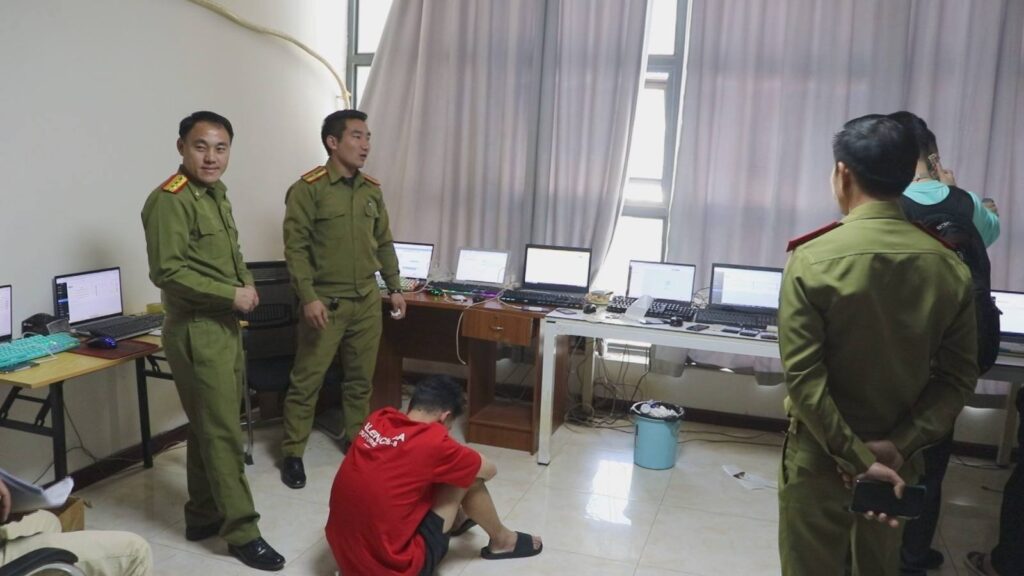
In November 2025, intensified raids by Chinese and Lao authorities pushed many scam operations out of the Lao zone. But according to workers, enforcement rarely shuts the industry down. Instead, it triggers relocation.
Sai Wan*, 21, has followed that pattern repeatedly. Originally from Mong Hsu in Shan State, he entered the industry at 18 following the launch of Operation 1027. He first worked at KK Park in Shwe Kokko along the Myanmar–Thailand border before moving east.
“I’ve been doing this job for more than three years,” he says. “We have a monthly target we must meet using English and Chinese online. If we reach the amount, there are no problems.”
The quota, he explains, is at least US$15,000 in scam revenue per month. Workers who meet their targets can earn salaries exceeding 30,000 baht, plus bonuses. Messaging platforms such as WhatsApp are commonly used to target foreign victims, particularly in Western countries.
“When we hear about arrests on this side, we stop and move to Laos,” he says. “When they arrest people there, we come back here.”
After the November crackdown, he returned to Tachileik along with many others.
“Those who worked in Laos have now come back. They’re operating quietly again, but only hiring people who already have experience. Most are young.”
For Sai Wan, the choice is pragmatic rather than ideological.
“If you don’t have income, no one helps you,” he says quietly. “This job makes money easily. If I worked somewhere else, I wouldn’t earn this much. I didn’t finish school. It’s hard to find work.”

Scams Re-Emerging in Tachileik
Tachileik’s infrastructure has long depended on Thailand for electricity, telecommunications, SIM cards, and internet connectivity. In early February 2025, Thai authorities cut power, fuel, and internet links to five border locations associated with scam activity, including Tachileik, after the Thai prime minister declared that Thailand must protect its citizens.
Local authorities later restored electricity through alternative supply lines from Laos. Residents say scam operations resumed soon afterward.
“Two months ago, you didn’t see them,” says Nang Leng, a local merchant. “Now they’re back again, but scattered. Before, they worked together in big buildings. Now they work separately in small places.”
Residents report that returning workers from Laos are renting houses across town and operating in small groups of four or five. The shift toward decentralized structures, they say, makes enforcement more difficult.
“Before, they moved openly,” says Sai Kaung, a Tachileik resident. “Now they stay quiet.”
He has also noticed subtle cultural shifts.
“There used to be Thai goods and Thai signs everywhere. Recently, Chinese signs have become more common. If you didn’t know better, you might think you were near the Chinese border.”
He believes officials are aware of the activity but fail to intervene due to bribery.
A Criminal Economy Shaped by Conflict
Analysts warn that scam operations in the region have evolved into a transnational criminal economy intertwined with armed conflict and political competition.
In October 2023, the Three Brotherhood Alliance launched Operation 1027 under the slogan “Eradicating Scams and Toppling the Military Dictatorship.” Despite major offensives across northern Shan State, large-scale scam operations persist.
Observers say multiple armed actors — including ethnic forces and regime troops — have competed to arrest scam leaders and hand them over to Chinese authorities, using enforcement as leverage for political legitimacy.
China issued arrest warrants in October 2023 for two former United Wa State Army officials accused of involvement in scam networks, offering rewards of up to 500,000 yuan. No confirmed arrests have been publicly announced.
A political observer in northern Shan State says even the execution of prominent scam figures has failed to disrupt the industry’s expansion.
According to a January 14 survey by ISP-Myanmar, at least 75 new scam operations have appeared in 34 townships since Operation 1027 began. Networks once concentrated in hubs such as Laukkaing, Pangsang, and Mong La had already spread into central Shan State and major cities like Yangon and Mandalay before the offensive.
“Because of scams, Operation 1027 happened,” says a politician in Lashio. “Homes were destroyed and people died. Leaders were arrested. But scams still exist as they always have.”
At an editorial roundtable, SHAN Editor-in-Chief Sai Murng drew a historical comparison.
“When drug lords are arrested and executed, drugs don’t disappear,” he said. “It’s the same with scam leaders. They are caught, but the industry only grows.”
Global Crackdowns, Limited Results
On November 12, 2025, the United States announced a coordinated crackdown targeting Chinese criminal networks operating across the Golden Triangle. Led by U.S. Attorney Jeanine Ferris Pirro, agencies including the FBI, Secret Service, and Drug Enforcement Administration formed a joint Scam Center Strike Force.
Myanmar’s military authorities established their own anti-fraud committee the following month.
Yet activists and analysts remain skeptical.
“If these gangs didn’t have armed groups and military figures behind them, they would have been cleared out long ago,” says a political activist in Lashio.
He argues that the industry has become a recruitment pipeline for young people facing unemployment, disrupted education, and economic collapse driven by prolonged conflict.
Adaptation as Survival
For residents of Tachileik, the transformation is visible. Large scam compounds have given way to dispersed networks operating quietly inside ordinary homes. Techniques have grown more sophisticated, and detection more difficult.
“Now they don’t live together in big groups,” Sai Kaung says. “They work in small teams, and their methods are more advanced.”
For workers like Sai Wan, the calculation remains stark: risk versus survival.
“In times like this,” he says, “many young people want this job. They know it’s a scam, but they still do it.”
His voice carries neither pride nor defiance — only resignation.
Across the Golden Triangle, raids continue, arrests are announced, and task forces are formed. Yet on the ground, the pattern Nang Tit described persists: when pressure rises on one side of a border, the industry simply moves to the other.
*Names have been changed for security reasons. This article was originally written in Burmese by Nang Seng Nom and translated into English by Eugene.





Leave a Comments