


Quite recently, the Three Brotherhood Alliance (3BHA) made a unilateral ceasefire announcement that it would extend its ceasefire for one month until the end of June for the sake of humanitarian aids delivery convenience by the international community to the vast population, which has to endure the terrible earthquake consequences at the end of March this year.
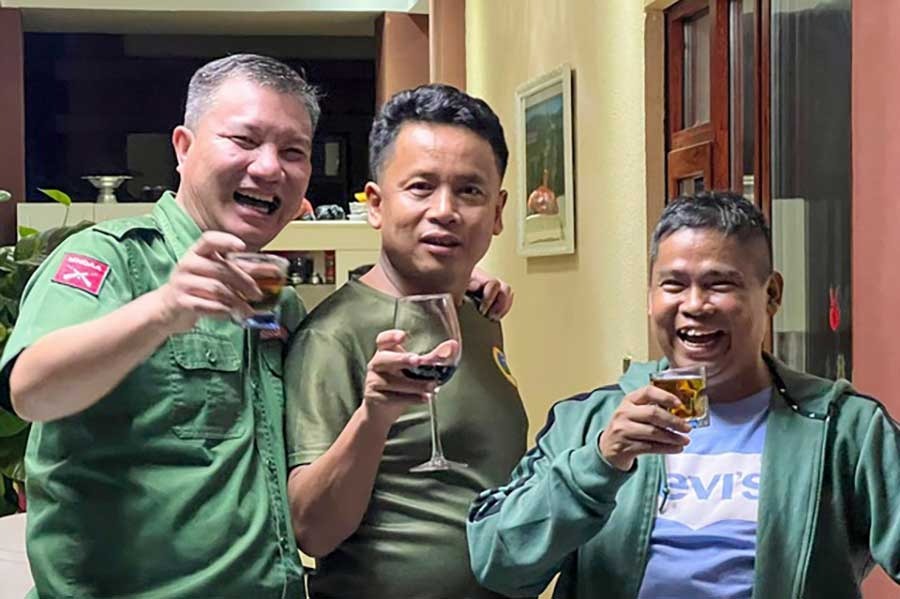
The 3BHA is made up of Arakan Army (AA), Kokang or Myanmar National Democratic Alliance Army (MNDAA) and Ta’ang National Liberation Army (TNLA) and they are part of the 7-member Federal Political Negotiation and Consultative Committee (FPNCC) headed by United Wa State Army (UWSA).
Other FPNCC members are Mongla or National Democratic Alliance Army (NDAA), Shan State Progress Party (SSPP) and Kachin Independence Army (KIA).
Likewise, the military council or State Administration Council (SAC) also follow suit with the unilateral ceasefire announcement. However, nothing on the ground will change and the war will go on, as has been the case during the last three unilateral ceasefire announcement by all parties.
The reason for this is both camps have clause incorporated in the announcement that in case of self-defence, they have the right to retaliate, which is exactly the reason for continuous fighting, each one blaming the other. But the real motive is likely no party is keen to really observe the ceasefire and feel rather at home with the ongoing civil war, so to speak.
At this juncture let us look into each group’s political and military positions, within the 3BHA and uncoordinated Operation 1027 context, which actually isn’t functioning at all as an alliance since the end of 2024.
We need to bear in mind that the 3BHA started out its Operation 1027 with a noble cause and aspirations of uprooting the military dictatorship system and establishment of a genuine federal democratic union.
Now this stance has been deviated and we need to explore and assess the present situation and political landscape we are experiencing it at this moment in time.
AA
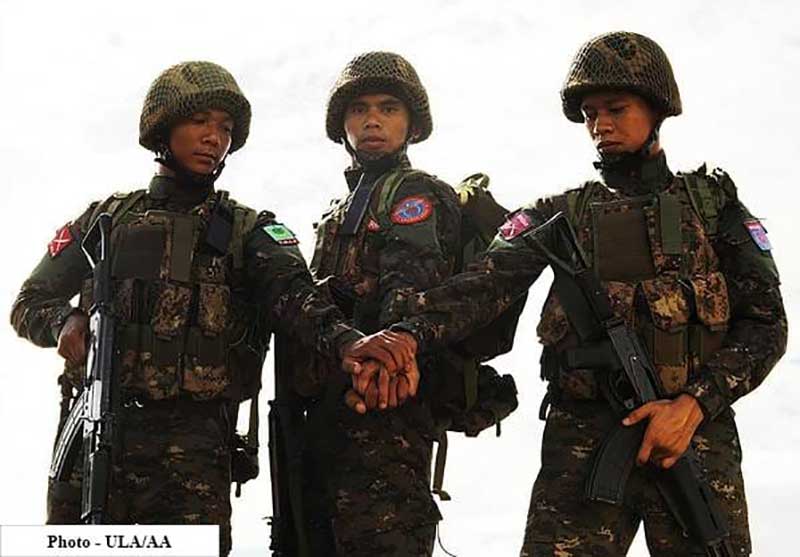
Despite Chinese pressure, directly or indirectly, AA won’t let up its goal of pushing out all the junta troops out of Rakhein State. In other words, even China or any other power will not be able to hinder AA’s commitment of having only its troops within the Rakhine State, on which AA leader General Twan Mrat Naing has told The Irrawaddy about a year ago in an interview.
AA has fought under the banner of Operation 1027 from 2023 to 2024, in which the 3BHA headed the operation, and other anti-junta forces also fought the military junta on their own initiative, like Kachin Independence Army (KIA) and Karenni Nationalities Defence Force/ Karenni National Progressive Party (KNDF/KNPP), Chin Brotherhood, Chin National Front, and the National Unity Government’s (NUG) People’s Defence Force (PDF) and Local Defence Force (LDF), mimicking 3BHA, capturing nearly a hundred towns, numerous junta’s military installations, including 2 Regional Military Commands, one in Shan State and the other in Rakhine State, across the country.
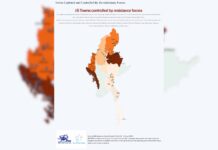
Reportedly, the anti-junta ethnic-democratic alliance is said to control about 60 percent of the country’s landmass and 70 percent of the country’s population, although the figures can’t be exactly verified with the rapidly changing military situation all the time.
To date, since launching its Rakhine offensive in November 2023, the AA now has control of 14 of Rakhine State’s 17 townships, including Paletwa Township in neighbouring Chin State, and has cornered the military junta into a few pockets of resistance garrisons in Sittwe, Kyaukphyu, and Manaung townships.
After seizing the southernmost part of Rakhine State, AA forces began pushing over the foothills of the Rakhine Yoma mountain range into the delta of Ayeyarwady Division or Region, according to Frontier Myanmar recent report.
The AA thrust into Ayeyarwady is part of the three-pronged AA offensive beyond the borders of Rakhine into neighbouring regions, in which AA forces have also moved from Taungup Township into Bago Region’s Padaung Township, and from Ann Township into Magwe Region’s Ngape Township.
Meanwhile, with AA in full control of the Indian and Bangladesh borders, both the governments had to engage with the it while stopping short of official recognition. Bangladesh is in direct contact with the AA, while India is engaging through the Mizoram state government. Reports suggest that the AA has even opened an office in Mizoram.
In addition, Bangladeshi government advisors have stressed that resolving the refugee crisis requires engagement not only with Myanmar’s regime but also with the AA and parallel National Unity Government (NUG) – which marks a significant shift in Bangladesh’s approach to the Rakhine situation, according to The Irrawaddy report of June 4.
In early February this year AA has been probing Rakhein’s capital Sittwe City with military operations, potentially signalling an impending assault on the city. The AA and the military junta have reportedly been exchanging artillery fire in the outskirts of the capital city, leading one military analyst to speculate that the AA was trying to ascertain the weaknesses in the junta’s defences in preparation for an assault on Sittwe, according to Center for Strategic and International Studies (CSIS) report of February 20, by Michael F. Martin an adjunct fellow (non-resident) with the Southeast Asia Program at the CSIS in Washington.
Quite recently, AA has been conducting offensive against Kyaukphyu in a somewhat softer way unlike full-scale attacks in the past, according to the Western News of June 6.
Military analysts say the AA is using a gradual advance strategy in the battle for Kyaukphyu, one of the three remaining cities in Rakhine State. The AA’s previous battles for capturing cities in Rakhine State were enthusiastically satisfying, but the battle for Kyaukphyu is not, which may be due to a change in strategy.
A military analyst who asked not to be named said that the AA is using a gradual advance strategy rather than a full-scale attack because of Chinese projects in the Kyaukphyu area.
“In the battle for Kyaukphyu, we see that the AA could have attacked with all its strength, but it has not yet attacked. In other words, it is using a gradual advance strategy. It may also be because it wants to show its power that it can finally capture Kyaukphyu at any time by advancing one inch at a time,” he said.
CDM Captain Zin Yaw also commented that in planning to attack Kyaukphyu, the AA is avoiding not to be in conflict with the Chinese (who are within the vicinity either as workers or foreign security forces).
“The AA is currently targeting the 32nd Police Assistance Battalion in Kyaukphyu. If they capture that battalion, they will have about 30 percent control of Kyaukphyu. In the Kyaukphyu battle, we do not see the AA using force to capture the city but attacking in a defensive manner. We see a strategy of slowly attacking with small columns without using heavy weapons. In normal battles, defensive attacks are always a good idea. In this Kyaukphyu battle, I think the AA is circumventing the Chinese in conducting its attack (on the junta),” he said.
MNDAA
It is totally becoming China’s tool and proxy, weighing in heavily on group survival mindset, rather than the original political rhetoric of uprooting the military dictatorship system and establishment of federal democratic union, which is short-lived. A total about-turn from its the Operation 1027 original goals to embracing the stance of currying for China’s favour, and at the same time, realizing it’s territorial expansionism urge into Shan majority settlement, for realization of a bigger wider Kokang Self-Admintered Zone.
It may well be that it is aiming to achieve a status of UWSA confederacy-like administration level.
According to the SHAN report of June 5, in Shan State’s Lashio and Hsipaw townships, the Shan State Progressive Party/Shan State Army (SSPP/SSA) and the Kokang Army (MNDAA) have been engaged in a series of clashes over territorial disputes.
Since January 2025, a formal ceasefire has been declared between the Military Council and the Kokang Army (MNDAA) through Chinese mediation, and the MNDAA has completely withdrawn from Lashio on April 17 after the Thingyan holiday.
Following the withdrawal, the Kokang Army (MNDAA) and the Shan Army (SSPP/SSA), members of the Federal Political Negotiation and Coordination Committee (FPNCC), have been engaged in a territorial dispute in Lashio and Hsipaw townships since the last week of April.
The ongoing clashes between the allied forces are also part of the territorial dispute that arose as a result of the “1027 Operation”.
In order to resolve these territorial disputes, the SSPP Central Political Committee and the MNDAA Central-level officials met to discuss the military tension and fighting situation at UWSA-controlled town of Panghsang in early May, but they were unsuccessful.
The reason for the failure of the talks was that the Kokang Army or MNDAA demanded the withdrawal of SSPP camps in the Muse and Kutkai areas or demanded that the SSPP not to collect taxes along the Union Highway, in which the meeting ended without any agreement, a military source told SHAN.
A Shan political analyst told SHAN that the conflict between the MNDAA and the SSPP is related to China’s interests of Belt and Road Initiative (BRI), known in China as the One Belt One Road (OBOR) and sometimes referred to as the New Silk Road, is a global infrastructure development strategy adopted by the government of China in 2013 to invest in more than 150 countries and international organizations.
“Now, if we look at the problem between the SSPP and the MNDAA, I think it is related to China’s BRI Silk Road. This BRI Silk Road extends to China from Nawnghkio, Kyaukme, Hsipaw, Hsenwi, Lashio, Kunlong, and Hopang, and it is a railway built by the British during World War II. The Kokang Army also wants to show China that they can protect and provide security along this Silk Road. Another thing is that they want the mines (controlled by SSPP). China wants to realize its BRI Silk Road project, but on the other hand, it wants to maintain its prestige as a great nation, so it will support the military council with the Government to Government policy,” said a Shan political analyst.
On April 28-29, the MNDAA entered the SSPP camp near the Namma coal mine in Hsipaw Township and demanded that the troops to withdraw, which led to clashes between the two sides.
Similarly, on June 1, SSPP Info reported that a clash broke out when a Kokang MNDAA unit from Brigade 611 ambushed a SSPP column at the exit of Narlai Village in Hanna Village Tract, Lashio Township.
SSPP Info also reported that 8 MNDAA soldiers were killed during the clash.
Lashio locals noted that the renewed fighting was due to the SSPP reinforcing a large number of troops to the areas occupied by the MNDAA at the end of April.
Since the Kokang withdrew from Lashio on April 17 due to the Chinese pressure, locals said that they have been encroaching on some areas in Hsipaw and Lashio townships where the SSPP/SSA is active.
Now, since May 25, the SSPP/SSA has been reinforcing its troops in Hsipaw and Lashio townships where Kokang forces have invaded, increasing military tensions between the two sides.
The renewed fighting between the SSPP/SSA and the MNDAA after a month has forced residents of Na Lai Village, Han Na Village, Hein Lom Village, and Kaung Kaw Village in the Han Na Village Tract to flee to safer places.
TNLA
Losing ground in Taung Kham and possibly Nwanghkio. It is trying to project de facto and de jure rule by implementing its administrative apparatus and system, such as issuing IDs and taking population census, opening more schools and so on.
Most PDF and LDF won’t come to TNLA rescue and only Danu People’s Liberation Army (DPLA) is with it to defend the captured territories.
According to DVB report of June 6, TNLA said most of Taung Kham territory has been given up and this could turn into a defensive war.
While the Taung Kham side has surrendered a large portion of its territory and military tensions remain, there is no concern, and the Taung Kham side may be able to turn into a defensive war, TNLA spokesperson Lwe Ye Oo said.
The military council is conducting an offensive to retake the Ta’ang National Liberation Army (TNLA)-controlled town of Nawnghkio, with fighting approaching 10 miles away from the town.
At a press conference on June 5, TNLA spokesman Lwe Ye Oo said most of the Taung Kham positions have to be given up and there should be no concern as it is a strategic move.
“There may be a defensive war. However, the public must always be wary of this. For example, the public around Taung Kham, especially the public around Nawnghkio, need to be aware of this security concern.”
Military observers say that the army column from the western side has reached Kangyi, and the army column from Naung Lin has reached Naung Cho Gyi Taing Pinle, so these two army columns could join forces and attack Nawnghkio Town.
The military junta is sending troops to Taung Kham via Lawksawk and Kyauk Gu, and from there it is launching an offensive on Nawnghkio Town, and is also supplying supplies by air.
In the renewed battle for Nawnghkio, TNLA troops and the DPLA are also involved, and fighting is ongoing in Kan Gyi village as of June 5. Latest report on June 8 said that the junta’s offensive was repelled.
Nawnghkio, located between Pyin Oo Lwin and Kyaukme towns, was captured by the revolutionary forces on July 10, 2024, and 11 months later the military is back on the edge of the town.
To date, the TNLA and military junta have met twice in February and April initiated, facilitated and mediated by China, which were both unsuccessful, as the TNLA refused to hand the captured territories back to the junta. The third round is said to be scheduled in August according to the TNLA sources.
It seems China won’t give up the pressure on TNLA and military junta to make a deal to achieve its aim of negotiated settlement between the two, so that China’s aim to further its scheme of trade and BRI could be implemented.
For now, the TNLA said it rejects the hand over of its seized towns and territories even the junta with its almost daily airstrikes on its captured towns and offensives on Taung Kham and Nawnghkio massively by the junta’s infantry forces and air attacks, plus the Chinese pressure and economic incentives to flavour the deal.
On June 5, TNLA spokesperson Lwe Ye Oo said that all the townships and villages in all the TNLA controlled areas households, after the Operation 1027, will be evaluated and registered.
“Registration records and household records are being collected. Immigration, especially, is imperative in these townships, when major law enforcement and justice are being served. Until now, we are producing and maintaining household registers along with our registration in every community and village. You can say that it is currently in progress,” Lwe Ye Oo answered in a press conference.
Immigration Department has been reorganized by TNLA in 2025. It is known that all the people living in Tawsha township where the processes will be done including population analysis, issuing household register, and issuing national register analysis.
TNLA announces that it is aimed at maintaining the true population census, systematically maintaining the census of people, issuing registration, monitoring and systematic population and immigration processes in the region.
Similarly from May 25, locals said the Department of Motor Vehicle Registration is issuing vehicle licenses to domestic cars, commercial cars, passenger vans and trucks, in Namkham and Namhsan cities controlled by TNLA.
A clear sign of defiance against the wishes of junta and China, projecting its earnest de facto and de jure power in its controlled territories, but no one can foresee how long this will last.
Analysis
Given such changing political landscape and scenarios, we may say of the 3BHA only AA is sticking to its gun and fighting for its professed political goals, which are ending the role of Myanmar military in politics and establishment of either genuine federal democratic union or confederacy.
Kokang or MNDAA has clearly changed their political positions, opting instead for the recognition of a much larger chunk of Kokang administrative areas, at the expense of the Shan majority, and to a lesser extend the Kachin population in the so-called Kachin Sub-State around Kutkai.
It also positioned itself as a first class China’s proxy, being a Han Chinese speaking ethnic group like the power that be in Beijing, to look after its master’s BRI projects and beyond. However, it is not clear if the recent MNDAA trying to throw out the Shan and Kachin resistance armies from northern Shan State movements are directive from Beijing or doing it on its own initiative to curry favour for itself.
The TNLA, although trying to play tough is losing ground in Taung Kham and around Nawnghkio and China’s five-cuts policy on its territories is taking the toll in the long run for its hard-pressed population. Besides, daily bombing, airstrikes, infantry offensives on the ground by the military junta, and as well problematic for its army’s logistic and military hardware reinforcement, dependent on China and UWSA are obstacles which it has to be confronted. Thus, it is not clear for how long TNLA will be able to withstand this pressure of “carrot and stick” from all sides.
For now, it is posturing to get nearer to the NUG setup, but its Operation 1027 aftermath’s behaviour makes the NUG/PDF and LDF think twice, as its mistreated them by chasing them out from northern Shan State once enough territories have been captured for the realization of its Ta’ang State aspirations. It even went so far as to evict the KIA, where it has settled for decades even before the TNLA was formed. On top of that the KIA even trained the TNLA in 2009 to build up its army. The same is also true with the SSPP, which was being chased out where possible, although it also have helped TNLA in many ways, including having cordial relationship as an ally and even teamed up together to chase out the Restoration Council of Shan State (RCSS), with the help of UWSA, in 2021.
In short, the 3BHA cooperation and coordination can be said as non-existence at the moment, other than doling out joint-statements occasionally on unilateral ceasefire announcement for public relation purpose, which the military junta also followed, without really meaning to implement it.
Having said that, the 3BHA impact on the country’s revolutionary momentum has stopped as an alliance, even though AA seems to be doing what it can by helping the Dry Zone, Anyar PDFs and LDFs where it possibly can to fight the military junta, and also penetrating into Ayeyarwady, Bago and Magwe divisions or regions to empower the revolution as a whole. Besides, AA also is actively aiding the KIA in Kachin State to repel the Junta’s troops in Bhamo recently and elsewhere within the state since decades.


Leave a Comments