



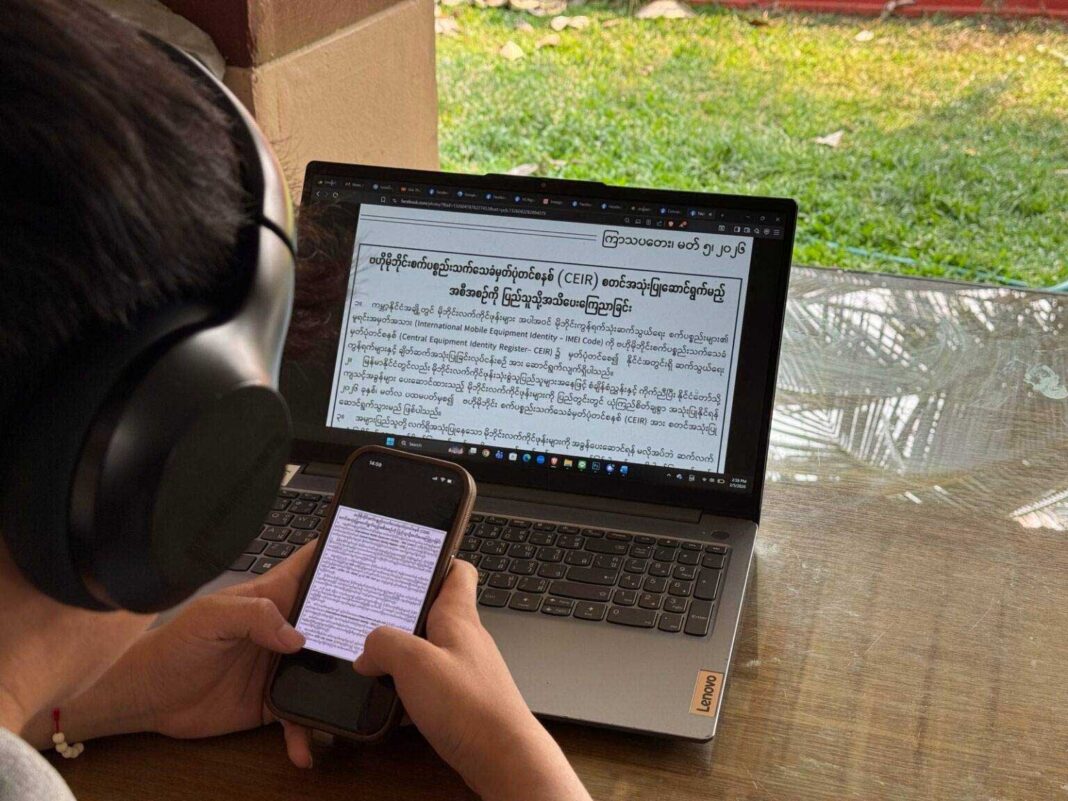
Myanmar’s military regime has announced the implementation of the Central Equipment Identity Register (CEIR), a system designed to track mobile devices across cellular networks, prompting concerns from technical experts that it could be used to monitor citizens and political opponents.
In a press release issued on March 5, the authorities said the CEIR system aims to combat mobile phone theft and curb the illegal smuggling of devices.
However, a technical expert told SHAN that the system could, in practice, become a powerful tool for digital surveillance targeting resistance forces, political activists, journalists, and the wider public.
“While a phone’s serial number can be altered, the IMEI (International Mobile Equipment Identity) is permanent. By exploiting this, authorities can track and monitor the personal data of individual users,” the expert said.
The expert explained that SIM cards in Myanmar are already required to be registered using national identification documents. Under the CEIR system, the phone’s unique IMEI will also be stored in a centralized database, linking the SIM card, the user’s identity, and the physical device.
This integration could allow authorities to identify which device is being used by which subscriber and potentially track an individual’s location through the telecom network.
“Previously, only mobile phone shops were required to register devices, which offered some level of privacy for users. Now it has become a system for direct individual tracking through the IMEI,” the expert added.
Once the CEIR system is fully operational, authorities will be able to identify which mobile devices are connected to specific telecom operators. Critics say that in Myanmar’s current political environment, the system could significantly expand the state’s capacity to track activists, journalists, and resistance networks.
The system also enables authorities to “blacklist” specific IMEI numbers, effectively blocking those devices from accessing mobile networks.
CEIR-type systems are used in several countries, including the United Kingdom, India, and Pakistan, primarily to combat device theft. However, under Myanmar’s former civilian government, implementation of such a system was delayed due to concerns over legal safeguards for personal privacy and data protection.
Under the regulations announced by the regime, mobile phones currently using SIM cards will be automatically registered in the CEIR system before March 31. After April 1, newly purchased phones that have not been taxed or officially registered will be allowed only 30 days of temporary use before being blocked from the network.
While authorities describe the system as a security measure to deter phone theft, members of the technical community warn that in Myanmar’s current political climate the CEIR could effectively function as a nationwide digital surveillance mechanism capable of tracking citizens’ movements.
Experts are therefore urging the public to remain cautious about their digital security and the potential risks associated with mobile device monitoring.







Leave a Comments