





Despite repeated pledges by Myanmar’s military junta and various ethnic armed organizations to eradicate online scam operations, investigations indicate that the illicit networks continue to expand across Shan State.
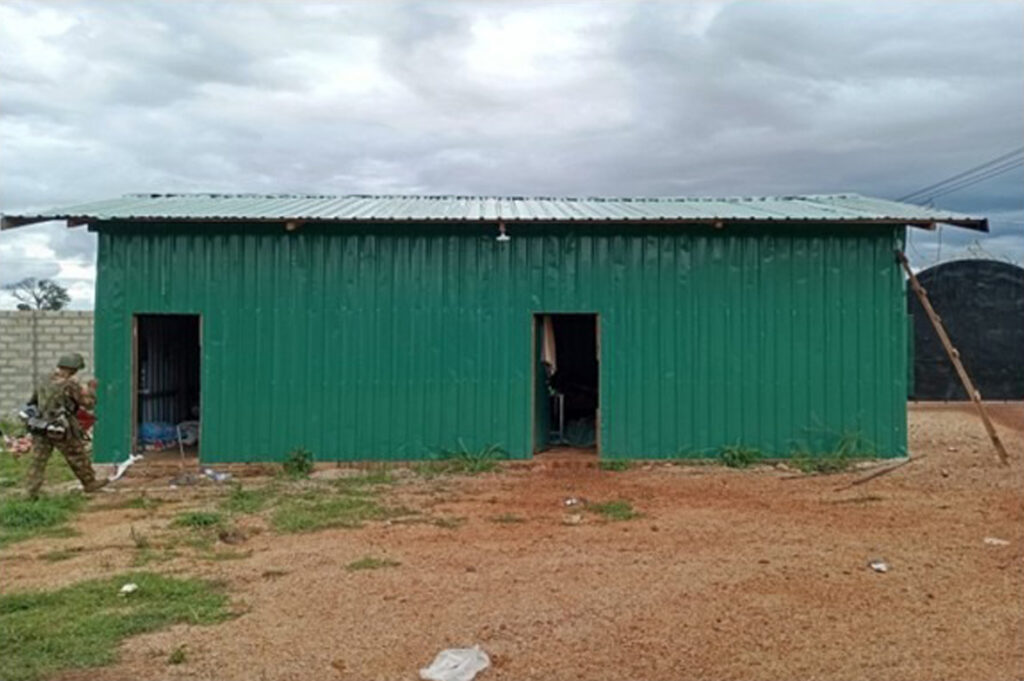
On August 4, junta troops raided an online scam operation allegedly run by Chinese nationals south of Nayai Village in Namlit Village Tract, Namsang Township. According to the regime, 49 suspects—including Chinese nationals—were arrested during the operation, while weapons, ammunition and equipment used in the scam operation were seized.
“These scam operations have been active in that area for around three years. This recent raid was just for show. They even found weapons during the arrests, which shows they are operating in direct coordination with armed groups. The location where they were arrested in Namsang is under the control of the Nayai People’s Militia,” a Namsang resident told SHAN.
According to the junta, those arrested included 36 Chinese men, two Chinese women, seven Myanmar men and four Myanmar women. Authorities said they also seized a P365 pistol, an Uzi submachine gun, two AK-47 assault rifles, magazines, ammunition, 67 mobile phones, four all-in-one computers, a central processing unit (CPU), and six Starlink satellite internet terminals.
The raid took place in territory controlled by the Nayai People’s Militia. Local militia forces aligned with the military have remained silent about cyber scam activities in the area and have taken no apparent action against the operations.
“Most of these scam rings operate in territories controlled by people’s militias. The militias never talk about fighting scams. Since these militia groups operate under the military, you can easily see the connection,” the resident said.
Following mounting pressure from China beginning in 2023 to dismantle online scam compounds along the China-Myanmar border, many syndicates relocated west of the Salween River, moving out of territories controlled by the United Wa State Army (UWSA) and the Myanmar National Democratic Alliance Army (MNDAA) and spreading across Shan State and other parts of Myanmar, according to a Shan political analyst.
“Nowadays, scam operations are active all the way from Shan State to Yangon, Mandalay, Kayin State and Tanintharyi Region,” the analyst said.
Although authorities frequently announce crackdowns, analysts say the scam industry continues to flourish because many operations are protected by powerful armed groups with significant financial interests in the business.
“In reality, while they claim to be cracking down on scams, they appear to be facilitating them behind the scenes. Because powerful armed groups, in one way or another, provide protection for these scam operations, they never truly disappear. If this continues, cyber scams can never be completely eradicated,” the analyst said.
The analyst added that people’s militias, which operate under the military’s command, are driven largely by economic interests rather than political ideology. If the military genuinely had the political will to address the problem, it could dismantle scam operations in militia-controlled areas. Likewise, although several ethnic armed organizations publicly claim to combat cyber scams, they continue to tolerate or protect such operations because of the substantial financial benefits they generate.
When the Brotherhood Alliance—comprising the Myanmar National Democratic Alliance Army (MNDAA), the Ta’ang National Liberation Army (TNLA), and the Arakan Army (AA)—launched Operation 1027 in northern Shan State on October 27, 2023, dismantling online scam centers was promoted as one of its primary objectives.
Leaders of the United Wa State Army (UWSA/UWSP) and other armed organizations have also repeatedly pledged during meetings with the junta in Naypyidaw to cooperate in eliminating cyber scam operations and drug trafficking. Despite those public commitments, however, the networks remain deeply entrenched.









Leave a Comments