

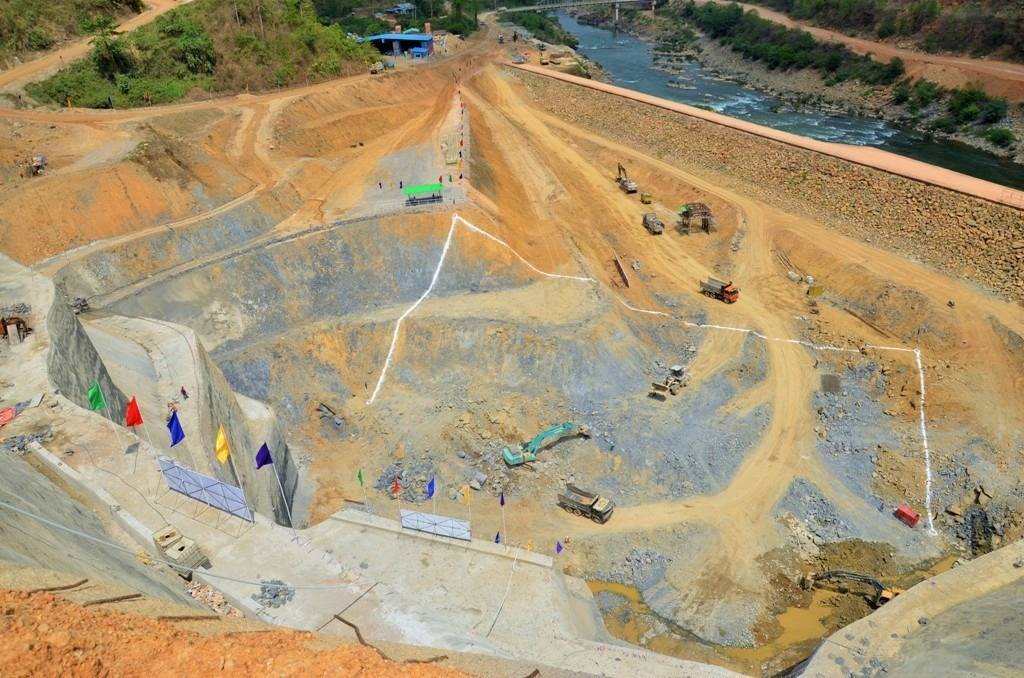
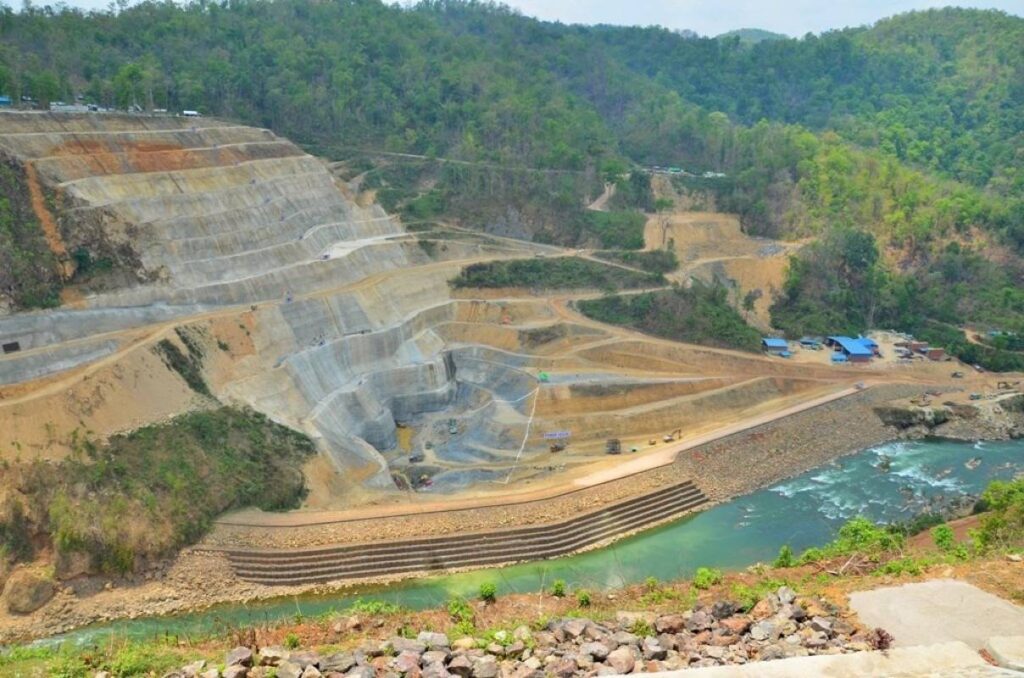
Amid ongoing conflict and political instability in northern Shan State, Myanmar’s military junta has announced plans to use Union funds to repair and resume construction of the long-delayed Upper Yeywa Hydropower Project, despite thousands of conflict-affected civilians still waiting for assistance.
According to the August 3 edition of the regime’s state-run newspaper, Global New Light of Myanmar (Myanma Alinn), fighting in June 2024 caused an estimated 26 billion kyats (US$5.87 million) in damage to machinery and infrastructure at the project site in Kyaukme Township. Although the regime said repairs would be financed through the Union Fund, it did not disclose the total budget required to fully restore the project.
“We haven’t heard of any company personnel returning yet. However, since last month, they have been repairing the Nawngping–Taungchay road. At the moment, no one is allowed to travel through the area,” a resident of Kyaukme Township told SHAN.
Despite years of opposition from local communities and environmental groups across Shan State, the junta’s latest announcement indicates that construction will proceed with the aim of completing the project during the 2029–2030 fiscal year.
Construction of the Upper Yeywa Hydropower Project began in the 2010–2011 fiscal year and is reportedly 53.95 percent complete. According to the regime, repairs to access roads and power transmission lines will begin in the 2026–2027 fiscal year. Once completed, the 280-megawatt plant is expected to generate 1.409 billion kilowatt-hours of electricity annually.
Critics argue that the project is being revived not to meet Myanmar’s electricity needs but to advance regional strategic interests.
The renewed push follows junta chief Min Aung Hlaing’s visit to China in June, where he met Chinese President Xi Jinping. During the visit, Beijing urged the junta to accelerate strategic projects under the China–Myanmar Economic Corridor (CMEC) and strengthen cooperation in power generation.
On April 13, the regime’s Minister for Electric Power and Energy, Ko Ko Lwin, met representatives of Chinese state-owned enterprises, including China Southern Power Grid, in Kunming. Discussions focused on expanding cross-border transmission networks linked to hydropower projects in northern Myanmar and expediting major projects such as Myitsone, Shweli (3), and Upper Yeywa.
Political analysts and local observers say much of the electricity generated by these projects is expected to serve cross-border power networks and industrial demand rather than communities living near the dams.
“By restarting this project, the junta is trying to reassure China that the China–Myanmar Economic Corridor remains secure,” said a political analyst who closely follows developments in Shan State.
The analyst added that Min Aung Hlaing continues to rely on support from foreign powers—including China, Russia, India, and Thailand—to consolidate his rule while placing Myanmar’s long-term national interests at risk.
For residents displaced by conflict, the regime’s spending priorities stand in stark contrast to their own circumstances.
While billions of kyats are being allocated to revive the hydropower project, residents whose homes were destroyed during fighting say they have received neither compensation nor meaningful assistance.
“No one has come to see our destroyed homes or our shattered lives. It feels like they care more about their political interests than the people,” a resident of Kyaukme said.
Sai Hor Hseng, spokesperson for the Shan Human Rights Foundation (SHRF), said the project should not move forward while armed conflict continues.
“We believe this is the wrong time to undertake such a project. Our country is far from peaceful or stable. With the military situation still highly volatile, armed clashes could erupt again at any moment,” he said.
He warned that the dam would inundate villages including Talong East and Talong West in Kyaukme Township, displacing hundreds of residents and destroying their livelihoods.
“Restarting this hydropower project is like adding fuel to the fire,” he said.
The project’s revival comes amid continued instability and shifting territorial control in northern Shan State.
During the early stages of Operation 1027, the Ta’ang National Liberation Army (TNLA) captured 12 towns from the military, including Kyaukme. However, changing battlefield dynamics in 2025 forced the TNLA to relinquish Kyaukme, Hsipaw, Nawnghkio, Mong Mit (Momeik), and Mongkut (Mogok) to the junta. Kutkai was subsequently transferred to the Myanmar National Democratic Alliance Army (MNDAA) in March 2026.
Amid these territorial shifts, the TNLA formally proposed the establishment of an autonomous Ta’ang State during talks with the junta on July 19.
“‘Peace talks’ are being held, but we have to ask: whose peace are they talking about? Who are these talks really for? Are they genuinely intended to build peace for the people?” Sai Hor Hseng said.
For many residents of northern Shan State, the proposed revival of Upper Yeywa represents more than the return of a suspended infrastructure project. It symbolizes a government willing to invest billions of kyats in a controversial dam while communities displaced by war continue to wait for reconstruction, compensation, and lasting peace.

Leave a Comments