



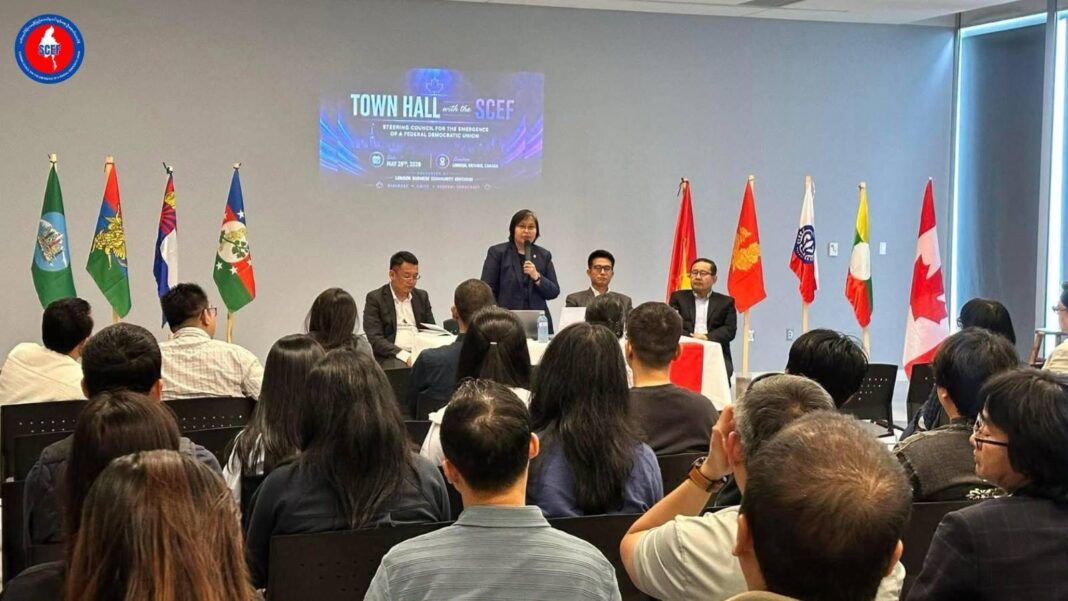
A highly anticipated meeting between the United League of Arakan/Arakan Army (ULA/AA) and the Steering Committee for the Emergence of a Federal Democratic Union (SCEF) finally took place, sparking excitement among the Myanmar public. In the days leading up to the July 23, 2026 meeting, the SCEF had also held separate talks with the Pa-O and Mon resistance forces, the Spring Revolution Alliance (SRA)—an alliance of armed groups formed during the Spring Revolution—and the federal unit parliaments and governments of Sagaing, Magway, and Mandalay regions. In total, the SCEF reportedly met with eleven organizations in just eight days.
The Fracture of Two Myanmars
As the sun sets on July 2026, the landscape of Myanmar is defined not by a clear victor, but by a profound and dangerous fracture. The nation exists in a state of suspended animation, locked in a high-stakes stalemate where the military junta controls the capital and the major urban centers, while the resistance holds the vast rural hinterlands and border regions. This is not merely a military deadlock; it is a collision of two irreconcilable political visions. On one side stands the regime of Min Aung Hlaing, desperate to manufacture a facade of legitimacy through a co-opted coalition. On the other stands the people’s movement, embodied by the Steering Committee for the SCEF, which is rapidly consolidating a genuine alternative government rooted in the will of the citizenry. The coming months will determine whether Myanmar descends further into a permanent dictatorship or emerges as a federal democratic union.
The Junta’s Illusion of Unity
The military junta’s strategy has evolved from brute force to a sophisticated diplomatic gambit known as the 100-Day Peace Initiative. This initiative is designed to create an illusion of national reconciliation by assembling a broad coalition of some twelve armed groups. This list is carefully curated to include the seven Ethnic Armed Organizations, known as “7 EAO Alliance”, that historically signed the Nationwide Ceasefire Agreement, alongside the China-backed militias of the northern borderlands such as the Myanmar National Democratic Alliance Army (MNDAA) or Kokang, National Democratic Alliance Army (NDAA) or Mongla, Ta’ang National Liberation Army (TNLA), Shan State Progress Party (SSPP) and United Wa State Army (UWSA), and various junta-proxy forces like the Shanni Nationalities Army (SNA) and Border Guard Force (BGF). By bringing these disparate groups to the table, the junta aims to present itself to the international community as the only viable architect of peace.
The logic behind this maneuver is transparent. The junta seeks to leverage the inclusion of traditional ethnic armies to claim that it has achieved a “National Reconciliation,” thereby neutralizing the National Unity Government and the SCEF as political actors. With the diplomatic shield provided by China and Russia, who continue to block decisive action at the United Nations Security Council, the regime believes it can parlay this domestic coalition into international recognition. They are banking on the hope that the world, weary of the conflict, will accept this manufactured “peace” as the new status quo, effectively legitimizing the 2021 coup and the 2008 Constitution that enshrines military dominance.
The People’s Counter-Offensive
In stark contrast to the junta’s top-down co-option, the SCEF is executing a bottom-up political revolution. Unlike the junta, which relies on the patronage of external powers, the SCEF draws its strength solely from the people. It is a movement without a state sponsor, fueled by the aspirations of millions who have taken to the streets and the fields to demand the restoration of their democracy. The recent diplomatic surge by the SCEF has been nothing short of remarkable. In a span of just eight days, the committee has engaged with eleven different armed groups, signaling a determined effort to broaden its coalition beyond its current core of the National Unity Government (NUG), the Committee Representing Pyidaungsu Hluttaw (CRPH), Karenni National Progressive Party (KNPP), Karen National Union (KNU), Kachin Independence Organization (KIO), and Chin National Front (CNF).
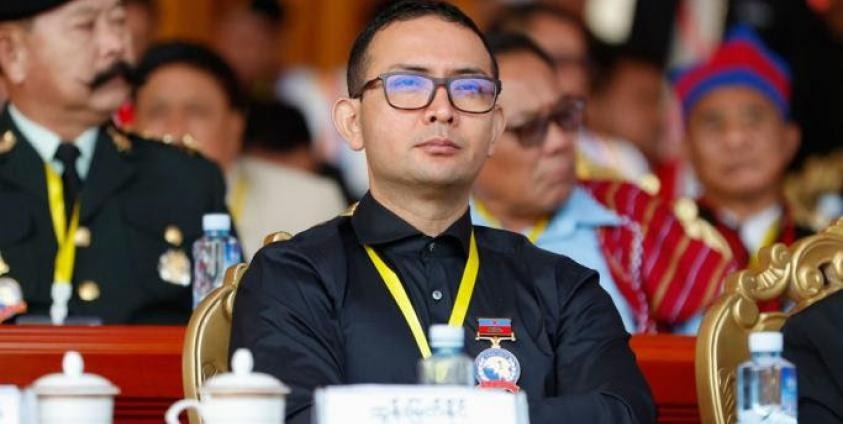
The most significant development in this political consolidation is the public virtual meeting between the SCEF and the Arakan Army. This engagement marks a strategic pivot, as the Arakan Army (AA), a powerful force that had previously operated with a degree of autonomy, is now aligning itself with the SCEF. This move effectively strips the junta of its ability to claim that all major armed groups support its peace initiative. By actively soliciting the support of groups that have not yet joined the alliance, the SCEF is building a formidable political and military entity capable of replacing the junta in Naypyitaw. The momentum is shifting, not through a single decisive battle, but through the steady, relentless work of uniting the fragmented opposition into a coherent, legitimate government-in-waiting.
The Crisis of Regional Diplomacy
The geopolitical implications of this fracture are playing out acutely within ASEAN. The regional bloc, once the primary forum for resolving the Myanmar crisis, is now the battleground for the junta’s survival strategy. The military regime is actively exploiting divisions within ASEAN, rejecting the Five-Point Consensus while simultaneously courting members who prioritize stability or economic ties over democratic principles. This has led to a dangerous disunity, with some nations seemingly willing to recognize the junta’s new regime, while others cling to the fading principles of the consensus.
This internal schism is exactly what the junta needs to survive. If ASEAN were to recognize the junta’s some twelve-group alliance as the legitimate representative of Myanmar, it would validate the coup and render the resistance’s political struggle moot. The junta is betting that ASEAN’s desire for a quick resolution will override its commitment to democratic norms. However, this gamble ignores the reality that the junta’s “peace” is a sham, designed only to preserve military power. The failure of ASEAN to present a united front has allowed the junta to manipulate the diplomatic landscape, turning the Five-Point Consensus into a hollow shell that no longer serves the interests of the Myanmar people.
The Imperative for a New Diplomatic Paradigm
The current trajectory is unsustainable. The stalemate allows the junta to continue its atrocities while the resistance, despite its moral and political strength, lacks the international legal framework to force a transition. The solution lies in a bold departure from the status quo. The international community must move beyond the failed strategy of neutrality and adopt an innovative diplomatic framework inspired by the successful United Nations Transitional Authority in Cambodia (UNTAC) model. This approach requires the UN and ASEAN to work in tandem to create a Joint Transitional Council that recognizes the SCEF as the sole legitimate political interlocutor.
This framework would not merely observe the conflict but actively facilitate the political transition. It would mandate the exclusion of the military junta from the core decision-making process until it agrees to a full withdrawal from power, thereby removing the primary obstacle to peace. By channeling humanitarian aid directly through the de facto administrative structures of the resistance, such as the federal councils in Karenni, Magway, and Mandalay, the international community would sever the junta’s ability to weaponize aid. Simultaneously, a unified declaration recognizing the SCEF as the legitimate government-in-waiting would strip the military’s peace initiative of any diplomatic weight.
The Path to Federal Renewal
For this model to succeed, ASEAN and the UN must present a united front, leveraging their combined influence to pressure the junta’s external backers to support a genuine transition. The goal is to create a clear, time-bound pathway to a federal democratic union that respects the rights of all ethnic groups and upholds the results of the 2020 election. This is not merely a diplomatic exercise; it is a moral imperative. The future of Myanmar hinges on the international community’s willingness to embrace this innovative approach and place the aspirations of the Myanmar people at the center of the solution.
The momentum is already building within the resistance. The SCEF’s rapid expansion, the strategic alignment with the Arakan Army, and the growing international recognition of its legitimacy suggest that the resistance is gaining the upper hand. The junta’s attempts to buy time through sham negotiations are increasingly seen as a desperate measure. By adapting the lessons of Cambodia to the unique complexities of the Myanmar conflict, the UN and ASEAN can facilitate the emergence of a federal democratic union that uproots the dictatorship and restores dignity to a nation long denied its sovereign voice. The transition from a fractured stalemate to a unified democracy is not only possible; it is the only path that leads to a lasting peace. The choice is now clear: continue to legitimize a military dictatorship that has plunged Myanmar into chaos, or embrace the people’s aspiration for a federal democracy. The world must choose the latter, for the sake of the Myanmar people and the stability of the entire region.



Leave a Comments