




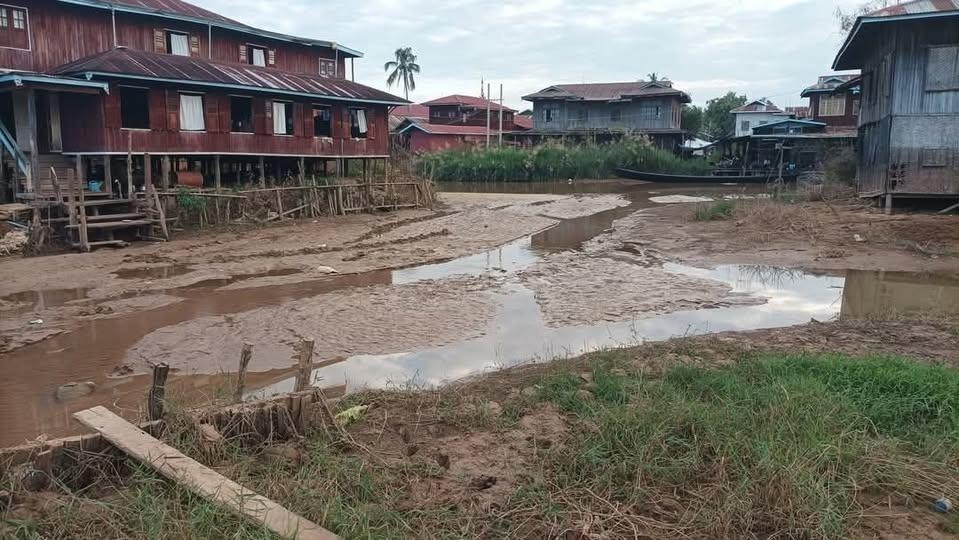
Rice cultivation in the Inle Lake region of Nyaungshwe Township, southern Shan State, is declining sharply due to repeated natural disasters and environmental degradation, according to local residents.
Over the past two years, earthquakes and severe flooding have destroyed hundreds of acres of paddy fields, inflicting significant economic losses on farmers. The combined impact has also altered the lake’s ecosystem, with large volumes of silt deposited into the lake, raising the lakebed and disrupting water levels.
Residents report that during the current dry season, water levels have dropped by more than 1.5 feet, making irrigation increasingly difficult and reducing agricultural productivity.
“In previous years, it was a cycle of flooding followed by drought. Crops were either submerged or destroyed by extreme summer heat. Everything we invested was lost,” a local farmer told SHAN. “Last year, I planted five acres of rice, but this year I’m planting only three. If it fails, the losses will be smaller. As long as I have enough for my family to eat, that’s enough.”
Farmers in the region typically plant summer rice in April, but this year excessive silt accumulation has made planting difficult or impossible in some areas. The situation has also affected other local industries, with the region’s well-known Inle tomato production significantly reduced due to water shortages.
Local observers attribute the environmental decline of Inle Lake to both natural and human-driven factors, including deforestation in the surrounding watershed, expanding upland farming, population pressure, and charcoal production.
“The degradation of Inle Lake has been happening for a long time,” said a local environmental activist. “While natural disasters play a role, human activities are even more significant. To save the lake, we urgently need to restore forests and plant long-term, water-retaining trees.”
Inle Lake remains a critical resource for surrounding communities, underpinning not only agriculture but also livelihoods, food security, and access to basic services.
Residents also report increasingly extreme weather patterns, including intense heat during the dry season and sudden fluctuations in water levels, which rise rapidly after rainfall but recede quickly during prolonged heat.
As environmental pressures intensify, farmers warn that declining yields and unstable conditions could have long-term consequences for both the local economy and food security in the region.




Leave a Comments