




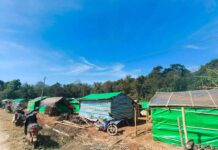
The Shan Human Rights Foundation (SHRF) reports that more than 40 acres of farmland have been destroyed downstream of rare earth mines in the Mong Khark area of Mong Bawk Township, Eastern Shan State, which is under the control of the United Wa State Army (UWSA).
According to SHRF’s September 18 statement, heavy rains on July 27 caused flooding along the Lwe (Nam Lwe) River, submerging rice, corn, peanut, and soybean fields. When the water receded, a 60 cm-thick layer of sludge was left on the land, destroying the crops.
“The wastewater from the rare earth mines flows into the Lwe River. When it floods, it destroys farmland and leaves toxic sludge behind. The soil becomes unusable, and nothing can grow on it,” said Ying Leng Harn, SHRF spokesperson.
Farmers tried replanting crops in unaffected areas, but further floods on August 5 and 10 destroyed those as well. Locals say they have never seen this level of damage before.
SHRF noted that rare earth mining in Mong Bawk has expanded significantly since the 2021 coup, growing from just three sites in 2015 to at least 26 sites in 2025, according to satellite imagery.
Sai Hor Hseng, another SHRF spokesperson, said the extracted minerals are likely being exported to China. Rare earth minerals are vital for producing electric vehicles, smartphones, wind turbines, and other electronics, and China relies heavily on Myanmar’s supply.
SHRF has urged stakeholders to address the environmental and livelihood impacts caused by unregulated rare earth mining in the region.







Leave a Comments