




It is becoming quite evident that the political landscape in Burma or Myanmar isn’t just a plain struggle of ethnic-democratic, anti-junta forces against the tyrannical military dictatorship system only, but a merciless competition of resources control and allocation, particularly zooming in on the extraction rare earth elements (REEs) and other mineral resources.
The Kachin State is the first line exploited territory, followed quite intensely by Shan State, according to the recent news making the rounds.
The KIA has taken over Special Region 1 – a rare earth hub previously controlled by the junta-aligned New Democratic Army Kachin (NDA-K) in October last year and now the Myanmar military council is trying to retake it, including the jade hub in Hpakant, Indawgyi and Bhamo townships, by ramping up its counteroffensive, according to KIA spokesman Colonel Naw Bu. That is how intense the resources control competition is becoming in today’s armed conflict spectrum.
According to Reuters report of June 12, 2025, Beijing’s access to fresh stockpiles of REEs has been throttled recently after a major mining belt in Myanmar’s north was taken over by Kachin Independence Army (KIA), an armed group battling the military junta, which China supports.
Although KIA allowed shipments of the existing rare earth inventories to China, to resume operations at full capacity, the KIA needs an agreement with China, which seems quite problematic for the time being, reported Reuters,
But “(in) October 2024, the Kachin Independence Army (KIA) seized control of Chipwi and Pangwa, two towns at the center of one of the world’s most valuable concentrations of heavy rare earth elements. These materials, particularly dysprosium and terbium, are essential to the production of electric vehicles, wind turbines, and advanced defense systems. China responded by closing border gates along the Yunnan corridor, halting rare earth shipments from Myanmar,” according to Stimson Center, based in Washington DC, report of June 24, 2025, titled: “Rare Earths and Realpolitik – Kachin Control, Chinese Calculus, and the Future of Mediation in Myanmar”.
“The KIA, meanwhile, has gained not only revenue but leverage. With export volumes near 2023 levels and a fixed price reportedly agreed at 35,000 yuan per ton, the KIA could generate well over USD 200 million annually. This figure surpasses the budgets of several small states. Recent interviews with local actors suggest exploratory discussions on a new ceasefire model. These talks do not center on federalism or political power-sharing, but on border trade, taxation, and mining control. For many ethnic armed organizations, however, resource control has always been integral to their federalist vision. In this sense, resource-sharing is not a substitute for political settlement, but a core component of it,” emphasized the report.
Accordingly Chinese miners are now opening two new deposits for extraction of REEs between the towns of Mong Hsat and Mong Yawn. The Shan Human Rights Foundation(SHRF) also confirmed the existence of the two new extraction facilities in its report of June 19.
Mong Bawk area which is located Southeast of Panghsang, the United Wa State Army (UWSA) capital, has been an REEs extraction center since 2015.
Thus, it seems the Chinese companies are pushing to extract more REEs in Shan State territories controlled by the UWSA, which is its proxy. So much so, media are starting to dub UWSA as a Wagner-like mercenary outfit for China.

Rare earth mining in Shan State
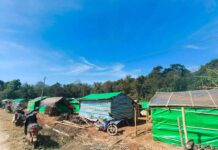
According to SHAN report of June 24, three rare earth mines in the Wa-controlled Mong Bawk area ten years ago have now expanded into 26 mines in 2025 along the hills south of Mong Bawk town, the SHRF said in a statement released recently.
“The expansion of these rare earth mines has accelerated since the 2021 military coup,” said SHRF spokesperson Sai Hor Hseng. “Because the area is under UWSA control, mining has gone ahead unchecked.”
Three of the rare earth mines near the China–Myanmar border are just 3 to 4 kilometers from Mong Bawk town.
Rare earth elements are essential for producing electric vehicles (EVs), wind turbines, smartphones, computers, and other electronic devices.
According to SHRF, the mining operations in Mong Bawk are not officially listed as of the list published in November 2021. Thus, it is quite clear that it is an arrangement between the UWSA and China, effectively bypassing the military junta regime, which China actually supports it.
“Chinese companies are being allowed to mine rare earths in UWSA-controlled areas without Naypyidaw’s approval. These minerals are likely being exported directly across the border into China,” Sai Hor Hseng said. However, he added that SHRF could not confirm the specific companies involved.
Rare earth mining is also taking place in the Mong Yawn area of Mong Hsat Township, near the Thai–Myanmar border, another territory controlled by the UWSA. Satellite images show at least two mines in Mong Yawn, around 25 kilometers from Thailand’s Chiang Mai Province. However, exports from Mong Yawn are reportedly restricted to military council-controlled checkpoints, which means the junta may also benefit from this REEs extraction.
The mining method used, known as “in situ leaching,” involves injecting chemicals into the ground to extract rare earth minerals. This technique, already in use in Kachin State, has been widely criticized for polluting surface and groundwater and causing long-term environmental harm.
Mong Bawk lies between two major rivers the Salween (Than Lwin) and the Mekong. Wastewater from the mines flows into the Salween River via the Kar River to the west, and into the Mekong River via the Lwai River to the east. This means while Chinese territory remains unaffected, communities downstream in Shan State could face serious health risks, SHRF said.
SHRF emphasized that these operations are damaging forests, contaminating water sources, and threatening the health and livelihoods of local communities.
Myanmar’s rare earth production is estimated at 31,000 metric tons in 2024, according to Statista. The country now ranks as the world’s third-largest rare earth producer, after China and the United States.
ISP Findings in Kachin State
According to part of the Executive Summary report (June 2025) of Institute for Strategy and Policy – Myanmar (ISP-Myanmar) titled, “Unearthing the Cost – Rare Earth Mining in Myanmar’s War-Torn Regions” writes: “Over the past eight years (from 2017 to 2024), Myanmar has become China’s primary external source of rare earth minerals, with a total Myanmar export value exceeding USD 4 billion. Following the 2021 military coup, Myanmar’s exports of rare earths saw a significant surge, with USD 3.6 billion worth of rare earth minerals shipped during the post-coup period 2021-2024. This 2021-2024 post-coup surge in rare earth exports constitutes 84% of the total value of Myanmar’s rare earth exports to China across the wider 2017-2024 eight year period. The peak year was 2023, when exports reached USD 1.4 billion, largely driven by an expansion of mining activities in conflict-affected regions, particularly in Kachin State. Satellite imagery confirms a marked rise in illegal, unregulated mining activities, involving both military-backed entities and ethnic armed organizations (EAOs), exacerbating environmental and social challenges.”
“The situation in Kachin State underscores broader trends in rare earth mining, where environmental and social instability often go hand in hand. This highlights the urgent need for responsible mining practices that prioritize the welfare of local communities, transparency in land transactions, and stronger regulatory oversight to mitigate exploitation and social ills. Addressing these issues is essential not only for protecting the environment but also for fostering long-term peace and stability in conflict-affected regions, where the exploitation of natural resources continues to drive social and political unrest.”
In the report recommendation conclusion, it writes: “In the case of Kachin, rare earth extraction has entrenched a conflict economy where armed actors profit from unregulated mining. This has deepened local militarization, weakened civilian governance, and diverted natural resource revenues away from public benefit. The sustained conflict economy not only hinders peace and sustainable development in Kachin but also poses long-term risks to neighboring countries, particularly China through illicit trade flows, and regional instability. Policy responses should prioritize demilitarizing natural resource governance and establishing transparent, community-led oversight mechanisms to prevent the cross-border spread of conflict-driven resource exploitation.”
Analysis

As we can see the REEs extraction is part of the resources allocation competition, mainly between armed organizations of all sorts, which includes the junta’s Burma Army and also EAOs.
The logic behind is as Min Thayt, social critic and political analyst, puts it in his recent piece in Burmese “Is it ownership competition for natural resources?” pointed out that the armed groups are taxing the population to feed their cannon fodders, while natural resources exploitation and extraction which makes biggest money goes to build up their army even stronger and to expand their territories.
“Today, the KIA’s role is beginning to resemble that of the United Wa State Army (UWSA), which has long controlled tin exports to China from Wa State. The UWSA operates a system of informal taxation, providing stable access to resources in exchange for political non-interference. China has tolerated this model of armed commerce in Wa State and may do the same in Kachin,” according to Stimson report mentioned above.
Thus, Shan State and Kachin State, with the main actors like KIA and UWSA receptively, will hold sway over resources allocations which will empower their respective organizations even further with buyers like China, to the awe and admiration of the other EAOs in the field.
In sum, REEs extraction, including other natural mineral resources, will be feverishly sought and competed among the EAOs and also the junta’s army. In doing so it becomes clear that the main projection of all armed stakeholders in Burma now is fixed on gaining resources allocations, as it is the most lucrative way to empower them in no time.
Because of this the current situation has become a major arms race, a major wealth race, and a major competition for natural resources, all disguised as seeking solution to the political problems. And in process, the people’s aspirations of rooting out the military dictatorship system and establishment of a genuine federal democratic union have altogether lost their meanings, so to speak.




Leave a Comments