

Kokang toned down its expansionism as TNLA figures out on how to survive backlash from its high-stake ethnic state assertiveness
Three pieces of news hit the headlines which are crucial in trying to assess the political situation in northern Shan State, especially on the inter-ethnic conflict facet heightened by ethnonationalism upsurge.
The first one is the reportedly partially resolved fighting between the Kokang or Myanmar National Democratic Alliance Army (MNDAA) and the Shan State Progress Party/Shan State Army (SSPP/SSA).
The second news is Chin Brotherhood Spokesman Salai Yaw Marn interview which pointed out the need for the ethnic armed organizations/ethnic resistance organizations (EAOs/EROs) to curb their ethnic rights and territorial demand disputes and resolve them only after the military dictatorship system is abolished, and resolved them under the federal democratic union, civilian government through political dialogue and political means according to the procedure.
The third one is the 9th batch Bamar People Liberation Army (BPLA) basic military training graduation ceremony used as a stage to further alliance-building of the EROs and the Bamar resistance groups like the National Unity Government/People’s Defence Force (NUG/PDF) and Local Defence Force (LDF), which will give fall-back position for the Ta’ang National Liberation Army (TNLA) and at the same time, energize the anti-junta ethnic-democratic forces as a whole.
These three developments are linked to each other in trying to assess the present containment of inter-ethnic conflict, which in turn, has a tremendous negative effect to the ongoing people’s revolution as a whole.
But first let us look at the scenarios one after another.
MNDAA backs down from aggressive stance

Kokang or MNDAA has been aggressively expanding its Kokang Self-Administered Zone or Special Region 1, to include most of the northern Shan State from Laukkai to Lashio.
Flushed with victories from Operation 1027, it likely thought SSPP and Kachin Independence Army (KIA) could be pushed away easily and would let it take over the territories inhabited by majority Shan/Tai which the said two EROs have been residing since decades. The KIA is active in Kutkai and surrounding areas, while the SSPP has been in Shan majority populated in the rest of the areas ever since the Shan revolution started in the late 1950s.
On June 19, Shan Herald Agency for News (SHAN) reported that the SSPP/SSA and the Kokang MNDAA have agreed not to recruit or impose administration in the disputed area, according to an investigation.
On June 17, officials from both sides met for the second time in Than Lwin Village near Nam Paung Village in Lashio Township, and an agreement was reached that the MNDAA would not recruit, impose administration, or collect taxes in the areas controlled by the SSPP near Mong Rae, Nam Paung, and Hseng Kiao, a military source said.
“The main thing is that the Kokang side has not withdrawn its troops during the complicated military situation. However, they talked about (creating non-hostility condition) so that both sides’ troops are not harmed and not being obstructed in their movement. They agreed not to recruit soldiers, establish an administrative structure and collect taxes in the SSPP area again, and that what happened will be resolved later between the two sides,” the military source said.
The meeting held in Lashio Township was attended by the Deputy Chief of Staff of the MNDAA, the Secretary of the Special Region 1 Administrative Committee, 211, 311, 511, 611 Brigade Commanders and 13 Deputy Chiefs of External Relations from the MNDAA side.
Similarly, the SSPP side was led by the Deputy Chief of Staff and Chief of Customs Lt. Gen. Ngoa Hpa and Maj. Gen. Win Aung, and members of the Central Military Command, and political commanders from 989, 979, 738 Brigades in total 14 attended.
In addition, the ‘Wa’ army UWSA also attended the meeting as a neutral representative and recorded the results of the discussions, the Kokang News Network reported on June 18.
SHAN contacted SSPP spokesman Major Sai Phone Han to inquire about the agreement reached in the second round of talks between the SSPP and MNDAA, but his phone was switched off.
Initially, it is understood that the MNDAA asked to come to the SSPP headquarters for talks, but the SSPP side responded to go to the UWSA-controlled Panghsang Town where the Federal Political Negotiation and Consultative Committee (FPNCC) chairman is located. However, the tripartite meeting took place in Lashio Township, another military source said.
After this second round of talks, a liaison group between the SSPP and MNDAA will be set up to continue resolving the territorial dispute, the military source added.
In early May, the SSPP Central Political Committee and the MNDAA Central Level Officials met in Panghsang controlled by the Wa Army UWSA, to discuss the military tension, but it was unsuccessful. Then, on June 1, two clashes broke out between the SSPP/SSA and the MNDAA within the same day in Hanna Village Tract, Lashio Township, resulting in the deaths of eight Kokang soldiers and with some troopers injured, SSPP Info reported.
According to DVB report of June 20, A local resident close to the MNDAA said, “The MNDAA forces began withdrawing from the confrontation with the SSPP on the evening of June 18. (Reportedly) only the MNDAA troops are to withdraw.”
He said that the MNDAA side is making concessions and withdrawing after reaching an agreement on the necessary troop withdrawals from Hsipaw and Lashio townships, where territorial disputes and clashes have erupted in recent days.
18 Chin resistance groups set priority
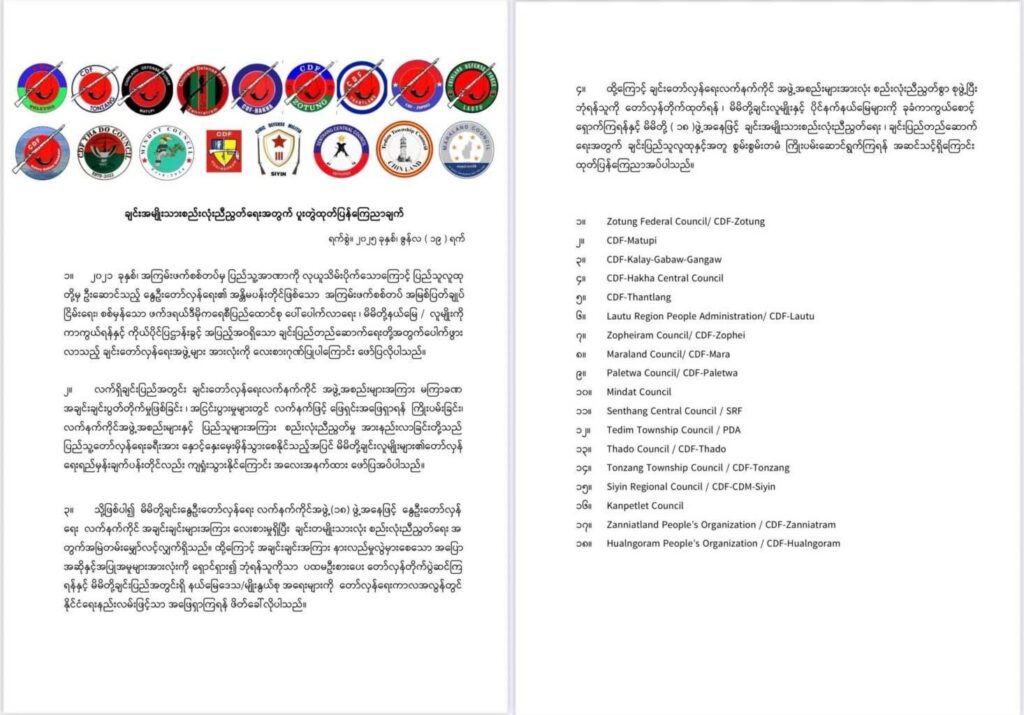
According to Shwe Phee Myay report of June 20, 18 Chin Revolutionary Army groups issued a joint statement on June 19 to resolve territorial and ethnic issues only after the revolution.
For the sake of Chin national unity, they said that only after overcoming the common enemy first, should they find a political solution to territorial claims and ethnic issues (under the democratically elected civilian government through political means and dialogue within a given guideline and framework).
Chin armed groups in Chin State have often tried to resolve conflicts and disputes with weapons.
This has weakened the unity between the armed groups and the public, which could delay the people’s revolution, and may also deviate from the revolutionary goals.
In 2024, a territorial dispute between the CDF-Lautu and MDF broke out in Matupi and Thantlang townships in Chin State, leading to shooting between the two sides.
In addition, there have been minor territorial clashes between the CDF-Huang Ngo Ram and the CNDF in Rid Khao Dar township in Falam township these days.
“The main issues are related to disputes over tribal territory and property. They have tried to resolve these issues through armed confrontation rather than through political means,” a Chin politician told Shwe Phee Myay.
After minor territorial disputes, the CDF-Huang Ngo Ram declared Rid Khao Dar Township an emergency zone on June 16.
In Tedim and Tonzang townships, Chin National Army (CNA), Chinland Council (CC), and Zomi Revolutionary Army (ZRA) have also been frequently clashing over territorial disputes.
On June 9, the CDF-Tonzang attacked and captured the ZRA camp in Maal Kwe village, Tonzang Township, and the two sides have been in a state of tension.
“Although there is no conflict in Tonzan, there is always fighting between the two sides. Now there is a possibility of fighting. Both sides are preparing for war.
“The ZRA is also spreading rumours of fighting,” a local from Tonzan Township told Shwe Phee Myay.
The 18 Chin Defence Forces are also ready to work together with the people of the Chin region to unite the Chin people and build a Chin state. The statement was jointly issued by members of the Chin State government, namely PDF-Zotung, CDF-Matupi, CDF-Lautu, CDF-Hakha, CDF-Paletwa, Kalay Gabaw Gangaw, CDF-Thangtlang, CDF-Lautu, CDF-Zophei, CDF-Mara, Mindat Council, SRF, PDA, CDF-Thado, CDF-Tonzang, CDF-Siyin, Kanpetlet Council, CDF-Zanniatram, and CDF-Hualngoram.
BPLA 9th batch basic military training graduation
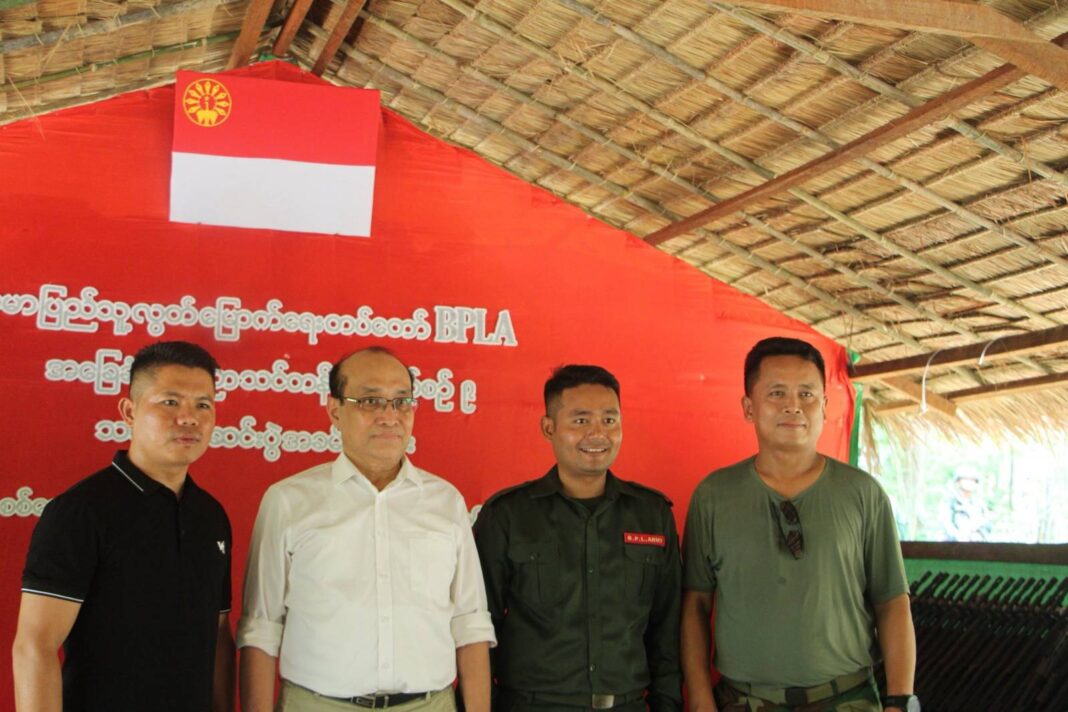
Shwe Phee Myay, on June 21 reported the 9th batch of the Burma People’s Liberation Army (BPLA) Basic Military Training Course graduation ceremony was held in TNLA controlled region.
The graduation ceremony was held on June 7, and various awards were given to those who excelled during the course, and the graduates were equipped with weapons, and a new battalion was formed for Military Region 203.
The graduation ceremony was attended by Dr. Zaw Wai Soe, Union Minister for Health and Education of the NUG, General Tar Phone Kyaw, Secretary General of the Palaung State Liberation Front (PSLF)/TNLA, Vice Chairman of the Karenni Interim Administrative Council (IEC), Khun Bee Htoo, a commander of the AA, the Commander-in-Chief and General Secretary of the People’s Liberation Army (PLA), the Vice Chairman of the All Burma Students Democratic Front (ABSDF), and the Commander-in-Chief of the BPLA, the statement said.
The alliance leaders emphasized the need for unity among different forces in order to succeed in the revolution, and that if they are united, the military dictatorship will end quickly.

Analysis
The first report that the MNDAA readily meet the SSPP and ironed out a partial solution to the brewing and volatile inter-ethnic conflict is a positive sign, given that the hitherto aggressive and haughty military and political stance of the MNDAA, flushed from victories of Operation 1027 against the military junta, in northern Shan State.
However, China has constrained the MNDAA’s enthusiastic aspirations playing an important role in national politics, together with the TNLA and Arakan Army (AA), which is to uproot the military dictatorship system and establishment of federal democratic union.
In the process its recruiting of Bamar resistance groups and training them to fight against the military junta, under the banner of Operation 1027 for two years have achieved tremendous result of success, especially in northern Shan State, capturing almost all of it, including the Military North Eastern Command. This irked China, even though it was the one which initially gave directive to the northern EAOs to launch offensive against the military junta in the first place, in the name of controlling illegal online gambling and cyber-related crimes, that the junta was indifferent as it benefited directly and indirectly from such undertakings by local and international Chinese gangs.
Suddenly, China made an about turn from its previous policy stance and decided to keep the Myanmar military junta in place and asked the northern EAOs to withdraw back to their original stomping grounds, for whatever reason it might have in store. In process, the MNDAA was pressured to draw back from Lashio and is now even asked to completely return back to Kokang Self-Administered Zone.
However, Kokang it seems is playing its card to exert itself as China’s first class proxy in looking after China’s interest in realizing its Belt and Road Initiative (BRI) projects by pushing the KIA and SSPP out from along the Myanmar-China trade routes. This resulted in firefights with the SSPP, as it has nowhere to go but has to defend its turf. Besides, the SSPP is under high intense pressure from northern Shan State population to act and protect the majority Shan from MNDAA and TNLA riding roughshod on the population.
It must have been a combination of China’s disapproval of selling, or portraying itself as China’s proxy; “carrots and sticks” tactics employed by both China and military junta; and also the noticeable animosity and anger of the majority Shan population of some 2 million against 300,000 Kokang people and MNDAA.
Other than that, nobody now believe the Kokang’s political rhetoric of uprooting the military junta and establishment of federal union, as it is now quite clear that it is more inclined to bargain only for more territorial gain and widen its Self-Administrative Zone.
Whatever the case, the positive move to talk with the SSPP rather than to engage in armed conflict is to be welcomed, even if it is a partial conflict resolution for the time being.
In the same vein, the TNLA is also exactly in the same category, which hasn’t come around yet to talk to the Shan majority that it wants to cow and administer, just because the two Shan armies aren’t united yet to take up the task of defending the Shan areas and Shan population, as they have professed to be their historical duties.
Meanwhile, rumours of about 2,000 Shan in Namkham, Muse areas are said to have been recruited and assembled to fight for Shan people, proposing the SSPP to take them in, which the SSPP still have to respond to it.
The second report which centred on the 18 Chin resistance groups to prioritize the fighting of the common enemy, the military junta, than fighting each other for ethnic and territorial disputes is also a positive development.
The four-point joint statement issued by the 18 groups on June 19 emphasized the following in paragraph 2 as: “(We want) to earnestly state that the recent military implementation solution in trying to resolve the frictions and arguments among Chin revolutionary groups; deterioration of unity between the public and armed organizations; could weaken, procrastinate and the makes the people’s revolution lustreless, resulting in failure to attain revolutionary goal and even defeat.”
The 3rd paragraph said that “It is hoped that Spring Revolution armed organizations should respect each other and unite. It moreover invited the Chin armed organizations to be careful of the conversation and actions which could lead to misunderstanding should be avoided; and revolutionary struggle against the common enemy be the first priority and issues like territorial and ethnic disputes should be resolved in the aftermath of the revolution through political means.”
The third report is to portray the alliance of EROs and anti-junta organizations like NUG/PDF, LDF to fight against the junta.
BPLA 9th batch basic military training graduation held in TNLA area portrayed as a unity-building process of the EROs and NUG/PDF, which was attended by NUG Minister Zaw Wai Soe, TNLA, All Burma Student’s Democratic Front (ABSDF), AA, Karenni and People’s Liberation Army (PLA), armed wing of the Communist Party of Burma (CBP), leaders.
This comes at a time, when TNLA is pressured with “carrots and sticks” tactics by China and Military Council as well to give up its captured towns and territories, like the Kokang has been pressured to do in Lashio, Military North Eastern Command.
It is now further pressured to completely draw back to Kokang Self-Administered Zone altogether, in exchange for economic incentives by trading with China.
Reportedly, TNLA has to meet the junta in coming August according to China’s insistence, whether it likes it or not. If it refused, China and the junta will definitely heightened up the pressure and if it really teamed up with the NUG/PDF in official sense, the pressure would be even more intense.
So it seems, TNLA is preparing ground for a softer fall back position.
TNLA knows too well that it has to make decision, as it can’t just take the whole cake and eat them all alone. This coalition-building with NUG is a sort of survival option move, which it only has half-heartedly pursued in the aftermath of Operation 1027 by mistreating its Bamar PDF allies and outrightly hostile to the fellow EROs in northern Shan State, by trying to push them out of their home ground. This openly showed its territorial expansionism urge to realize it’s expanded Ta’ang State aspirations, at the expense of the other ethnic groups within the Shan State.
In sum, the present inter-ethnic conflict situation may be assessed as achieving partial solution where MNDAA is concerned but with a lot of negative impact on the part of TNLA in northern Shan State political, military situation as a whole.
As time and again being urged, this brewing inter-ethnic conflict won’t just go away easily unless the narrow, aggressive ethnonationalism and territorial expansionism mindsets, including racial supremacy doctrine, are changed and replaced by more accommodative “unity in diversity” mode, coupled with harmoniously living together by all concerned parties in the existing reality of multi-ethnic Shan State.

Leave a Comments