



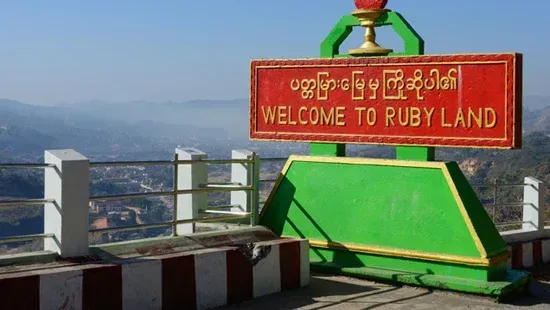
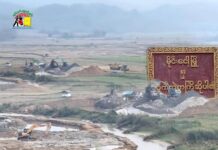
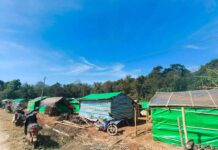
In the misty highlands of northern Shan State, the once-lush fairways of Mogok’s golf course, a local landmark in the fabled “Ruby Land”, have been swallowed by a wasteland of gaping pits and billowing dust. Where residents once gathered for leisure, industrial excavators now claw relentlessly at the earth, extracting rubies and sapphires under the watch of armed guards.
“The golf course is gone. Every time I pass it, my heart breaks a little more,” said Ko Thar Nge (name changed), a longtime gem trader.
Mogok, renowned for producing the world’s finest rubies, fell under the control of the Ta’ang National Liberation Army (TNLA) and allied resistance forces in late July 2024 during “Operation 1027.” Within weeks, the new authorities granted mining licenses to companies tied to TNLA officials, Wa State interests, and Chinese investors, according to multiple local sources.
The scale of extraction is staggering. “They operate 24/7 with machinery we’ve never seen before,” said Ko Thar Nge. “Even the historic Mogok Club complex, untouched under military rule, is being dismantled for gems.”
Heavy Machinery, Heavy Restrictions
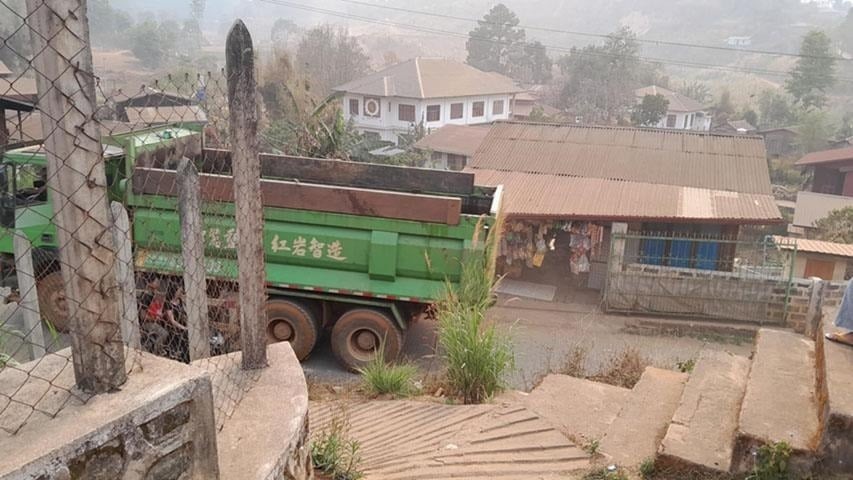
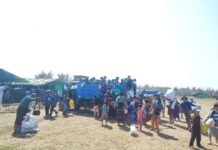
The TNLA’s Gemstone Committee, composed of four TNLA representatives, two PDF members, and four selected villagers, tightly controls operations. Outsider laborers work under strict surveillance, no phones, no photos. Precious stones are hauled away in coal trucks to washing stations in Namhsan.
Local miners, many from generations-old gem-trading families, face steep restrictions. “They demand 40% of our finds as tax and force us to sell only to their Chinese buyers,” one trader said. Those who refuse lose access to ancestral mining plots.
At a May 4 press conference, TNLA Joint Secretary-General Col. Tharpan La defended the policies, claiming taxes fund land rehabilitation and that local experts oversee operations. But residents like Nang May remain unconvinced. “The environmental damage is irreversible. We’re losing our land, our heritage, and our future.”
Taxes, Corruption, and Broken Promises
Despite assurances, locals say mining revenues vanish into opaque budgets. “They don’t repair bombed bridges or roads,” Ko Thar Nge said. “Municipal taxes just pay TNLA salaries, nothing for the people.”
Meanwhile, junta airstrikes target TNLA-held mines, destroying equipment worth millions. Operations now often shift to nighttime to evade bombing runs.
Gold, Greed, and Militarization
A similar pattern has emerged in neighboring Momeik Township, where multiple PDF-linked groups are taxing gold mining operations. According to gold miner Sai Oo, as many as 19 PDF factions are active in the area, some dressed in military uniforms, their identities blurred.
“When the TNLA came in, they said four sites belonged to the people,” said Sai Oo. “Now Kokang troops are involved. I can’t even tell who’s who anymore.”
Since September 2024, the TNLA has been demanding a 10-pisa gold tax from miners. Those unable to meet quotas, like miners in Shwe Taw, have fled to Mandalay.
The Myanmar National Democratic Alliance Army (MNDAA), known as the Kokang Army, has followed suit. In March 2025, violent protests erupted in Kutkai over Chinese-backed gold mining near the Nam Lin Creek headwaters. Six people, including two Kachin Independence Army (KIA) soldiers, were killed.
Although Kokang leaders later agreed to pay funeral costs and temporarily suspend operations, mining has intensified in other areas. Since capturing Lashio, the MNDAA has expanded coal mining in Hsipaw Township, dispatching heavily loaded convoys through Namma to the Chin Shwe Haw border crossing with China.
“They drive like overloaded sand trucks, fast and reckless,” said Sai Win, a resident of Namma.
In late April, tensions escalated into violence when MNDAA troops clashed with Shan State Progress Party (SSPP) forces at coal sites in Namma. Reports emerged of MNDAA soldiers beating and detaining SSPP personnel, and looting homes and monasteries. On April 30, the SSPP claimed it had retaken the Hsinkyawt militia camp after a brief MNDAA occupation.
Despite a ceasefire meeting in Panghsang, no permanent agreement has been reached. The SSPP remains active in contested areas like Hsinkyawt and Pang Nyu, prompting fears of renewed conflict.
“Mining to Fight, or Fighting to Mine?”
The fierce competition for control over mineral-rich areas like Mogok and Hsipaw has led many residents to question the motives behind ongoing armed struggles.
“If you control the gold and the rubies, you control the war chest,” said Sai Win. “It makes you wonder, are they fighting for freedom, or just mining to fund more fighting?”
Environmental advocates share that skepticism.
“Northern Shan is cursed,” said a young activist. “Armed groups are destroying what’s left of our forests and rivers to fund their agendas. The people are trapped, between bullets, floods, and landslides.”
Noted* Translation by Eugene, adapted from the original Myanmar article by Sai Khwan Murng.



Leave a Comments