




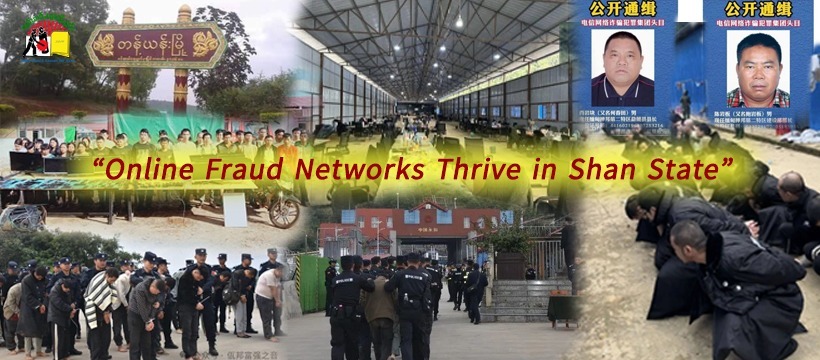
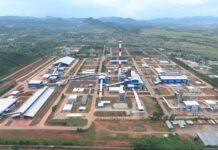
The buildings, made of blue corrugated iron sheets and stacked with earthenware, cover a large area of red soil.
At first glance, they appear to be warehouses for storing corn, a common goods in the region. However, residents of Tangyan say these structures, built in recent months, are used for “online fraud schemes.”
The area was once a rubber plantation owned by the Manpang Militia in Tangyan Township.
“The former rubber plantations have been turned into gambling dens with the use of bulldozers. Ordinary people can’t enter. Only locals are hired for the work, not outsiders. The salary starts at 1,500 yuan (USD 200),” said Sai Win, a Tangyan Township resident.
A monthly salary of 1,500 yuan (USD 200) is significant and mean a lot to local people.
The Operation 1027 launched last year by the Three Brotherhood Alliance in northern Shan State, aimed to crack down on the growing online scamming businesses along the Myanmar-China border. These scams have since spread to militia- and ethnic armed group-controlled areas across Shan State.
Previously, these operations were confined to gambling dens under militia control. But since 2024, Chinese scammers have exploited political instability, paying large sums to militia and ethnic armed groups for safe passage and protection.
“The armed groups bring in the Chinese scammers, charging 10,000 to 50,000 yuan (USD 1,350-6,800) per person. They use military vehicles to transport them to camps. When the political situation gets tense, they move to other places,” explained Sai Htun, a local resident.
In areas formerly controlled by the Manpang Militia in Tangyan Township and along the Salween River, online fraud rings have been active for nearly a year. They lure young people those unemployed with promises of jobs in regions impacted by military conflict.
Locals report that these online fraud operations pay taxes to some officials of the United Wa State Army (UWSA) Brigades 318 and 713 in exchange for security and protection. By agreement with the military council, the UWSA deployed over 2,000 troops to Tangyan Township in July, which is outside the designated territory.
In November, the UWSA arrested nearly 800 Chinese and 300 ethnic youths involved in online scams in Namhu and Peng Kaung villages. On December 2, the UWSA and the Shan State Progressive Party/Shan State Army (SSPP/SSA) arrested around 50 more suspects in Tangyan Township, according to locals.
“The over 700 people arrested in Peng Kaung were handed over to China. They moved to Tangyan to avoid further arrests,” Sai Win explained.
On November 19, the UWSA announced it had handed over 762 Chinese nationals arrested in Tangyan Township to Chinese police through the Pangwaun border gate. Photos showed confiscated items, including 76 Starlink routers, over 1,500 mobile phones, computers, and related equipment.
China’s CCTV reported on November 22, that 69 fugitives from China’s most wanted list were among the 762 suspects handed over. However, doubts remain about the legality of such direct transfers by the UWSA.
Extradition normally involves national governments under bilateral treaties or agreements. A CDM judge explained that only central governments have the authority to extradite suspects. “The military council, not being a legitimate government, makes such actions controversial,” the judge said.
Due to Myanmar’s sovereignty, rule of law is not in place, the judge explained that extradition to China often occurs as transfers through local authorities like the Kokang Army (MNDAA) and United Wa State Army (UWSA). “This is more of a political act than a legal one,” the judge noted, adding that other ethnic armed groups also transfer suspects in coordination with neighboring governments.
In September 2023, the UWSA began handing over Chinese nationals involved in online scams, transferring more than 1,200 suspects to Chinese police since then. This year (2024), they arrested over 400 more and handed them over on at least three occasions.
However, two former UWSA officials wanted by China, Chen Yanban (Bao Yanban) and Xiao Yanquan (Aik Hok), remain at large despite search efforts by armed forces disguised as Chinese police. Chinese police are offering a reward of 100,000 to 500,000 yuan (USD 13,640-68,200) for information and cooperation leading to the arrest of the two officials.
Meanwhile, the military council transferred 10 major suspects, including a former Kokang militia leader and businessmen, to China via Nay Pyi Taw Airport in January 2024. Among them were Bai Suocheng, his son Bai Yingcang, and other prominent figures linked to telecom fraud operations targeting Chinese citizens.
The first joint operation between the Military Council Police and Chinese authorities took place in Muse in March, during which over 50,000 suspected scammers were handed over to China. According to ISP-Myanmar, the Kokang MNDAA handed over 40,000 suspects, while the UWSA, NDAA, and SSPP/SSA handed over 13,000 suspects.
China’s Ministry of Public Security (MPS) launched a crackdown on cybercrime gangs in 2023, planning to work with Thailand and Laos to target Myanmar-based groups. However, these gangs continue to operate, from the Myanmar-China border in the northern Shan State to the Shan State-Thai border.
“These scams are run far from cities and villages, making the armed groups and authorities hard to eliminate. It seems like they’re pretending to cooperate with China while taking bribes,” said Sai Htun, explaining why these operations persist.




Leave a Comments