




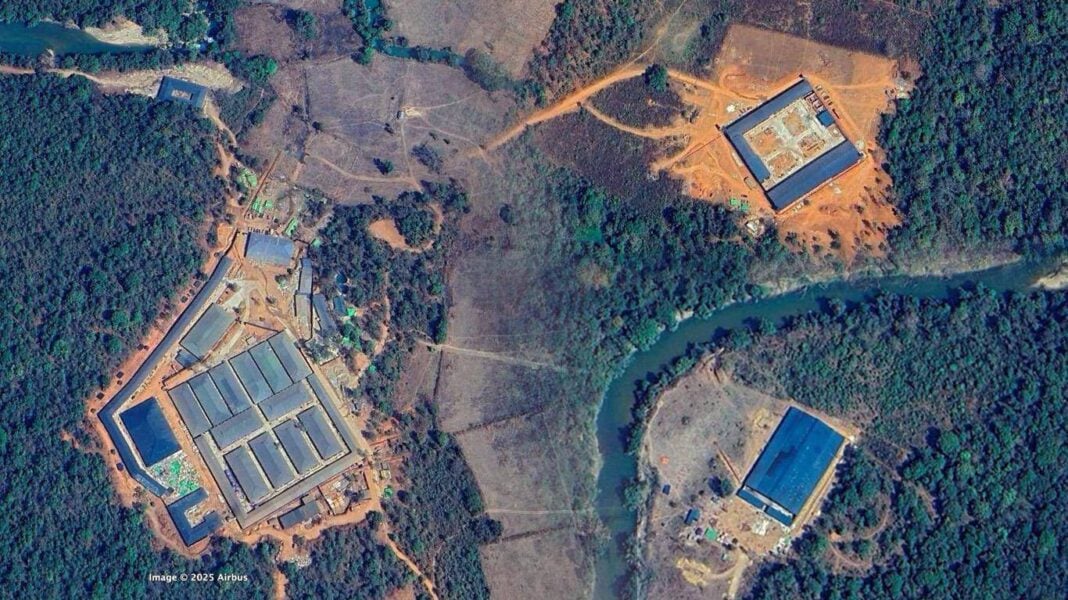
In the war-ravaged hills of Shan State, cybercrime has become a booming underground industry, one that exploits desperation, fuels corruption, and exposes a deepening humanitarian and security crisis in Myanmar.
Known locally by its Chinese name zha pian (诈骗), online fraud has evolved into a sprawling operation involving trafficked workers, armed protection, and high-level complicity. Chinese nationals, many deceived with promises of legitimate jobs, are forced to work in scamming compounds shielded by militias, ethnic armed groups, and corrupt military officials. For a growing number of Shan youth, the scam trade is no longer a crime, and it’s a means of survival.
A Crisis Beyond the Battlefield
Earlier this year, Thai, Myanmar, and Chinese authorities launched joint crackdowns targeting cyber fraud in border towns. The Three Brotherhood Alliance, comprising the Ta’ang National Liberation Army (TNLA), the Kokang Army (MNDAA), and the Arakan Army (AA), also announced as “Operation 1027”, a campaign to dismantle scam centers.
Yet on the ground, these efforts have faltered. In southern Shan State’s Laihka and Mong Kung townships, fraud operations persist under the patronage of pro-military militias. In Wan Pang, a strategic village tract at the intersection of three townships, Chinese-led syndicates frequently relocate to evade raids, often with militia assistance. The area is also under the sway of the Shan State Progress Party (SSPP/SSA).
“They just move from village to village when word gets out,” said a Laihka resident who requested anonymity. “Locals are forced to supply them with food, while authorities turn a blind eye, or take bribes.”
A Shield of Guns and Corruption
In March, Myanmar’s military claimed to have arrested over 700 scam workers in Nam Sang Township. Yet within weeks, the networks resurfaced in Pang Leing (Nammang Area), a village controlled by a Mark Kieng militia near Mong Nai. Locals describe these compounds as fortified enclaves, with Chinese workers confined under armed watch.
“Even when some are arrested, more replace them,” said Sai Lon, a Namsang resident. “It’s a vicious cycle, they bribe the right people, and the business continues.”
Near the Chinese border in Muse, authorities detained 130 individuals, including 41 Chinese nationals, in recent anti-scam raids. Yet witnesses say the operations remain intact, shielded by corrupt officials and armed groups.
“If you want to run a scam center, you pay off officials. If you refuse, they arrest you,” a Muse local revealed. “For young people here, this pays better than farming. They don’t join because they want to, they join because they have no choice.”
A Lost Generation
Shan State’s youth, battered by years of conflict, displacement, and economic ruin, are increasingly ensnared in the scam trade. Many are former farmers or displaced civilians from war-torn regions, left with few alternatives.
“These young people don’t dream of wealth, they just want safety, food, and a future,” said a woman from Hsenwi.
The crisis has even reached Myanmar’s elite. In 2024, authorities arrested former general U Myin Hlaing and Kokang MP Bai Suocheng for alleged ties to scam syndicates, a stark reminder that cybercrime is deeply interwoven with the country’s power structures, both military and ethnic.
A Regional Threat
The fallout extends beyond Myanmar’s borders. In Thailand, lawmakers warn that unchecked cybercrime networks threaten regional security and enable human trafficking.
“Without stronger international cooperation, this won’t stop, and more Thai citizens will become victims,” said Thai MP Rangsiman Rome.
For Shan State’s residents, the issue is not just criminal, it’s existential. Until systemic corruption, poverty, and conflict are addressed, cybercrime will remain a desperate lifeline for thousands with nowhere else to turn.
Noted* Translation by Eugene, adapted from the original Myanmar article by Sai Hseng Leng.










Leave a Comments