




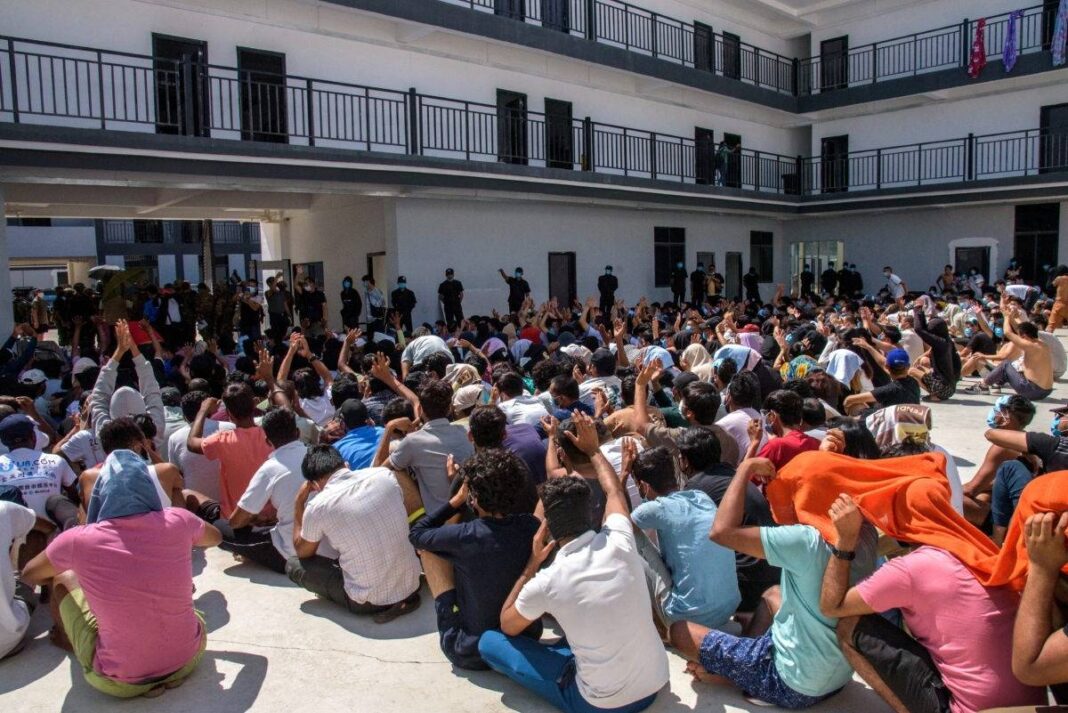
Recent reports of Shan Herald Agency for News and Khit Thit Media on cyberscam and scam center operations have made headlines, raising questions about whether Chinese Foreign Minister Wang Yi’s claim that the illicit trade is being eradicated is credible or just state propaganda aimed at portraying China as in control. Let’s take a closer look and compare it with the reality on the ground.
The Displacement from Border Compounds to Urban Ghost Hotels
The narrative spun by the military junta in Naypyitaw has long been one of a valiant struggle against transnational crime. Following the major offensives of late 2023 and the subsequent “1027 Offensive” campaign, China’s Foreign Minister declared victory, claiming that the notorious scam compounds of the borderlands had been dismantled and the criminal syndicates routed. Yet, the latest reports from August 2026 tell a starkly different story. The scourge of cyber-scamming has not been uprooted; it has mutated. It has fled the exposed border compounds only to burrow deep into the heart of Myanmar’s urban centers, transforming from a localized border nuisance into a sophisticated, decentralized, and deeply entrenched shadow state that now permeates the very fabric of the nation’s economy and security apparatus.
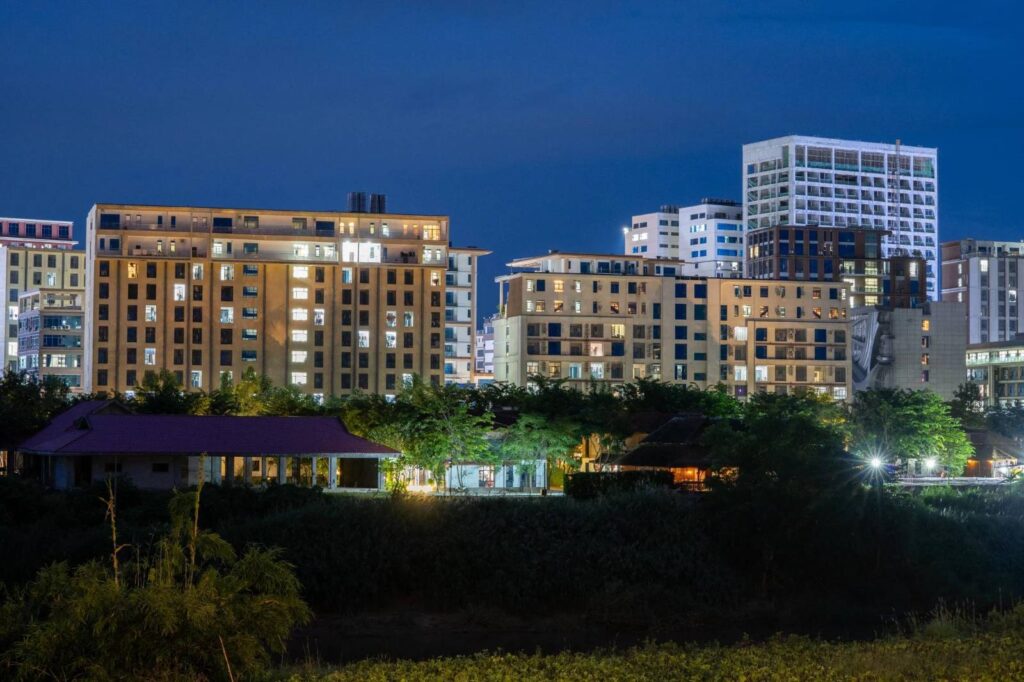
The displacement of these operations from the wilds of Shan State and Karen State to the manicured streets of Yangon is not merely a change of address; it is a strategic evolution. In the borderlands, the old model of massive, walled compounds housing thousands of trafficked workers was a visible target for airstrikes and ground offensives. Today, the industry has adopted a strategy of camouflage. Chinese syndicates, now operating with the blessing of local power brokers, have purchased or leased high-end hotels in Hlaingthaya, Bahan, and Tamwe, turning them into “ghost” compounds. These venues, often bearing the names of legitimate hospitality chains or IT training centers, serve as fronts where the upper floors function as secure, windowless fraud factories. The victims are no longer confined by barbed wire in the jungle but by digital locks and guarded elevators in luxury apartments, while the illicit funds are laundered through the purchase of real estate and local business licenses.
The Tatmadaw’s Cynical Charade and Systemic Complicity
This metamorphosis would be impossible without the active, indispensable participation of Myanmar’s entire armed ecosystem. The notion that these criminal enterprises operate in a vacuum, outside the control of the state or its rival factions, is a dangerous fallacy. The reality is that the scam economy has become the lifeblood of the country’s fragmented military landscape, binding together the junta, ethnic armed organizations, and private militias in a web of mutual benefit and complicity.
The Tatmadaw, or Myanmar Army, and its affiliated militias are not merely bystanders to this crisis; they are architects and beneficiaries. The central government’s public posturing as the sole defender against organized crime is a cynical charade. The military’s own command structure has long been entangled with the very networks it claims to fight. In border regions, the army has historically provided the “protection” that allowed these compounds to thrive, often in exchange for a significant share of the profits. Even as the regime publicly raids a few low-level compounds to appease international pressure, the upper echelons of the military continue to reap the rewards of the wider network. The seizure of over 140 Starlink terminals in eight months is a testament to the industry’s resilience, but it also highlights the military’s selective enforcement, targeting only those operations that have failed to pay their “taxes” or those that threaten the regime’s diplomatic standing.
The Militia Network: Security, Lodging, and Profit-Sharing
The complicity extends far beyond the junta’s regular forces. The ethnic armed organizations (EAOs) and the various ethnic resistance organizations (EROs) have found themselves in a complex, often contradictory position. While some resistance groups have publicly condemned the scam industry, the economic reality on the ground has forced many into a pragmatic, if not direct, involvement. In many contested border areas, the EAOs provide the security and the logistical space necessary for these operations to continue. Without the tacit approval or direct protection of these groups, the large-scale trafficking and confinement of workers would be impossible. The revenue generated from these scams has become a critical funding source for the ongoing civil war, creating a perverse incentive where the continuation of the conflict ensures the continuation of the criminal economy.
Particularly disturbing is the role of the militia groups that remain loyal to or allied with the military junta. Groups such as the Democratic Karen Benevolent Army (DKBA), the Border Guard Force (BGF) and the Karen National Army (KNA) led by the controversial Bo Chit Thu, have been identified as key facilitators in this new era of urban infiltration. These militias, often operating in the buffer zones between government and resistance territory, have leveraged their local influence to provide the security, lodging, and administrative cover for scam syndicates. In some cases, they have moved beyond simple protection rackets to become direct profit-sharing partners. The DKBA and BGF, for instance, have been instrumental in facilitating the movement of workers and the laundering of funds, using their control over local checkpoints and administrative zones to shield operations from scrutiny. The involvement of these groups, which are ostensibly part of the state’s security architecture, underscores the depth of the corruption that now defines the Myanmar conflict.
The Urban Infiltration: From Border Lawlessness to Yangon’s Elite Neighborhoods
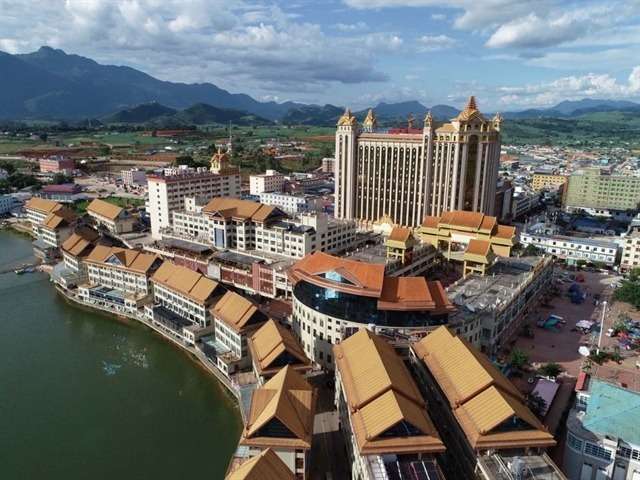
The recent migration of these operations into Yangon, the country’s economic capital, signals a dangerous new phase. The syndicates are no longer content with the lawless borderlands; they are embedding themselves in the heart of the nation’s most affluent neighborhoods. They are buying up luxury apartments, establishing front companies, and bribing local administrators, police, and neighborhood watch leaders to turn a blind eye. The reports of Chinese nationals paying hundreds of thousands of dollars for local business licenses and the presence of rigged casinos in the upper floors of Yangon hotels are not isolated incidents. They are symptoms of a system where the line between legitimate business and organized crime has been completely erased.
According to a Yangon-based business community, some Chinese citizens who previously held (ID code number) 3/ registrations from Karen State and 13/ registrations from Shan State have been exchanging them for Yangon Region-based 12/ registrations and census records by paying large sums of money. Many of these individuals, who don’t even speak Burmese, are reportedly involved in the tiger trade and have obtained 12/ registrations and census records from Yangon’s outskirts, such as Htan Tabin, Shwe Pyi Thar, Hlaing Tharyar, and Dagon Myothit. They have now registered as hotel owners and businessmen under these 12/ registrations, reported Khit Thit Media recently.
This pervasive involvement of all armed factions creates a paradox that makes the eradication of the scam industry nearly impossible. The very institutions tasked with enforcing the law are the ones profiting from its violation. The Min Aung Hlaing government, in its desperate attempt to maintain a veneer of legitimacy, has launched performative crackdowns that target only the most visible or uncooperative elements of the network. These raids serve as a pressure valve, releasing just enough steam to satisfy international observers while leaving the core of the operation intact. The government’s reliance on the revenue from these illicit activities to fund its war effort and sustain its crumbling economy means that it has no genuine incentive to dismantle the system.
The Future of a Narco-Scam State
Looking ahead, the trajectory for Myanmar is bleak. The scam industry is no longer a temporary aberration; it is a structural feature of the country’s political economy. In the near term, we can expect the operations to become even more sophisticated, utilizing advanced technology and deeper local integration to evade detection. The “ghost hotels” will multiply, and the rigged casinos will become more common, further eroding the social fabric of urban centers. In the long term, the country risks becoming a permanent “narco-scam” state, where the economy is inextricably linked to criminal enterprise, and the armed forces, both government and non-state, are locked in a cycle of violence fueled by illicit profits.
The path to a solution requires more than just military raids or international pressure. It demands a fundamental reckoning with the role of all armed organizations in the country’s illicit economy. As long as the Tatmadaw, the militias, and the EAOs continue to view the scam industry as a vital source of revenue, the problem will persist. The myth of the “clean sweep” must be exposed for what it is: a lie told by a regime that is deeply complicit in the very crime it claims to fight. Until the political and economic incentives that drive this shadow state are addressed, Myanmar will remain a haven for cyber-criminals, and its people will continue to pay the price for the greed of their leaders.








Leave a Comments