



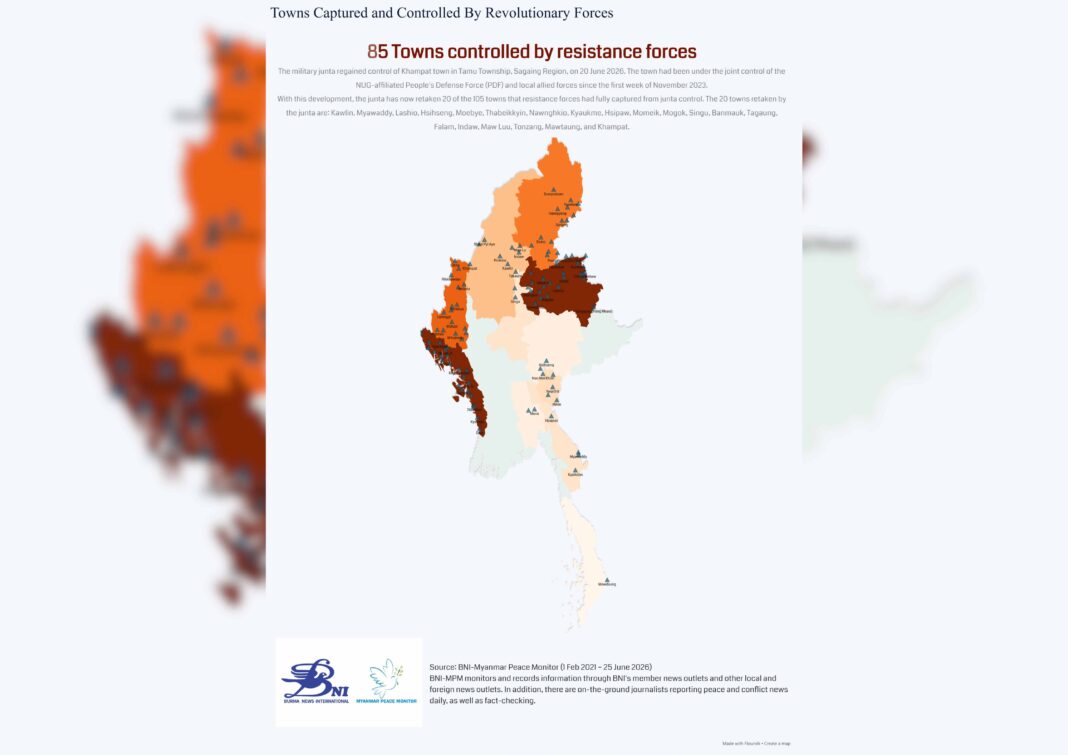
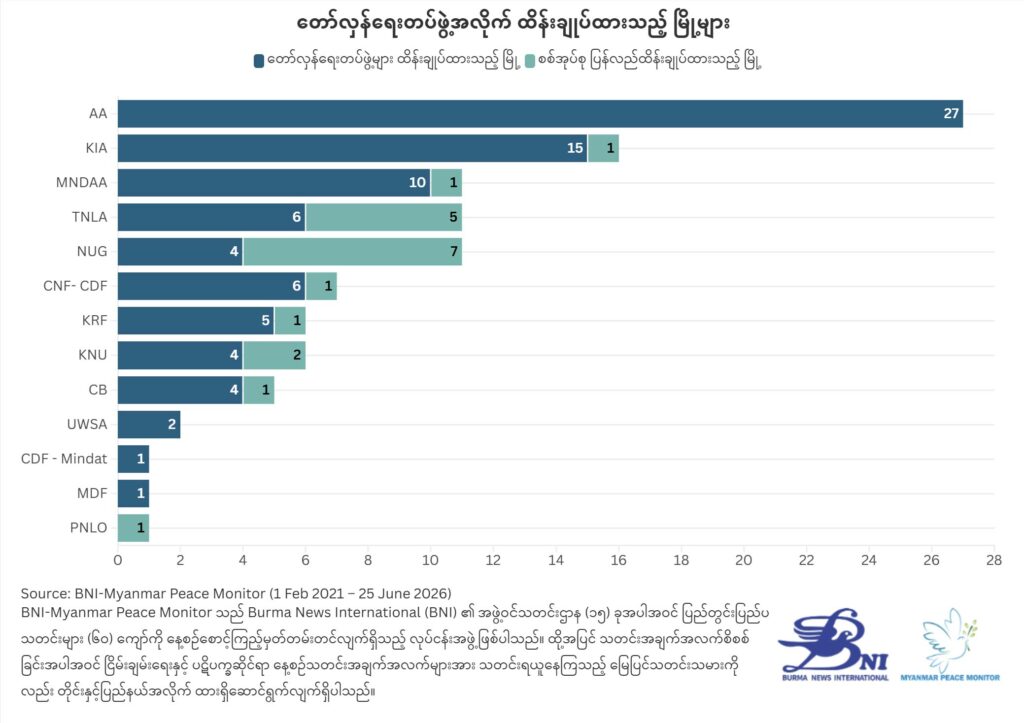
On June 24, Thanlwin Times reported that the Myanmar military has regained control of at least 20 strategic areas, including key hubs like Falam, Lashio, Myawaddy, Kyaukme, and Tagaung. This figure is often contextualized by the Burma News International (BNI) and Myanmar Peace Monitor (MPM), which estimate that approximately 87 towns remain under the control of anti-junta forces as of May 15, 2026. When framed against the roughly 100 towns captured by resistance groups since the onset of “Operation 1027” in October 2023, pro-junta narratives—echoed in video podcasts by Burma News Network and various media —have declared a “one-fifth” recapture rate as evidence of a decisive shift in momentum. The prevailing headline suggests the Burma Army or Tatmadaw is turning the tide of the civil war, reclaiming the initiative, and signaling a resurgent army.
However, a deeper examination of battlefield dynamics, corroborated by independent conflict monitors, reveals that this narrative is largely a propaganda-driven illusion. The junta’s apparent momentum is not a strategic comeback but a tactical repositioning designed to mask a broader stalemate and cover deep-seated weaknesses in the central heartland and the northern frontier.
The Data: A Limited Rebound, Not a Comeback
To understand the reality behind the headlines, one must weigh the sources. The strongest support for the “momentum” narrative comes from the Armed Conflict Location & Event Data (ACLED) project, which notes that the military reversed some resistance gains in 2025 through intensified airpower, drone warfare, and “divide-and-rule” tactics. However, even ACLED stops short of calling this a turning point.
In contrast, more cautious and comprehensive analyses suggest a quagmire. The Council on Foreign Relations (CFR) acknowledges localized gains, such as the recapture of Kyaukme, but concludes that the war remains a stalemate where neither side can achieve a major breakthrough. The Bertelsmann Stiftung Transformation Index (BTI) and the International Institute for Strategic Studies (IISS) offer an even starker view: while the junta retains air superiority and can contest large areas, it has failed to restore nationwide control. IISS reports from 2025 and 2026 emphasize that the regime’s “advances” are often brutal, localized counter-offensives that fail to translate into lasting political or strategic dominance. The consensus among analysts is clear: the junta has achieved a limited military rebound, but not a strategic resurgence.
The “Town-Holder” Strategy vs. Rural Reality
The core of the junta’s “success” relies on a costly, specific tactic: the recapture of urban centers and trade corridors through overwhelming aerial bombardment and artillery. In the Dry Zone regions of Sagaing, Magway, and Mandalay, as well as parts of Chin State, resistance groups (PDFs and local alliances) have indeed withdrawn from major towns like Thabeikkyin, Tagaung, and Falam.
This retreat, however, was often a tactical necessity rather than a strategic defeat. Holding static urban positions against the junta’s intensified airstrikes, drone attacks and artillery bombardments became untenable, resulting in high civilian casualties and the destruction of infrastructure. By retreating, resistance forces have effectively traded territory for survival, shifting to guerrilla warfare in the countryside. They have abandoned the “dots” (towns) to preserve their fighting forces while retaining control over the “canvas”—the rural townships, forests, and mountain ranges where the junta cannot project power.
The junta may fly its flag over a recaptured town hall, but it often cannot secure the roads leading to it, nor does it control the surrounding villages where the resistance blends into the population. In the Mandalay region, for instance, while the military has retaken Tagaung, resistance forces continue to launch raids, disrupt supply lines, and maintain a fierce presence in the hinterlands. The “victory” is thus an administrative shell, not functional control.
The Northern and Western Fronts: A Defensive Stalemate
The narrative of a nationwide junta resurgence crumbles when examining Arakan (Rakhine), Kachin, and Karenni (Kayah) states, where the military is demonstrably on the defensive.
* Arakan State: The Arakan Army (AA) controls nearly the entire state, including the strategic port city of Kyaukphyu and the capital, Sittwe (where the junta holds only a small, besieged pocket). The AA has expanded its operations into Magway, Sagaing, Ayeyawaddy, and Bago regions, effectively cutting junta supply lines. The junta’s recent attempts to retake territory have been rebuffed, forcing them to seek China’s mediation for a ceasefire rather than launching new offensives.
* Kachin State: The Kachin Independence Army (KIA) maintains firm control over key economic zones, including the jade mining hub of Hpakant and the Rare Earth Elements (REE) belt in Pangwa. Despite junta efforts, the KIA has not been dislodged from these strategic areas. The military is struggling to secure the Bhamo corridor and remains bogged down in a defensive posture along the Chinese border.
* Karenni State: The siege of Loikaw continues, with the Karenni National Progressive Party (KNPP) and allied forces holding significant ground. The junta has not achieved a decisive breakthrough to break the siege or retake the state capital.
In these regions, the junta is not “gaining momentum”; it is holding the line against a determined and capable opponent. Any “counter-offensives” here are limited, localized, and often repelled. The claim of momentum is a selective truth, highlighting gains in the central regions while ignoring the losses and stalemates in the periphery.
The Propaganda Machine: Why the Illusion?
Why, then, does the junta insist on this narrative of success? The answer lies in political survival and external legitimacy.
- Domestic Legitimacy: With the “100 Days Peace Initiative” and the staged elections of 2025–2026, the junta needs to project an image of stability and control. Acknowledging the loss of the countryside and the strength of the resistance would undermine its claim to be the sole legitimate authority.
- International Relations: China and other regional powers are more likely to engage with a regime that appears to be “winning” or at least stabilizing the country. A narrative of momentum helps secure continued military and economic support, particularly from Beijing, which prioritizes border stability over democratic ideals.
- Morale and Conscription: The junta has relied on a massive conscription drive to replenish its ranks. A narrative of victory is essential to maintain morale among conscripts and to justify the continued sacrifice of lives for a cause that many soldiers and civilians view as lost.
The Cost of “Victory”
The cost of these “victories” is astronomical. The recapture of towns like Falam and Myawaddy has come at the price of massive civilian displacement, the destruction of infrastructure, and widespread human rights abuses. The junta’s reliance on air power and artillery has turned many towns into rubble, making long-term administration impossible. Furthermore, these “victories” are often temporary. History has shown that the junta can retake a town, but it rarely holds it for long without a permanent ground presence—a capability it lacks due to manpower shortages and the resilience of the resistance.
Conclusion: A War of Attrition, Not a Turning Point
The junta’s claim of gaining momentum is a half-truth. It is a tactical illusion created by the recapture of urban centers in specific regions, while the broader strategic picture remains one of stalemate and attrition. The resistance has adapted, shifting to guerrilla tactics that neutralize the junta’s conventional strengths. The military controls the towns, but the resistance controls the countryside, the border regions, and the narrative of the future.
The “one-fifth of towns” figure is a statistical reality, but it is a misleading metric of overall success. It ignores the loss of strategic depth, the erosion of legitimacy, and the resilience of the resistance. Until the junta can address the root causes of the conflict and offer a genuine political solution, its “victories” will remain hollow, and its momentum will continue to be a propaganda tool rather than a reflection of reality. The war is far from over, and the junta’s current gains are merely a pause in the resistance’s advance, not a decisive turning point.


Leave a Comments