
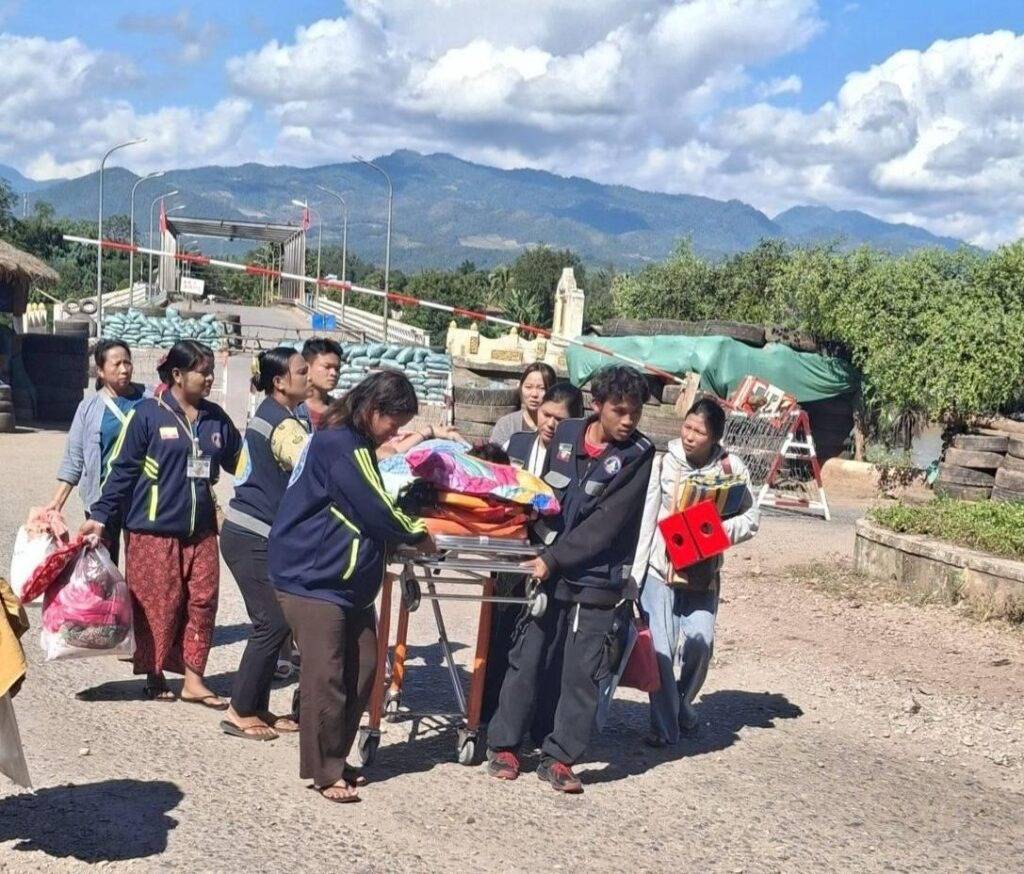
The bridge linking the towns of Hsipaw and Lashio has remained closed by Myanmar’s military junta for nearly eight months, forcing residents to rely on dangerous and costly alternatives for daily travel and emergency medical care.
The bridge has been closed to all motor vehicle traffic since Nov. 14, 2025, following the collapse of negotiations over territorial control between junta forces and the Myanmar National Democratic Alliance Army (MNDAA).
“The bridge is still closed. Vehicles cannot pass through,” a Hsipaw resident told SHAN. “People are still forced to walk across, and patients have to be carried on foot. Some people are relying on small boats to cross.”
The prolonged closure has placed a heavy financial burden on local residents. With the main transport route cut off, travelers have been forced to use private ferry services, where crossing fees exceed 10,000 kyats per person and 20,000 kyats for a motorcycle.
“It has been closed for nearly eight months,” the resident said. “We really want it to reopen. If the bridge were operational, it would make travel and work much easier. Everyone hopes the situation will be resolved, but as long as the bridge remains closed, the public has no say.”
Although both the junta and the MNDAA initially imposed restrictions along the route, the MNDAA withdrew its checkpoint personnel on Jan. 2, 2026. Despite the withdrawal, the military junta has continued to block the bridge, stationing troops at the site and prohibiting all vehicular traffic.
The crisis began after the junta sought to reassert control over the region. During negotiations held in Lashio in November 2025, the junta demanded that the MNDAA withdraw from key sections of the Union Highway, including the Hsipaw–Lashio and Lashio–Mongyai routes. When the talks failed, the military standoff escalated, leading to the indefinite closure of the bridge and highway.
For residents of Hsipaw, the bridge is more than just a piece of infrastructure—it is a vital lifeline. Locals continue to urge the authorities to lift the blockade immediately, restore the movement of people and essential goods, and ensure uninterrupted access for patients requiring emergency medical transportation.

Leave a Comments