



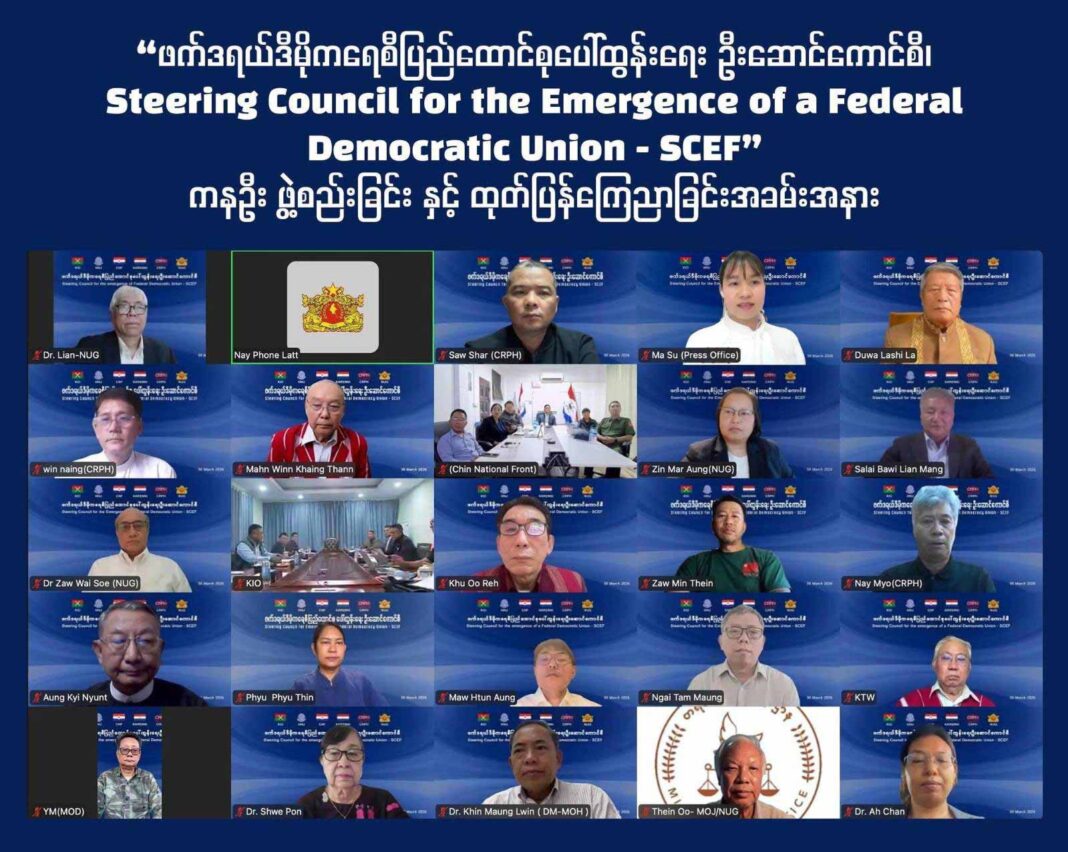
In a recent interview with Khit Thit Media’s “People to People” program, Dr. Zaw Wai Soe, Coordinator of the Steering Council for the Emergence of a Federal Democratic Union (SCEF) Secretariat, said: “SCEF has formed a Military Strategic Cooperation and Command Committee. The committee is currently led by ten military leaders from the various organizations that are fighting. SCEF is not a political document; it is a collaboration. As I said earlier, there has never been a single implementation command and strategic aim for the entire country. In the past we could only declare a common understanding. Now we are working together.”
Dr. Zaw Wai Soe, who also serves as a federal minister in the National Unity Government (NUG), announced that SCEF will pursue a more proactive diplomatic strategy. The newly formed SCEF—comprising the Kachin Independence Organization (KIO), Karen National Union (KNU), Chin National Front (CNF), Karenni National Progressive Party (KNPP), and the NUG—is coordinating with ASEAN and preparing engagement with Canada, the EU, China, and India.
Established on March 30, 2026, SCEF aims to unify the resistance’s previously fragmented foreign policy. Dr. Soe said that where ethnic groups and the NUG once issued conflicting statements—“two or three voices”—SCEF now presents a single, unified position. This consolidation has enabled the resistance to submit coordinated inputs to ASEAN, helping to sustain the bloc’s critical stance toward the military junta.
Planned diplomatic priorities include:
- Launching an advocacy campaign in Canada to represent the resistance;
- Strengthening ties with the EU beyond what the NUG could achieve alone;
- Engaging directly with China and India to explain conditions on the ground and increase international pressure on the regime.
Dr. Soe emphasized that SCEF’s unified structure allows for a more accurate assessment of the situation and a stronger diplomatic push than the NUG acting alone.
The current political landscape
The contest for control of territory and international legitimacy is now primarily between two blocs: the military-dominated, quasi-civilian regime headed by Gen. Min Aung Hlaing, and SCEF—a coalition of four major Ethnic Armed Organizations (EAOs) and the NUG/People’s Defense Force (PDF). Not formally aligned with SCEF are the United League of Arakan/Arakan Army (ULA/AA) and the Spring Revolutionary Alliance (SRA), a newly formed coalition of many smaller armed groups that has not yet been fully integrated.
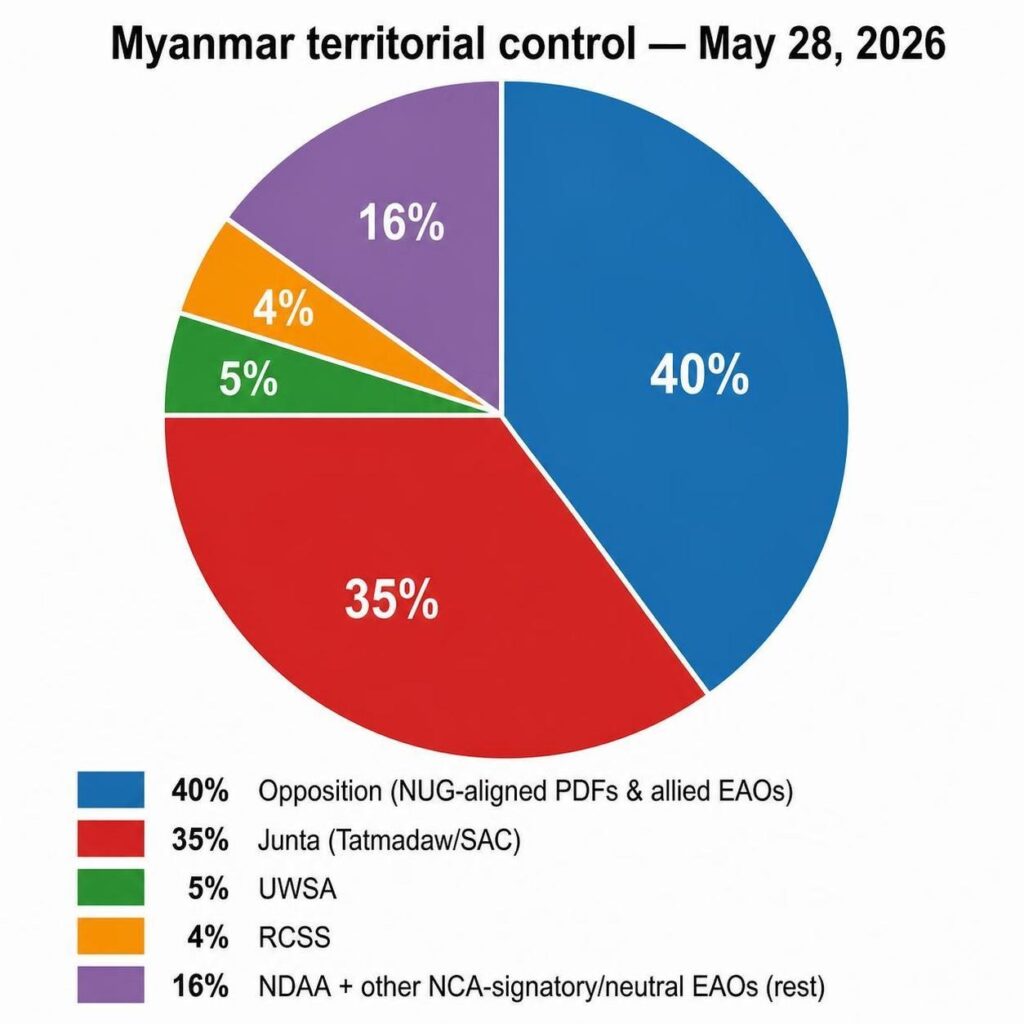
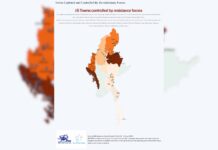
Open-source estimates of territorial control in Myanmar as of May 2026 indicate roughly:
- 40% Opposition (NUG-aligned PDFs and allied EAOs)
- 35% Military junta (Tatmadaw / Min Aung Hlaing regime)
- 5% UWSA
- 4% RCSS
- 16% Other NCA-signatory or neutral EAOs and remaining areas
The junta has amplified rhetoric about battlefield gains, claiming it can rout anti-military forces and retake lost territory. While the regime has addressed some of its weaknesses—such as enforcing conscription to boost manpower and improving drone use and logistics—it remains far from reasserting full control. With backing from China and Russia, the junta has made advances in parts of the central region (the historic Bamar heartland: Magway, Mandalay, Sagaing) and northern Shan State. Severe economic hardship has also raised doubts among the diaspora and domestic population about the resistance’s ability to deliver immediate stability. Nevertheless, the regime is not close to regaining all lost territories.
Anti-military forces continue to control more than 80 towns. Richard Horsey, a senior official at the International Crisis Group, noted in a BBC Burmese Service interview on May 16, 2026, that battlefield conditions vary widely by region. He said anti-junta forces are doing well in some areas—especially Rakhine—while the military holds advantages in parts of the central region and has reclaimed some towns and roads lost during Operation 1027 (2024–25), sometimes with direct or indirect support from China. “One cannot make a single characterization of the ongoing battlefield situation,” he added.
As of late May 2026, the international community remains divided over Myanmar’s leadership, producing a complex geopolitical stalemate. Western democracies—the United States, the EU, Canada, and Australia—have pursued isolationist measures: sanctions, refusal to recognize junta elections, and political backing for the NUG through resolutions and outreach. While the NUG lacks formal recognition from major powers, it has secured significant moral and political support from these states.
By contrast, China and Russia provide political cover at the UN, facilitate arms transfers, and shield the junta from certain international pressures. Regional neighbors such as India and Pakistan, and ASEAN members including Thailand, Vietnam, and Laos, have taken transactional approaches—maintaining diplomatic channels to manage border security, refugees, and trade—effectively granting the regime limited de facto legitimacy. ASEAN, Bangladesh, and Singapore occupy a middle position, publicly calling for dialogue and condemning abuses while hesitating to fully isolate the junta for fear of regional instability. This fragmentation ties Myanmar’s internal conflict to shifting international alliances and battlefield dynamics.
Priority-setting for SCEF
Despite optimistic announcements, SCEF must prioritize actions that energize its thrust and meet the people’s aspirations. Battlefield success and political-diplomatic gains are strategic priorities that are closely linked.
AA participation is widely seen as essential to military success. Although de facto collaboration between the AA and SCEF exists, more is needed to increase momentum. The main sticking points are:
- Tactical cooperation, not ideology: The AA’s cooperation with SCEF is often situational rather than based on shared ideology.
- Autonomy: The AA insists on maintaining its own command structure and decision-making authority; it does not take orders from the NUG or SCEF.
- Rakhine focus: The AA prioritizes the liberation of Rakhine State. Cooperation with other groups is often instrumental to that aim rather than a commitment to a unified national revolution or federal union. Given its history as an independent kingdom, the AA may prefer confederation or, less realistically, full independence; confederation is the more viable option under current international norms.
- China factor: The AA’s relationship with China is more nuanced than that of other EAOs. China has pressured some groups to stand down, yet the AA has preserved autonomy, likely due to its strategic position and control of the Bangladesh border. Beijing’s perception of SCEF and the NUG as pro-Western may make China reluctant to see the AA fully integrate into SCEF.
How SCEF might respond
A revised cooperation model is advisable. Rather than pressing for full political integration, a “SCEF + AA” approach—focused on coordination in military operations, diplomacy, and logistics—may be more effective. Such an arrangement would:
- Combine forces to defeat the military junta;
- Preserve the AA’s autonomy and political vision;
- Lay groundwork for a future “asymmetrical federal union” that accommodates AA aspirations for self-determination.
A flexible alliance—allowing the AA to retain independence while partnering on immediate shared objectives—can deliver tangible results now. This model could also incorporate the Spring Revolutionary Alliance (SRA), an umbrella of roughly 19 smaller and several larger revolutionary groups.
Conclusion
The Myanmar resistance is at a critical inflection point. The formation of SCEF has unified the diplomatic voice of the NUG and major EAOs. To achieve decisive military victory and ensure a stable post-junta transition, the resistance should integrate the AA—and possibly the SRA—into a cohesive operational alliance under the principle “diverse actions, common goals,” accelerating revolutionary momentum for the benefit of the people and the country.




Leave a Comments