




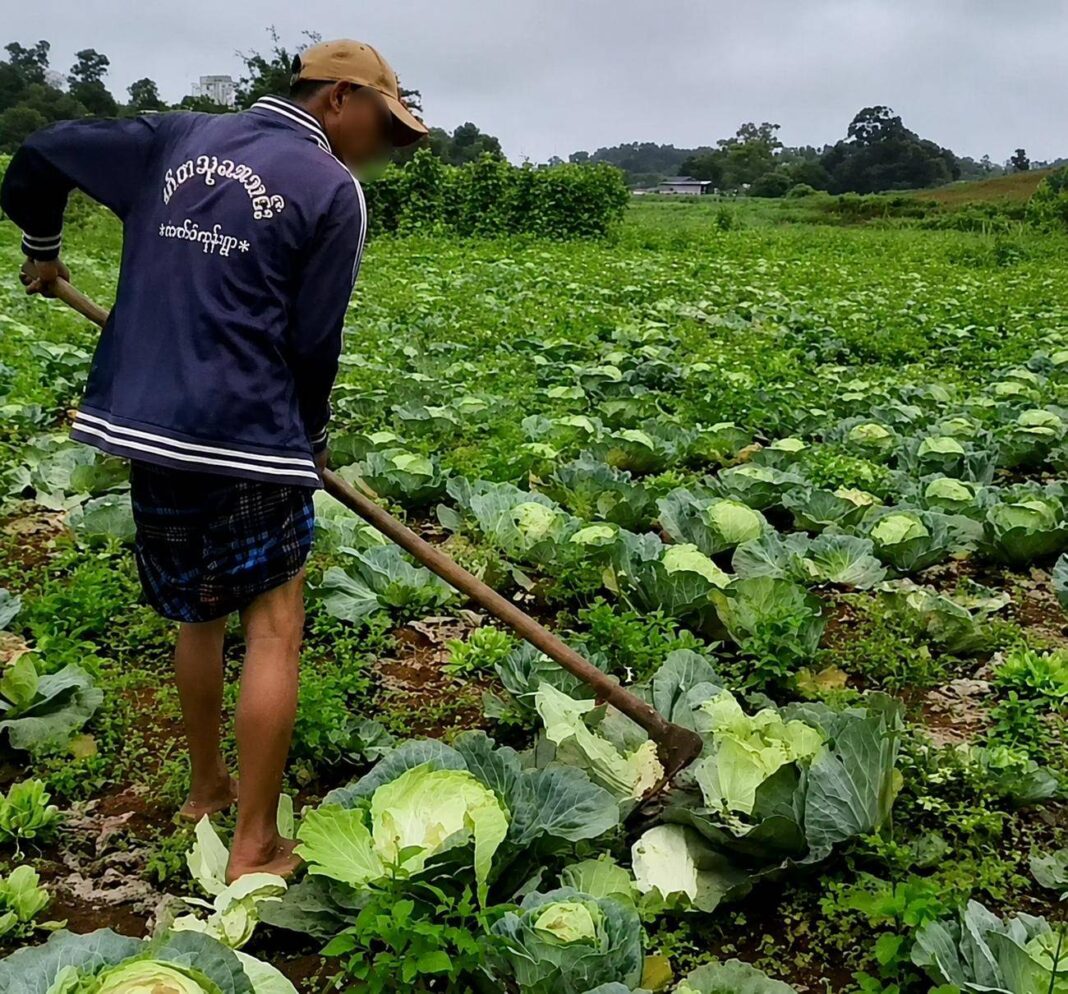
Farmers across southern Shan State are suffering heavy financial losses after cabbage prices collapsed during this year’s harvest season, forcing many to destroy their crops because they can no longer recover production costs.
Farmers in Pangtara (Pindaya), Ywangan, Aungban, and Pang Laung (Pinlaung) townships told SHAN that plummeting market prices, rising transportation costs, and strict security inspections along trade routes have pushed many growers into crisis.
Southern Shan State is one of Myanmar’s main vegetable-producing regions, supplying cabbage, tomatoes, cauliflower, mustard greens, and corn to markets nationwide. Residents said cabbage prices have fallen dramatically, from around 3,000 kyats per head in 2025 to just 300 kyats this May.
The sharp decline has left many farmers unable to cover basic cultivation expenses, including fertilizer, fuel, and transportation costs.
“What can I do with 300 kyats per cabbage? It doesn’t even cover the cost of fertilizer,” a farmer from Pangtara told SHAN. “I can’t recover my investment, so I’m cutting them down and turning them into compost instead. This year has been extremely difficult. I don’t even want to plant anymore.”
Farmers said transportation restrictions and security checkpoints along major trade routes have worsened the situation. Lengthy delays reportedly cause vegetables to spoil before reaching markets, allowing wholesale buyers to further reduce purchase prices.
Some farmers have attempted to sell small quantities in local markets or donate vegetables to internally displaced persons (IDPs), but many say most of their harvest has become economically worthless.
Similar reports have emerged from Ywangan and Aungban, where some farmers have already begun clearing cabbage fields to switch to corn or peanuts in an effort to reduce future losses.
In Pang Laung Township, farmers are also grappling with flood damage after heavy rainfall on May 23 inundated corn, cabbage, and tomato fields.
“Runoff from the mountains flooded our farms,” a resident told SHAN. “Even the cabbage that survived has no market value. Farmers are exhausted. We have no capital left, and people are already worried about how they will survive next year.”
Residents noted that although crop prices fluctuated in 2025, many farmers remained financially stable because tomato prices remained strong. Encouraged by those returns, many expanded tomato cultivation this year.
However, farmers say worsening political instability, tighter security measures along transportation routes, rising fuel prices, and increasingly unpredictable weather are making agriculture increasingly unsustainable across southern Shan State.






Leave a Comments