



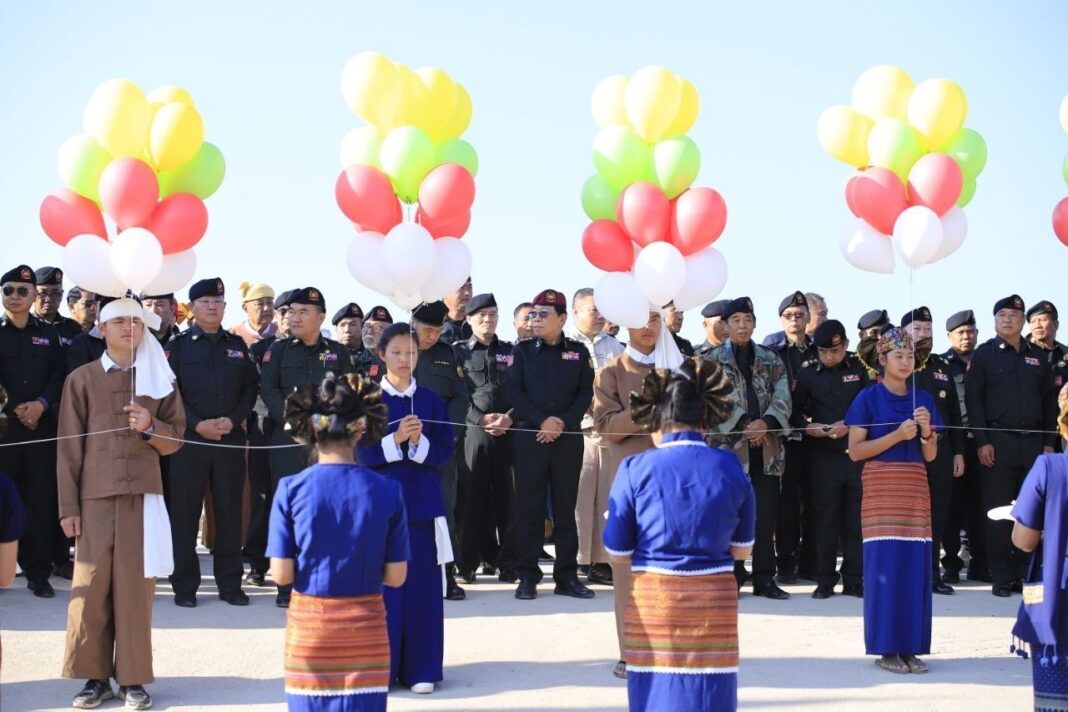
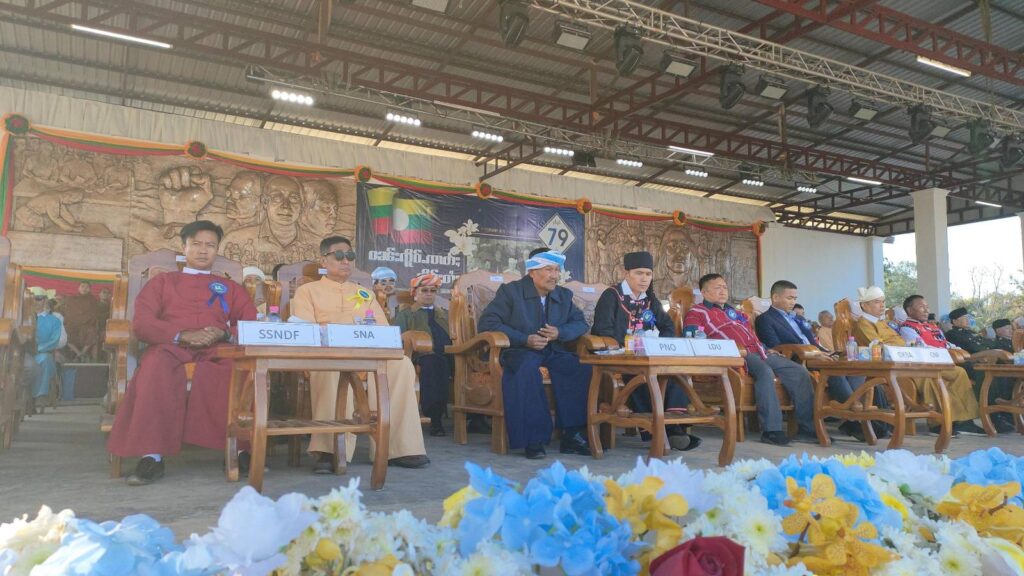
Once again it is the 79th Shan National Day and as usual we are reminded on how far we have come as a non-state nation, within the Union of Burma as a component, or rather how deep have we fallen from our original founding of Shan nation and protection of its sovereignty.
Shan National Day was promulgated to be on 7 February 1947, which demonstrated the unity of Shan princes and the people’s representatives of the Federated Shan States and declared, followed by the resolutions of “Shan National Anthem”, “Shan National Flag” and the formation of “Shan State Council” on the 11th and 15th of February, 1947 respectively.
It is important to take into account that the documentation and birth of the Shan nation is signed by a Palaung Twangpeng Saohpa or Sawbwa Khun Pan Sing, who was President of the Council of Shan State Saohpa, on the 11th February 1947.
The Panglong Conference that followed on 12th February 1947 produced the Panglong Agreement between the Bamar or Burmese State (Ministerial Burma) represented by Gen Aung San and the ethnic nationalities Chin, Shan and Kachin to form a union on equal basis.
It is not an exaggeration to state that without Panglong Agreement or Accord, signifying the intent and willingness of the free peoples and nations of what could be termed British Indochina, there would have not been born the Union of Burma.
Unsuccessful Nation-building Process
It’s clear that the vision our forefathers had before the 1947 Panglong Agreement—a prosperous, united, multi-ethnic Shan State within the Union of Burma—has not only failed to materialize but has significantly deteriorated.
Years of Bamar-dominated civilian and military rule, driven by a doctrine of Bamar supremacy, have crippled the Shan nation-building process.
Now, rising ethno-nationalism and ethnocentrism within Shan State mean that some groups, like the Wa, Palaung, Kokang, and Pa-O, no longer embrace the shared vision of a common Shan national identity. Instead, daily life is marked by ongoing friction and even open conflict among ethnic groups, each seeking to shape its own distinct state from Shan territory.
While there’s nothing inherently wrong with wanting to elevate an ethnic group’s status to that of a nation, the reality is complicated. Shan State’s people have lived intermingled for centuries, creating a deeply mixed demographic pattern despite some localized enclaves. At its core, Shan State remains a multi-ethnic land.
The real question is whether its ethnic groups will keep competing endlessly over territory or rally behind the shared identity envisioned in 1947. Sadly, current political events suggest the answer is still a firm “no.”
Present Political Situation
Since Operation 1027 began on October 27, 2023, the Ta’ang National Liberation Army (TNLA) and the Myanmar National Democratic Alliance Army (MNDAA), or Kokang, have revealed a narrow focus on ethno-nationalism and territorial expansion, often at the expense of other ethnic groups. This trend also includes the Wa and Pa-O in southern Shan State. The Danu resistance against the military junta is gaining ground, and it wouldn’t be surprising if they too sought an ethnic state-level administration like the Palaung and Wa, though the Kokang have not openly expressed such intentions so far.
Let’s focus on the recent events that have further hindered any chance of harmonious coexistence, making it extremely difficult, if not impossible.
In Hsenwi Township, actions by the MNDAA or Kokang against the Shan/Tai majority, under the banner of freedom and liberation from the junta or Myanmar Army, have sparked concern.
Recent report from SHAN describe the MNDAA’s heavy-handed treatment of the Shan population, including gold mining that destroys biodiversity and degrades the environment, coercive land purchases from locals to grow crops like tissue-cultured bananas for export to China by Chinese companies, forced recruitment into its army, and, finally, various assimilation programs aimed at turning the Shan population into Chinese.
The TNLA has also attempted to undermine the Shan identity by replacing all road signs with entrance signs for towns and villages, and by making the learning of its Palaung language compulsory in schools within its controlled territories as the official language. This has come at the expense of other non-Palaung or non-Ta’ang ethnic groups, leading to high levels of dissatisfaction and resistance, and creating a volatile inter-ethnic conflict.
While the TNLA has recently eased its drive to assimilate other non-Ta’ang ethnic groups after setbacks and withdrawals from several captured areas like Mogok, Nwanghkio, Kyaukme, and others, its desire to expand and integrate non-Ta’ang communities remains strong, continuing in a subtler manner.
Shan State National Conference
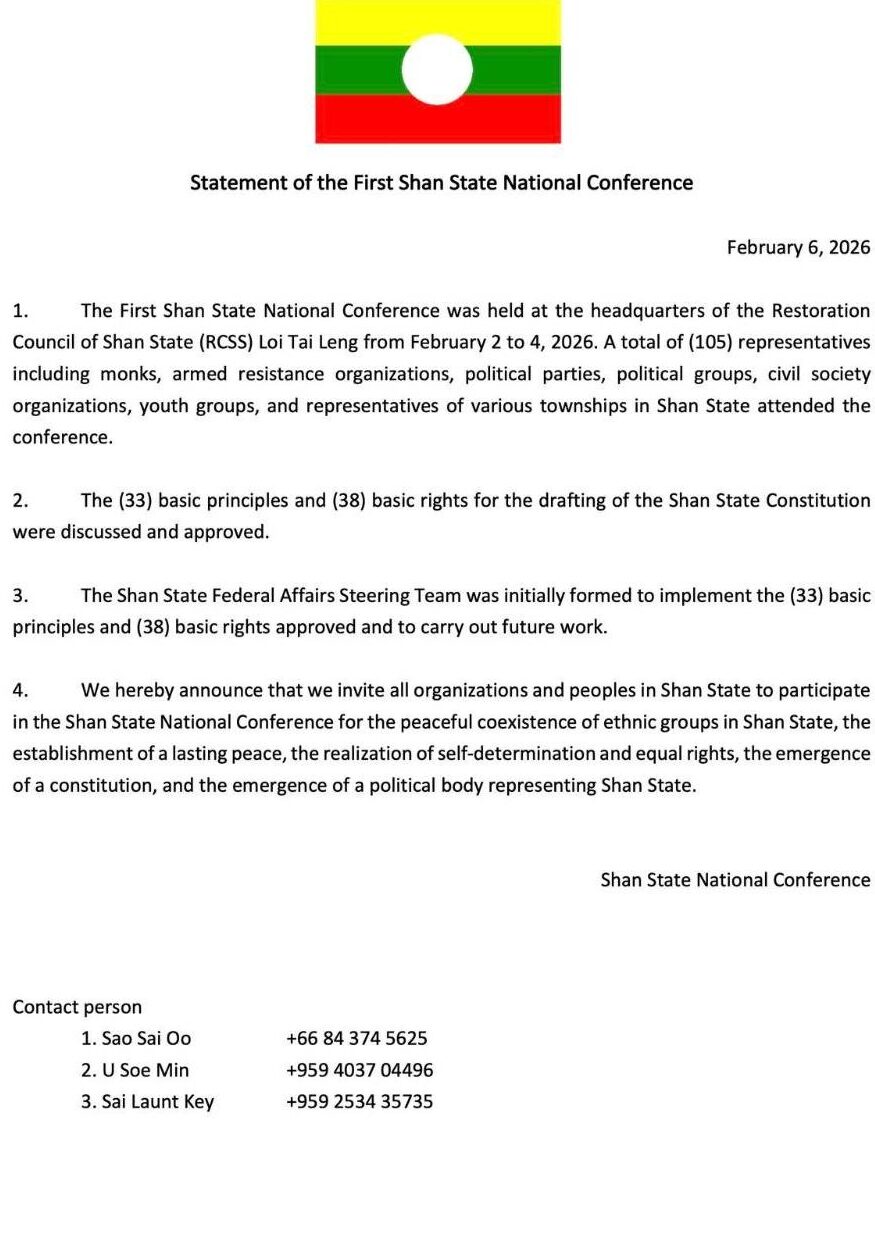
Meanwhile, the RCSS hosted the first-ever Shan National Conference at its headquarters in Loi Taileng, just across the Thai border. A statement released on February 6 highlighted the gathering of over a hundred delegates, including monks, EAOs, political parties, political groups, civil society organizations, youth groups, and representatives from various townships.
The 33 basic principles and 38 basic rights for the drafting of Shan State Constitution were discussed and approved.
The Shan State Federal Affairs Steering Team was formed to carry out the future work of the discussed, agreed principles and basic rights.
The Shan State National Conference statement urged all ethnic groups within Shan State for the peaceful coexistence, establishment of a lasting peace, realization of self-determination and equal right, and the emergence of a constitution and political body representing Shan State.
Outlook
Given the current situation, the Shan nation-building effort hasn’t really gained momentum. This is largely due to the Bamar-centric racial supremacy doctrine embedded within the political and military elite, which has long dominated the governance of the entire union.
Another factor is the rise of ethnonationalism among non-Bamar ethnic groups, who aspire to achieve an administrative state status equal to existing ethnic states like Kachin, Shan, Karenni, Mon, Arakan, and Chin. While everyone has the right to seek greater self-administration through political negotiation based on democratic principles and criteria yet to be established after a democratic government is formed, forceful territorial expansion and “might makes right” belligerence won’t work, which is exactly the issue at hand now.
While the current trend seems to be toward greater fragmentation and disintegration of the Shan political landscape, there’s still hope that a shared national identity, rooted in the idea of “unity in diversity,” could help avoid inter-ethnic conflict. By drawing inspiration from the 1947 Shan State nation-building efforts and pairing it with the right state-building incentives, it may be possible to restore peaceful coexistence and harmonious living.
It all depends on whether the parties involved are ready to work toward a win-win solution to end the inter-ethnic conflict and choose a lasting resolution that benefits all ethnic groups living in Shan State.






Leave a Comments