

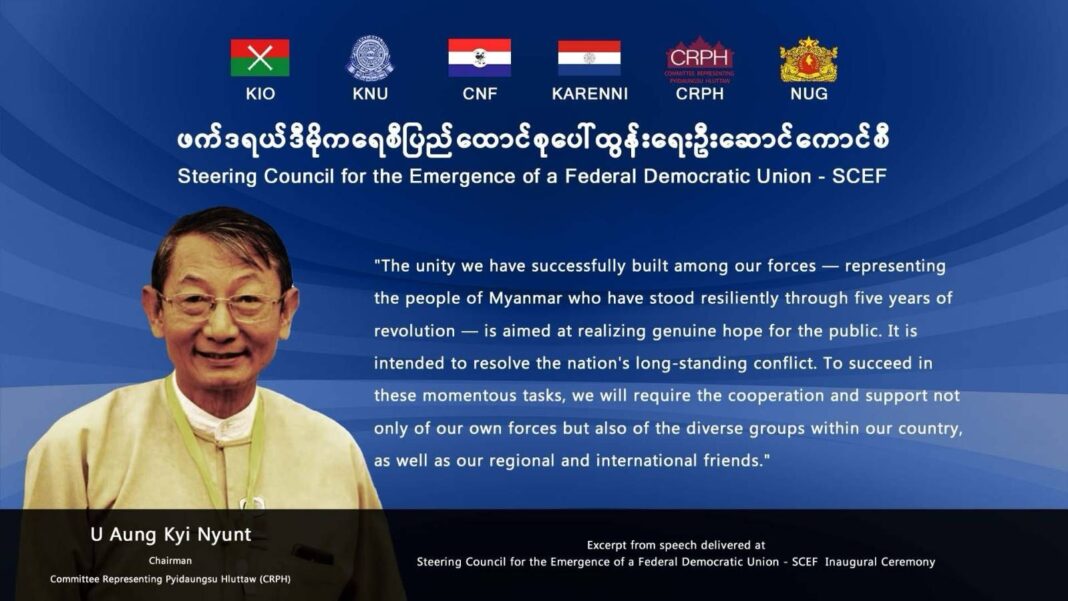
The Steering Council for the Emergence of a Federal Democratic Union’s (SCEF) formation marks a decisive escalation in Myanmar’s resistance landscape, uniting heavyweight political and armed opposition groups to expose and dismantle the junta’s bid to cloak military rule in civilian trappings. As the regime stages a cosmetic transfer of power, SCEF positions itself not merely as an alternative governing force but as the organizational counterweight that can coordinate armed and political resistance, sustain pressure domestically and internationally, and prevent the junta’s legitimacy laundering.
The main forces of the Spring Revolution—the National Unity Government (NUG) and powerful ethnic armed groups—announced late on March 30 the formation of the SCEF, according to multiple media outlets.
Leaders called the move a historic step to accelerate the revolution and build a unified federal military. The council has set six political objectives, the foremost being to permanently end military involvement in politics and place all armed forces under civilian control, NUG Acting President Duwa Lashi La said.
Other objectives include opposing any attempt to reinstate the 2008 constitution, drafting a new federal democratic constitution acceptable to all stakeholders, building a federal democratic union in line with that constitution, and advancing transitional justice for victims of the conflict.
Karen National Union (KNU) Chairman Padoh Saw Kwe Htoo Win, Karenni National Progressive Party (KNPP), Karenni State Interim Administrative Council (IEC) Chairman Khu Oo Reh, Chin National Front (CNF) Chairman Pu Zin Kyung, Pyidaungsu Hluttaw Representative Committee (CRPH) Chairman U Aung Kyi Nyunt, Interim President of the National Unity Government Duwal Sheila, and Union Prime Minister of the National Unity Government Mahn Win Khaing Than delivered speeches, successfully concluding the formation ceremony.
Duwa Lashi La said the effort is “based on the principle of national unity with responsibility and accountability for the emergence of a new federal union.”
KNPP Chairman Khu Oo Reh said the council will seek to fill remaining gaps with other relevant forces that haven’t enter the Federal Steering Council within 60 days. The SCEF will uphold “shared sovereignty” and serve as a closer military and political alliance among ethnic groups.
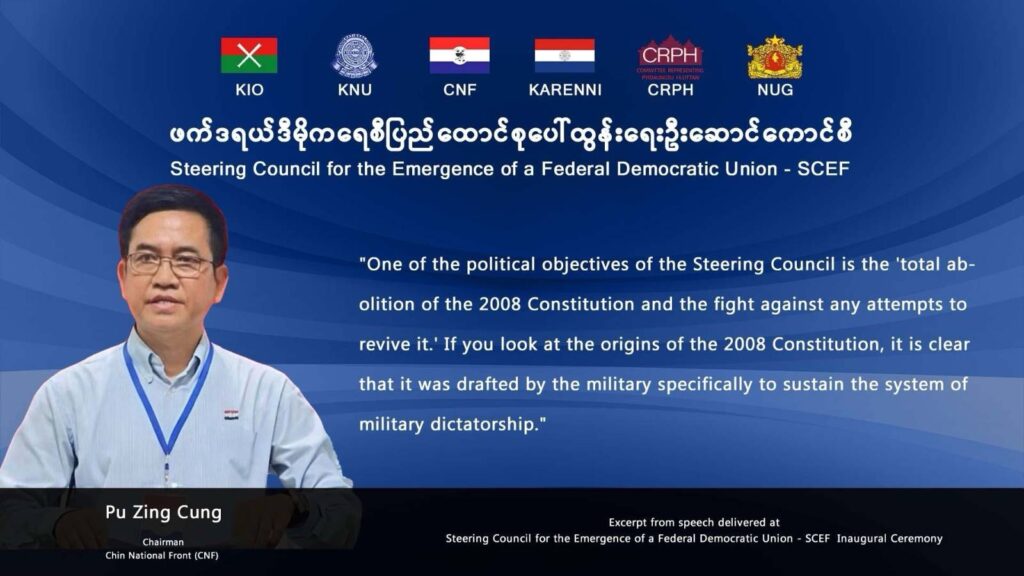
Speakers at the formation ceremony included KNU Chairman Padoh Saw Kwe Htoo Win; KNPP Chairman Khu Oo Reh; CNF Chairman Pu Zin Cung; CRPH Chairman U Aung Kyi Nyunt; NUG Acting President Duwa Lashi La; and NUG Union Prime Minister Mahn Win Khaing Than.
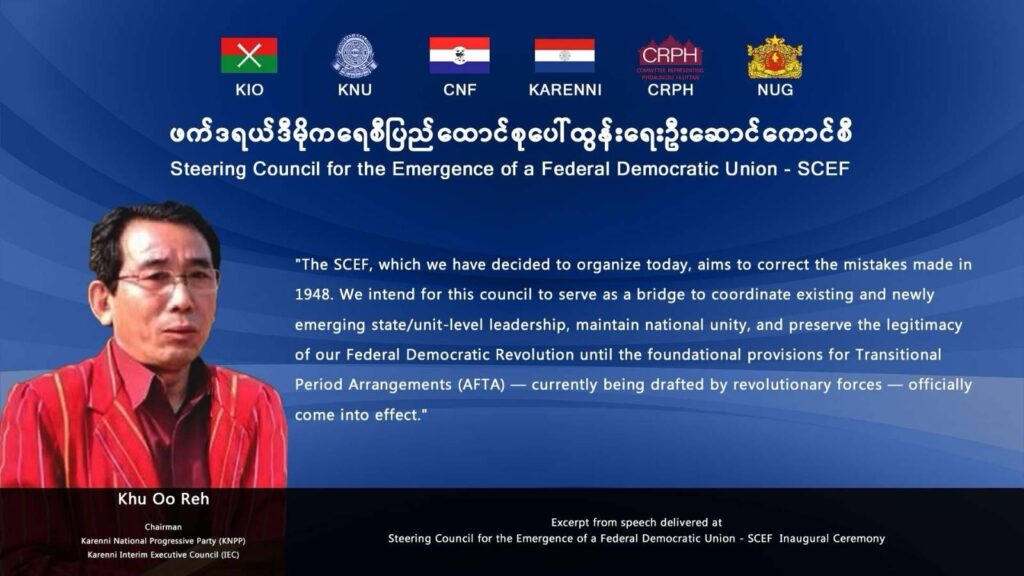
Moreover, the role of SCEF is clearly outlined and spell out by Karenni leader Khu Oo Reh stating: “The SCEF, which we have decided to organize today, aims to correct the mistakes made in 1948. We intend for this council to serve as a bridge to coordinate existing and newly emerging state/unit-level leadership, maintain national unity, and preserve the legitimacy of our Federal Democratic Revolution until the foundational provisions for Transitional Period Arrangements (AFTA) – currently being drafted by revolutionary forces – officially come into effect.”
Khu Oo Reh is Chairman of the Karenni National Progressive Party ( KNPP) and lead the Karenni Interim Executive Council (IEC).
The council initially includes the KIO, KNPP, KNU, CNF,the NUG and the CRPH.
NUCC and SCEF
Meanwhile, people are somewhat confused as the National Unity Consultative Council (NUCC), which is also a sort of united front supposed to be linked to NUG and CRPH came up with an announcement on its near completion of its draft charter.
According to the news, the NUCC, which is composed of the Spring Revolution forces and ethnic revolutionary groups, issued a statement on March 31 to mark the fifth anniversary of the Federal Democratic Charter drafting.
The statement stated that the transitional charter will soon be finalized.
The statement also urged the various forces, including the NUG CRPH NUCC, who pledged to participate in drafting the Federal Charter, to responsibly implement the provisions of the charter.
The Federal Steering Council, which was jointly formed by the NUG CRPH and K3C – an abbreviation of KIO, KNPP, KNU and CNF combined – on March 30, also stated that its goal is to draft a constitution based on federalism and democracy.
According to Khit Thit Media, the SCEF—bringing together ethnic revolutionary organizations (EROs)—was established to address military, political, and international-relations needs, and the NUCC will continue to exist as required, NUCC member U Naung Cho told Khit Thit.
“There are questions about the role of the NUCC following the emergence of the SCEF and whether the NUCC will cease to exist. We see that the nature, responsibilities, and powers of the current Federal Steering Council and the NUCC are not very different. The SCEF emerged according to the revolution’s practical needs: military, political, and international. All political and revolutionary commitments remain in the Federal Democratic Charter, and the NUG’s responsibilities and powers are defined there as well, so the NUCC’s role continues under the charter. This announcement is being released on the fifth anniversary of the drafting and promulgation of the Federal Democratic Charter to clarify these questions,” U Naung Cho said.
However, the role of NUCC will have to be determined one way or the other, by taking into account that it is made up of mostly CSOs with almost no EROs and also only one political party are involved at this present stage.
Minister of Foreign Affairs of the National Unity Government (NUG) on why SCEF was formed told BNN on April 4: “The reason of forming SCEF is in order to implement the common political, military and administrative goals of like-minded (anti-junta) organizations.”
The difference between NUCC and SCEF is that while NUCC is mainly concerned with oversight of FDC and policy matters, the SCEF is more concentrated on practical implementation, especially in military, politics cooperation and implementation, as only gathering policy and opinion from different groups are hardly enough and adequate for the revolution, Zin Mar Aung said.
“Another thing is in administrative level coordination and cooperation of the newly emergence federal units need to be more energized with fusion through negotiations.”
“Thus based on the military, politics and administration issues which we’ve already politically agreed upon, we formed the SCEF with the aim to practically and effectively implement the struggle, which will give more impetus to the revolutionary leadership and unity and strengthen the struggle,” Zin Mar Aung said.
On question of NUCC position after the SCEF formation, NUG Foreign Minister said: “It is like this, the Federal Democracy Charter (FDC) review is in process. But this doesn’t mean we’re replacing the NUCC. It will continue to exist. The continuation of the FDC review process is another part. We’re not undermining the existing organizations but to strengthen the Spring Revolution and to be able to effectively implement the military, politics and administration in unity and solidarity. In addition we’ve consulted with the NUCC and other institutions before we formed the SCEF.”
88 Generation leader Min Ko Naing in People’s Spring interview on April 5 regarding SCEF said: “SCEF is vital to the Spring Revolution. It embodies what the revolutionary people have long demanded and reflects months — even years — of preparation and hard work. We need strong, reliable allies and the ability to lead ourselves; we must demonstrate leadership both militarily and politically. This is the mainstream path: proving with our own strength that this is the only viable way forward.”
“This is not an end but a beginning. SCEF has opened the way for a broader, stronger, more powerful organization. We must keep expanding and strengthening our alliances — that is the key to the revolution’s success. Now that we have taken the first step, we must build momentum: bring more people in and secure full public support so our combined forces can win on both the military and political fronts.”
Political Coordination Body – PCB
The Political Coordination Body (PCB) (Statement No. 1/2026, March 30, 2026) calls for inclusive, negotiated solutions to Myanmar’s deep-rooted conflicts and the establishment of a Federal Democratic Union through a new federal democratic constitution. Formally established Feb 20, 2026, the PCB outlines goals to build federal democracy, ensure inclusive political talks with all conflict stakeholders, and work with allied groups. Its declaration demands immediate and unconditional release of political prisoners (including Aung San Suu Kyi and U Win Myint); protection of fundamental rights (freedom of association and expression); an end to forced conscription and attacks on civilians and civilian infrastructure; no reprisals against CDM members and civil servants; cooperation with international partners for humanitarian aid and rehabilitation; safe, dignified return for exiled individuals; and coordination with ASEAN, the UN, neighboring states, and other international actors to hold inclusive political dialogues toward a Federal Democratic Union.
Recent Development
To date the following organizations have formally signaled their support for the SCEF’s leadership and its six political objectives:
*Tanintharyi Federal Unity Implementation Council (TFUIC)
*Sagaing Federal Unit Interim Government (SFUIG)
*Mandalay Interim Regional Administration
*Technological Teachers’ Federation (TTF)
*Local-Based CDM Civil Servant Councils
*Interim Magway Federal Unit Government
*Chin National Defense Force (CNDF)
*Karenni State Interim Executive Council (IEC)
Ambassador Kyaw Moe Tun’s March 31, 2026 letter to UN Secretary General António Guterres requests that the UN and member states formally endorse the National Unity Government (NUG) and the newly formed Steering Council for the Emergence of a Federal Democratic Union (SCEF)—whose formation is attached in the March 30 announcement—as the sole legitimate representatives of the Myanmar people, arguing the move would demonstrate a unified, functional pro democracy structure for a future federal democratic union and contrast with the junta’s lack of legitimacy.
Myanmar Special Advisory Council (SAC-M) said the international community will back the newly formed Steering Council for the Emergence of a Federal Democratic Union (SCEF).
SAC-M called the SCEF—a historic alliance and a timely and significant development toward federal democracy. SAC M member Professor Yanghee Lee, who is highly recognized nationally, regionally, and internationally for her expertise in human rights is also the UN Special Rapporteur on the Situation of Human Rights in Myanmar from 2014 until 2020, praised the formation and said increased technology, capacity-building, and financial assistance from abroad will support the Leadership Council’s efforts to build a Federal Democratic Union.
SAC M also criticized the military council and its leader Min Aung Hlaing, saying a mere change of trappings will not make the regime a civilian or democratic government. The statement referenced the military’s convening of an illegal parliament and repeated airstrikes that have killed civilians in recent weeks.
Meanwhile, Nay Pyi Taw sources say interim president Min Aung Hlaing will hold a handover ceremony at the Presidential House after a swearing-in at the Union Parliament, transferring power to newly selected president Min Aung Haing. The military plans to announce a new government team after the transfer, reportedly allocating ministerial and deputy ministerial posts to leaders from various political parties and reinstating some former officials.
USDP congress reportedly nominated Min Aung Hlaing as president, Nyo Saw as First Vice President, and Nan Ni Ni Aye as Second Vice President on April 3.
Concerning the row between the National Unity Government (NUG) and the interim Magway Federal Unit government on extraction of oil revenue distribution, an online meeting was held on April 2 to address administrative and security issues in Magway’s Pakokku District, Myaing and Pauk townships. Attendees included NUG ministers (Dr. Zaw Wai Soe, U Ye Mon, Dr. Lian Hmung Sakhong and Magway interim leaders (PM Dr. Ye Tun Zaw, Deputy PM U Chit Win Maung, and parliamentary officials).
They discussed measures to avoid actions or publications that could harm civilians or bolster the military’s narrative, and reviewed facts to prevent escalation.
Officials of the National Unity Government and the Interim Government of the Magway Federal Unit met online on April 3, 2026, for their second discussion on management issues in Myaing and Pauk townships (Pakokku District).
Key outcomes were:
*Agreement to form the Magway Federal Unit Petroleum and Petroleum Products Supervision
*Group to oversee oil-field and petroleum industry management.
*Commitments to cooperate under the Magway Federal Unit Interim Arrangement Law to ensure systematic command and control of defense organizations, and to resolve security, rule-of-law, and related cases.
The meeting concluded successfully.
Analysis
Given the unfolding scenarios, the key challenges facing the SCEF are: defining the NUCC’s role within the revolutionary bloc; persuading other ethnic resistance organizations (EROs)—especially the Arakan Army (AA)—to join; and strengthening administrative capacity and essential services, including humanitarian aid, basic infrastructure, and food security.
To facilitate SCEF’s work, the NUCC should consider dissolving itself and handing over its draft charter to SCEF for adoption or adaptation as SCEF deems appropriate.
Myanmar Peace Monitor noted on 17 September 2025 that the NUCC’s progress has been notably slow: the People’s Assembly, intended to convene every six months, has met only twice in over four years, and a scheduled third assembly for October 2024 showed no signs of occurring. The inability to hold regular People’s Assemblies—a key accountability mechanism—underscores leadership weaknesses.
A well known Burmese political analyst who responded to this writer described the NUCC as a large but ineffectual institution: respected like a sacred tree (“nat”) but lacking real power. He said the NUG has long neglected NUCC, EROs treat it largely as a civil-society forum, and the charter remains largely a paper document without broad political commitments. According to him, some NUCC members have quietly withdrawn, and others in Mandalay and Sagaing have resigned on a personal basis.
Prioritizing outreach to uninvolved EROs—most urgently the AA—should be central to SCEF strategy, since the AA already conducts joint military operations with the NUG/PDF in Ayeyawady, Bago, Magway and Sagaing regions and has coordinated with local EROs in Chin, Kachin and northern Shan states.
However AA integration maybe constrained by obstacles and considerations such as: The AA’s reluctance to join SCEF stems from strategic, political, and geographic factors: its leadership prioritizes an “Arakan Dream” of regional sovereignty or extensive autonomy, making a union-level body potentially constraining; it is consolidating territorial control in Rakhine and parts of southern Chin to build proto-state administration; the Rohingya issue creates internal and international friction that could complicate alignment with an NUG inclusive bloc; and managing ties with China and India for border stability and trade makes formalizing ties with SCEF politically risky.
Given their territorial strength and bargaining power, the AA is likely adopting a wait and see stance: they may feel SCEF needs their military support more than they need SCEF’s mandate.
Chinland Council–Chin Brotherhood rivalry
The Arakan Army’s potential entry into the SCEF is complicated by its cooperation with the Chin Brotherhood in Palawtha and parts of Chin State. That relationship has strained ties with the Chinland Council (CC), led by the Chin National Front (CNF), which has publicly opposed AA activity in Palaewa and demanded its withdrawal, arguing the area falls within Chin State jurisdiction. Those disputes diminish prospects for a near-term AA accession to the SCEF.
Observers note that the Kachin Independence Organization (KIO) maintains working relationships with both the CC and the Chin Brotherhood, positioning it as a possible mediator if the parties agree to dialogue on Chin unity and a shared political agenda. AA’s past collaboration with the KIO in other theaters has also shaped its development and may factor into its strategic decisions.
China-influenced EROs
The SCEF faces an uphill task convincing groups such as the United Wa State Army (UWSA), Shan State Progressive Party (SSPP), and Myanmar National Democratic Alliance Army (NDAA) to join its ranks. Analysts point to Beijing’s substantial influence over several ethnic armed organizations and its interest in preserving stability around major infrastructure and economic initiatives, which constrains these groups’ willingness to take steps that could jeopardize relations with China. Past diplomatic and economic pressures on some armed groups underscore these limitations.
The SSPP, in particular, is generally seen as reliant on UWSA backing and likely to align with positions shaped by that relationship and by broader Chinese strategic calculus.
Strengthening administration, humanitarian aid, basic infrastructure, and food security
Apart from what have been already mentioned the proposed strategic road-map to meet the needs of a war-weary population and ensure a swifter return to normalcy, may include standardize public services (health, education, law enforcement) in liberated areas to provide a better alternative to the junta’s failing administration; establishment of decentralized humanitarian corridors through ERO-controlled borders (Thailand, India, China) to deliver aid directly to the 16+ million people in need; and finalize the Federal Transitional Constitution to provide a clear, pluralistic political end-point that includes non-armed stakeholders and ensures the new union is not just a “Council of Generals”.
Legitimacy contest
Last but not least, the UN legitimacy competition, which has been championed by UN Ambassador U Kyaw Moe Tun and persistently been followed up with the coordination and cooperation of the NUG, the new umbrella organization SCEF may have to work harder.
While the military junta has China, Russia and Belarus at its sides, the NUG and SCEF also have EU, France, Czech, Norway and quite observer the U.S., which approach has shifted toward “transactional” but steady support under the framework of the BURMA Act.
In ASEAN region, Indonesia, Malaysia, Singapore, the Philippines, Brunei are supportive, while Timor Leste is outright pro-NUG/EROs. Cambodia, Laos, and Vietnam are for the Myanmar military junta, while Thailand is more accommodating, pragmatic and for engagement with the junta.
In short, SCEF will face many hurdles and challenges that must be addressed; its formation is only the first crucial step and must be followed by sustained, revolutionary commitment to deliver results. The junta, for its part, will do everything to cling to the military supremacy it established after the 1962 coup.

Leave a Comments