



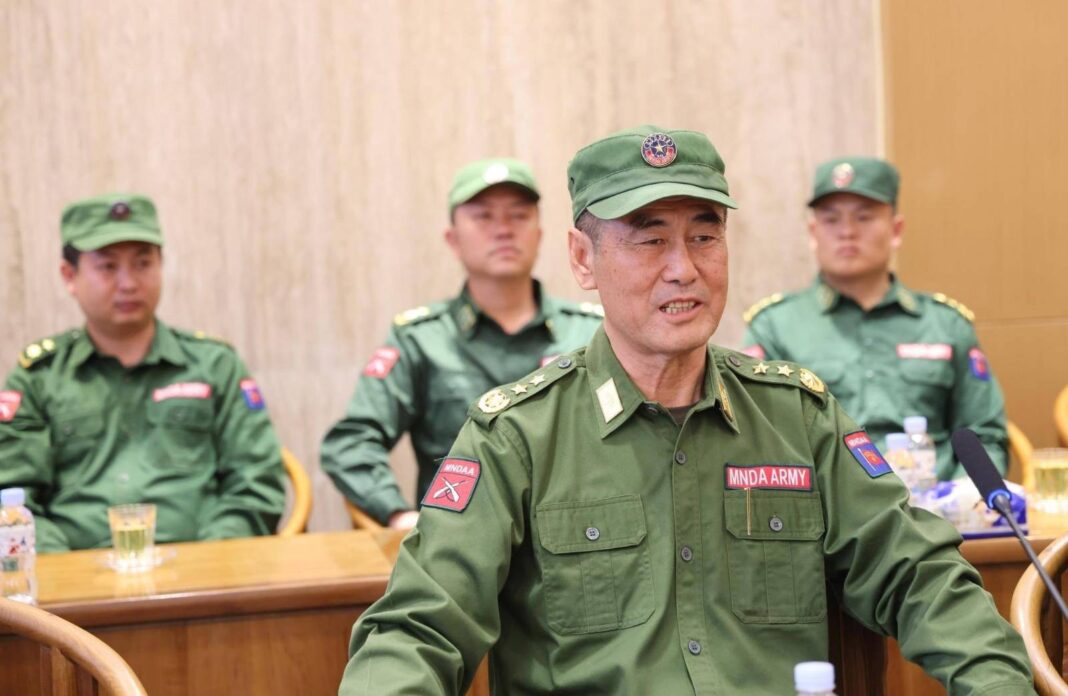
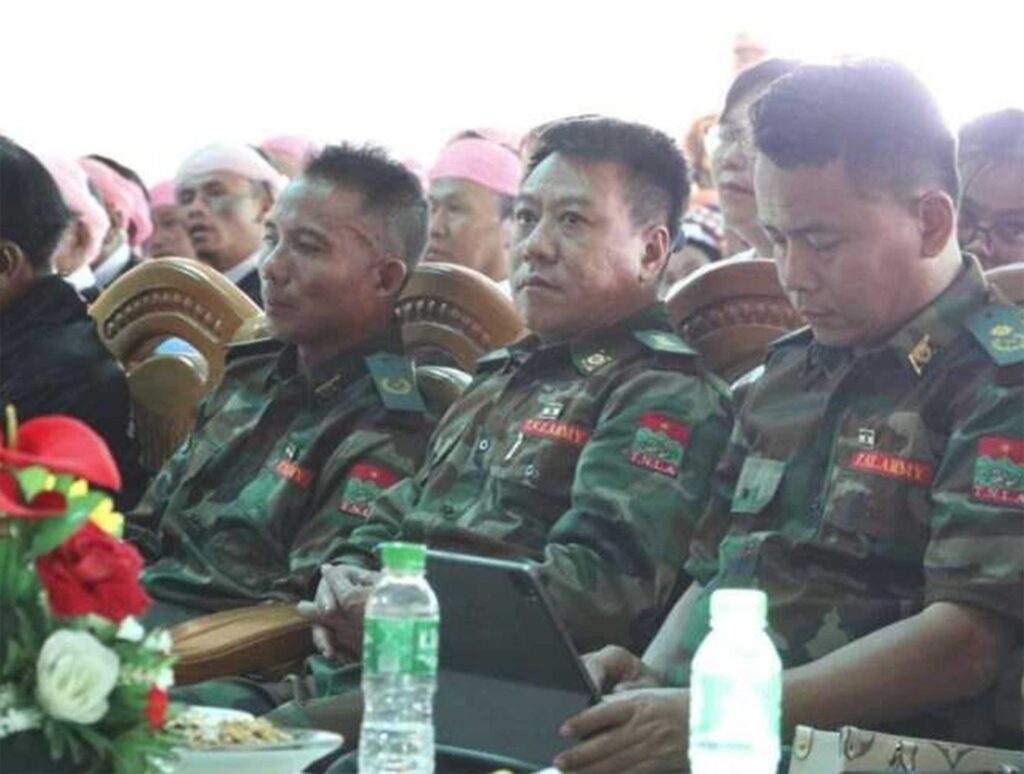
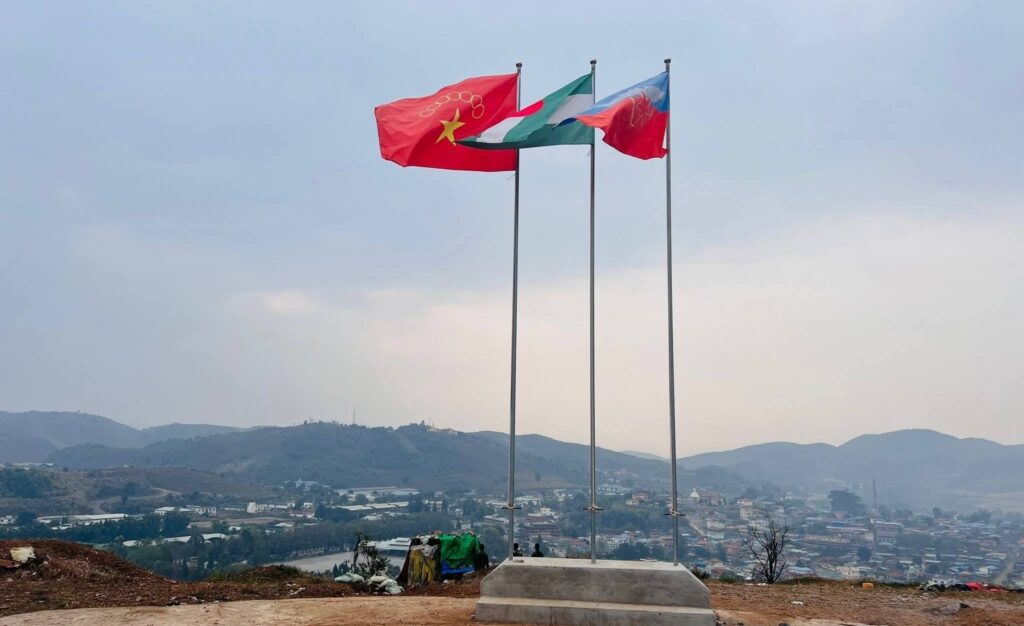
The ongoing conflict between the Ta’ang National Liberation Army (TNLA) and the Myanmar National Liberation Army (MNDAA) in Kutkai Township, northern Shan State, has intensified and continued into the morning of March 15. Local sources report that the violence, which ignited on March 14 due to disputes over territorial ownership and administration following the captured territories from Myanmar military junta, remains severe.
Both factions are accusing each other of provoking the clashes. The MNDAA claims it acted defensively in response to a TNLA attack on its patrol unit, while the TNLA contends that the MNDAA is simultaneously assaulting its military bases in Kutkai.
Reports indicate that video footage from the second day of fighting is circulating on social media, capturing the sounds of gunfire. According to the Shwe Phee Myay News Agency, the MNDAA is targeting key TNLA positions in Kutkai, resulting in heavy fighting.
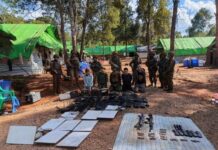
In addition to the clashes in Kutkai, local sources indicate that the MNDAA is launching attacks on TNLA camps situated between Namkham Township and Nam Hpak Kar. The MNDAA claims to have captured 47 TNLA soldiers and confiscated their weapons at the Muse (105) Mile and Kyinsankyawt (Jin San Jiao) Gate, two strategic trade points on the China-Myanmar border, which are jointly controlled by the Three Brotherhood Alliance (3BHA).
Meanwhile, the TNLA has expressed its intention to resolve the current crisis through dialogue and negotiation. In light of the ongoing military confrontations, the National Unity Consultative Council (NUCC) has called for an immediate ceasefire and urged peaceful political discussions. Earlier, the TNLA requested mediation from the Federal Political Negotiation and Consultative Committee (FPNCC) but received no response. Subsequently, the TNLA also reached out to Chinese border authorities for assistance in mediating the conflict. Additionally, TNLA leader Tah Phone Kyaw recently stated in an interview that they have been informing the Arakan Army (AA), a member of the 3BHA, about the situation.
Reliable sources informed Shwe Phee Myay that the Kokang Army-MNDAA and a joint force are planning to attack and take over Namkham, which is controlled by the TNLA, with intentions to subsequently attack Namtu, also under TNLA control.
Reports also indicate that members of the Ta’ang community are facing harassment and being interrogated about their affiliations, with villagers being instructed not to support the TNLA.
On March 16, the Ta’ang Civil Society Organizations Network (TCSO) called upon both the Kokang Army (MNDAA) and the Ta’ang Army (TNLA) to immediately cease hostilities and pursue a negotiated solution. The TCSO emphasized the need for both sides to halt actions that could lead to further ethnic conflict and work towards eliminating military dictatorship.
Coinciding with the MNDAA offensives against the TNLA in northern Shan State, Special Envoy for Asian Affairs of the Ministry of Foreign Affairs of China, Mr. Deng Xijun, was recently in Naypyitaw discussing trade matters, stability along the border of the two countries, exchanging views on matters including current developments in peace process, the continued constructive support of China for Myanmar’s efforts to achieve lasting peace and socio-economic development, cooperation in combatting online scamming and other illegal activities in border areas, with the military junta, according to the junta’s Ministry of Foreign Affairs.
Locals have also reported sightings of junta aircraft circling Kutkai during the recent fighting.
The situation in northern Shan State has developed rapidly and is quite challenging to understand. Although leaders of the MNDAA and TNLA have been meeting in Laukkai as of March 17, reports from military sources indicate that the MNDAA has demanded the withdrawal of certain TNLA camps near Einai village in Lashio Township. Fighting between the MNDAA and TNLA reportedly ceased on March 16.
Additionally, on March 16, the MNDAA instructed the Kachin Independence Army (KIA) to evacuate its toll gates along the Muse-Lashio Union highway due to an excessive number of checkpoints. Speculation suggests this directive aligns with China’s strategy for opening trade routes along the highway. However, KIA Spokesman Colonel Naw Bu has denied knowledge of such demands.
Current reports indicate that the MNDAA has ordered the removal of KIA checkpoints on the Union Road. When asked about these reports, Colonel Naw Bu stated that KIO checkpoints are still operational, emphasizing, “We have not informed the central government about this. I don’t know if we have gone to the front lines to tell them or not, but we have not told the KIO/KIA central government to remove the checkpoints. The checkpoints are still there.”
Trade route reopened
After the Kokang MNDAA took complete control of Kutkai Township in Shan State, the Union Highway was reopened to allow direct travel between Muse and Lashio, according to March 16 SHAN report.
Starting this morning (March 16), the Union Highway was reopened to allow direct travel from Muse on the China-Myanmar border to Lashio, which is controlled by the Military Commission, according to drivers who operate the Lashio-Muse route.
“The Muse-Lashio main road is open, and it is now being released. Trucks and large cars are also allowed to travel. Drivers say that small cars that use the main road have reached Muse. The Kokang side is releasing everything, they just ask for tax documents,” a driver who operates the Lashio-Muse route told Shan Herald.
On the morning of March 14, in the Mong Si, Nam Hpak Kar, and The MNDAA launched simultaneous attacks on TNLA camps in Loi Samsip, Man Paing and the surrounding area of the city using drones and heavy weapons, and after capturing the strategic camp hill on the evening of March 15, they have taken full control of the entire Kutkai township, according to Kutkai residents.
During the two days of fighting in Kutkai, TNLA has suffered 18 casualties and nearly 100 surrendered and captured, while MNDAA wounded are also receiving treatment at the Hsenwi Hospital, a military source said.
“The Kokang side has taken over all of Kutkai. Some TNLA soldiers surrendered and were captured, while others fled, and the Palaung soldiers dispersed them. There were 18 wounded in the fighting in the city, but there are no deaths. The total number of people captured alive from various places must be over 100,” the military source told Shan Herald.
TNLA spokesman Lwey Ye Oo did not respond to a request for comment on the TNLA’s withdrawal from Kutkai and the arrest of more than 100 soldiers by the MNDAA.
Similarly, a woman was killed when a drone bomb exploded in a house in Ho Kyint village near the strategic military base in Kutkai, where fighting intensified yesterday, according to Kutkai residents.
The armed conflict between the TNLA and MNDAA, which are allied, has many implications for the entire current revolution, the Spring Revolution Alliance (SRA) said today (March 16).
In a statement, the Spring Revolution Alliance (SRA), which fought alongside three allied groups during “Operation 1027,” urged the TNLA and MNDAA to resolve their conflicts through dialogue and not through military means.
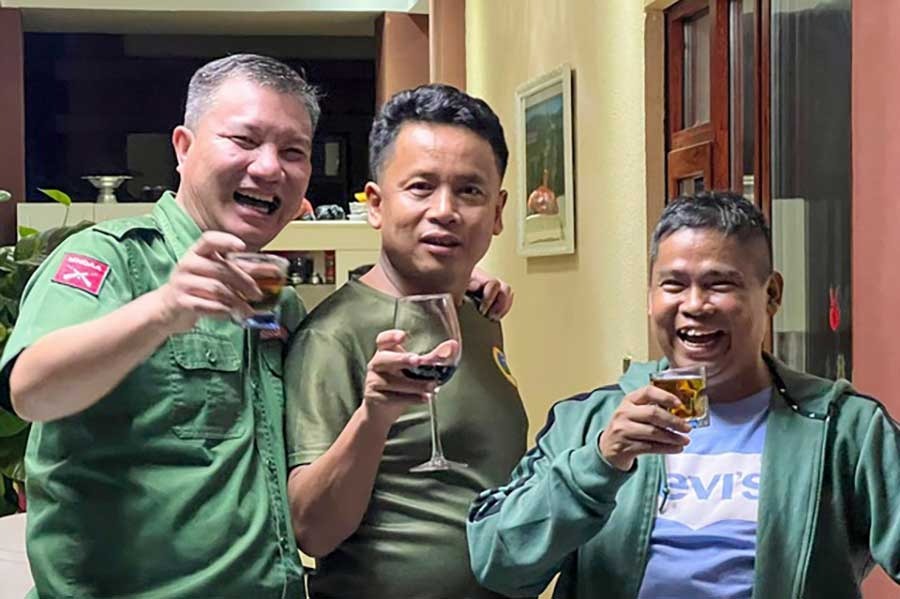
General Tah Phone Kyaw’s Interview
In an interview on March 15 with The Irrawaddy, TNLA General Secretary General Tah Phone Kyaw outlined his group position, some of the issues which are crucial are as follows:
On whether China is giving the green light for the MNDAA to attack TNLA, he said: “Since this has happened, various opinions have been expressed. But my understanding is that China needs peace and stability in this border area. No one should fight. We cannot fight against each other. We must not fight each other. This is always the case with our group and with the Kokang. We have told every time we meet the Chinese. We were told the same thing when we met with China last week. Therefore, we believe that the Kokang will not attack us with weapons and then (also) attack Kutkai. But my understanding is that the Kokang group’s attack on Kutkai has nothing to do with China giving or not giving the green light. I think China will not give the green light. I think China will not like this situation either.
On why China and FPNCC haven’t been able to act on TNLA request to mediate the conflict, he explained: “In conclusion, we must say that our efforts to resolve the conflict have failed and that this is the stage of armed conflict (has now occurred). But we cannot be discouraged. The people under our allies (administration) have suffered bitterly for many years. Now, we should not let them suffer more because of our two allies. Therefore, we will continue to present our situation to the Chinese side, the FPNCC leaders, and the three allies, the AA. To what extent can we give in? What concessions should we give? We will give in. We will negotiate. Solving the problem with the military is not the right way. To be able to work together, we must find a solution through dialogue. I will continue to try to do that. For now, we are in this conflict because our efforts (to negotiate peacefully) have failed. I hope that this will be short-lived. I hope that we can stop this conflict as soon as possible after the leaders of both sides have discussions and negotiations.”
On the Kutkai row with the MNDAA he stated: “Our issue is that the conflict between us has persisted for a long time. Since the start of our 1027 campaign, our Ta’ang army captured Kutkai, while the Kokang army secured areas like Mong Ko, Tamoenye, and Hsenwi. Meanwhile, the Kachin army took control of towns along our route. As we captured each town, we withdrew most of our military bases in and around towns in order to allow them to manage their administration effectively. We aimed to work collaboratively to facilitate their governance.
However, this has not been the case in Kutkai. For over two years, our administrative efforts have faced significant obstacles. Despite attempts to negotiate, we have made little progress. Just a day or two after we took Kutkai, the Kokang army entered the town, occupying schools, government buildings, and community centers, preventing the schools from opening and complicating city administration.
We have raised these issues among our senior leaders and included them in our discussions. Yet, during this revolutionary period, they believe that such discussions are unnecessary. If this situation continues, we simply cannot accept it. Consequently, our negotiations have failed. Even though the Kokang group is our ally, we have different regional perspectives and distinct policies regarding human rights, which complicates our grassroots initiatives and often leads to various problems. Language barriers further exacerbate our difficulties.
Recently, for instance, they issued Kokang registration cards in Kutkai and installed CCTV cameras along the main road, which has created tension and made administration even more problematic. I believe our organization has not fully comprehended the political ambitions of our Kokang allies, making resolution increasingly challenging.
We understand that the Kokang region lies in the eastern part of the Salween River, encompassing hill areas like Laukkai, Kunlong, and Chin Shwe Haw. However, the actual situation we face along the Lashio, Kutkai, and Muse roads serves as a crucial artery for the entire northern Shan State. Collaboration in regional administration has proven difficult, leading to a situation that has ignited tensions in Kutkai, ultimately causing an explosive crisis.”
Analysis
Given the current developments, it’s important to examine the interests and political positions of the parties involved in the TNLA-MNDAA conflict.
China, the Myanmar military junta, and the MNDAA appear to be aligned in their priority to reopen cross-border trade, which is expected to yield benefits for all parties involved. It seems that China has effectively placed the military junta and MNDAA under one umbrella concerning cross-border trade.
However, the positioning of the TNLA, KIA, and SSPP within this arrangement remains ambiguous. Analyzing the situation, it appears that the TNLA and KIA are closer to the National Unity Government (NUG), aligning them with what might be termed the “West camp,” which may not be favorable in the eyes of China. The SSPP may garner some sympathy from China, as it is aligned with the United Wa State Army (UWSA) and has historical ties to the Communist Party of Burma (CPB) in the 1980s. Thus, the distribution of benefits among these groups is uncertain.
In contrast, the MNDAA, or Kokang, is viewed by China as a compliant proxy, adhering to its directives particularly following the Operation 1027 initiated by the Three Brotherhood Alliance (3BHA). Notably, the Arakan Army (AA), MNDAA, and TNLA are all members of the 3BHA. Recently, the AA has called for the TNLA and MNDAA to resolve their disputes through negotiation.
The NDAA (Mongla) and UWSA are also poised to benefit from the reopening of trade, as both have served as compliant clients of China for over 30 years since the dissolution of the CPB in 1989.
Another political consideration is that this trade arrangement may undermine the waning momentum of the revolution, particularly in northern Shan State, which aims to dismantle the military dictatorship and establish a Federal Democratic Union.
In essence, it can be anticipated that northern Shan State may transition into an economic zone rather than a battleground where the military junta and ethnic armed organizations (EAOs) previously clashed.
Although the AA has urged the TNLA and MNDAA to settle their differences through dialogue, the overarching influence of China, aligning the military junta and MNDAA, suggests a focus on the benefits of opening trade routes between China and Myanmar via the Union Highway. Should this be the case, the junta stands to be a primary beneficiary alongside China, potentially diminishing revolutionary momentum.
The broader implications of these developments on the rest of the country remain uncertain. It is now up to the Kachin Independence Army, Karenni National Progressive Party, Karen National Union & Chin National Front (K3C), the NUG, and their alliance with the AA to consider proactive strategies to address these changes before it becomes too late.

Leave a Comments