



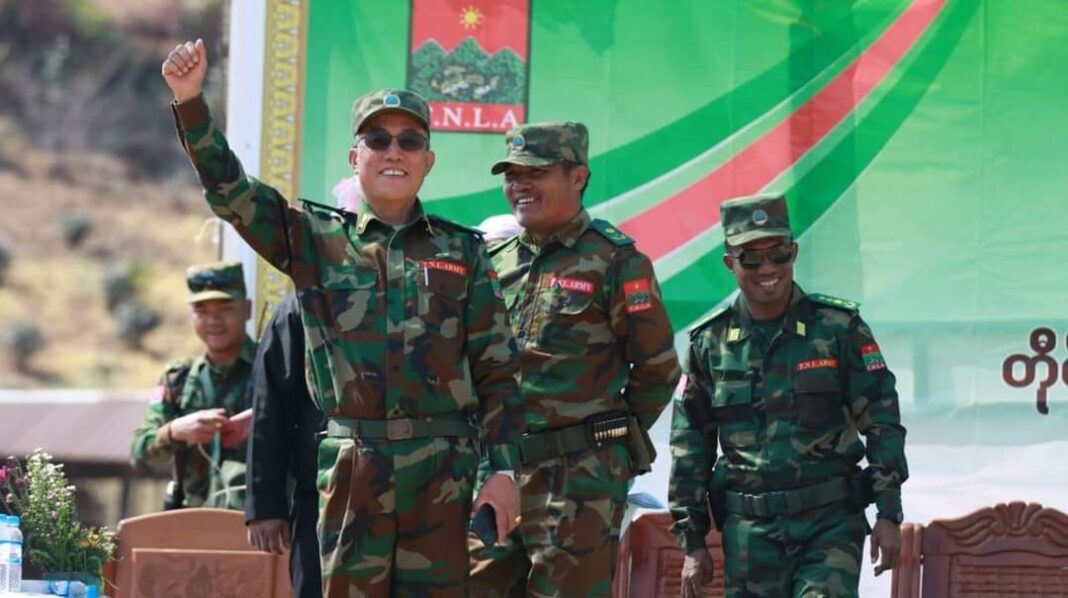
For months, many have been speculating that Ta’ang National Liberation Army (TNLA) is preparing for a ceasefire deal with the military junta, now known as State Security and Peace Commission (SSPC).
It has been trying to bargain with the junta for more territorial recognition on its captured 12 towns during Operation 1027, 11 in Shan State and 1 in Mandalay Region (Mogok), with the aim to incorporate them into its “Ta’ang State” aspirations. But the junta rejected it making use of the Chinese indirect pressure on TNLA; cutting ammunition and weaponry from United Wa State Army (UWSA), also through Chinese pressure; and lastly, the bombardment of the TNLA controlled territories with heavy artillery and airstrikes continuously.
Finally, as speculated the ceasefire deal happened as TNLA and SSPC met in Kunming China, through the Chinese mediation, or rather pressure on the former.
On October 29, TNLA announced the ceasefire agreement and agreed to hand over Mogok and Mongmit.
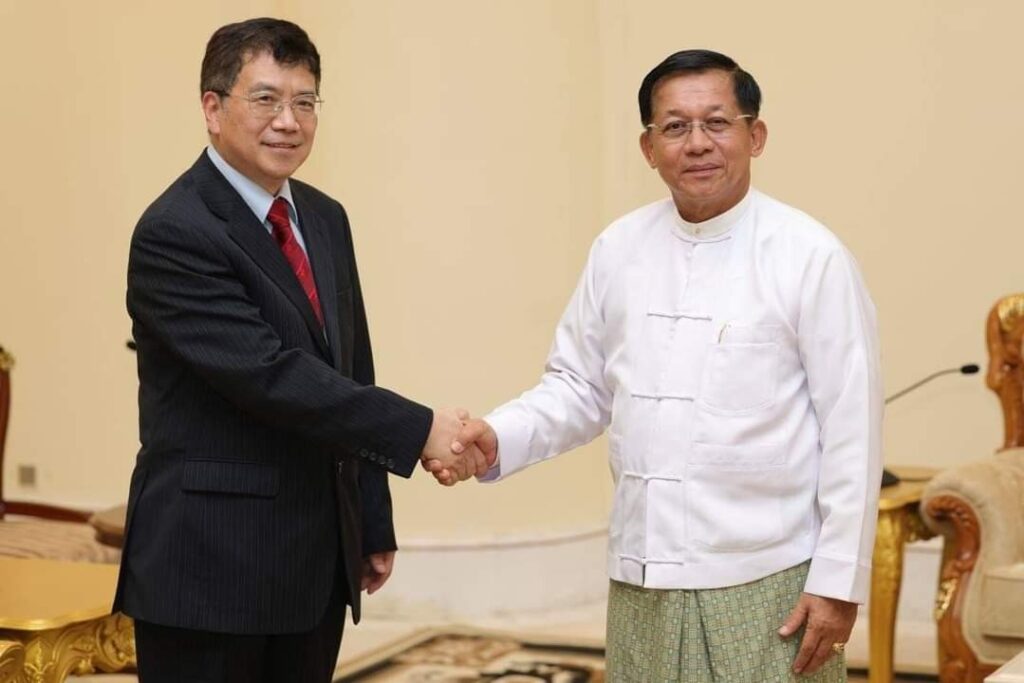
The agreement was signed at the 9thceasefire talks in Kunming, China, led by Chinese Special Representative Mr. Deng Xijun, according to a statement from the TNLA Press and Information Office. The 9th ceasefire talks were held from October 27-28, and were attended by a delegation led by Lieutenant General Tar Jock Ja from the TNLA and a delegation led by Lieutenant General Ko Ko Oo from the military junta.
The TNLA statement said, “Thanks to the mediation of the Chinese Special Representative, the two sides were able to reach a mutual agreement. The Ta’ang forces will withdraw from Mogok and Mongmit townships within the agreed period. The Myanmar military will not bomb or attack the Ta’ang region. The troops will stop at the places where they arrived and sign a mutual ceasefire agreement starting from 00:00 on October 29, 2025.”
On October 27, 2023, the Three Brotherhood Alliance, the Ta’ang (Palaung) National Liberation Army (TNLA), the Kokang Army or Myanmar National Democratic Alliance Army (MNDAA), and the Arakan Army (AA), launched Operation 1027 and captured several towns on the Myanmar-China trade route in northern Shan State, and attacked the military hotbeds of Mandalay and Sagaing regions. However, the MNDAA, which had taken control of Lashio due to Chinese intervention, was handed over to the military in late April 2025. The military then launched a fierce offensive against the TNLA, and the TNLA lost control of Nawnghkio town in July and Hsipaw town in early October.
Immediately after the ceasefire announcement, the Mandalay People’s Defense Force (PDF) issued a public statement that it will continue its struggle to overthrow the military dictatorship. It stated that it will continue to defend the areas it has gained control of in partnership with its revolutionary partners. It stated that it will continue to work towards its common goal of achieving federal democracy and ending the military dictatorship, regardless of any obstacles.
Likewise, on October 29, after the TNLA agreed with the military junta to withdraw from Mogok, the Mogok Strategy PDF pledges to the people of Mogok that they will continue fighting until the revolution is successful.
Mandalay PDF and Mogok Strategy PDF are under the NUG’s Ministry of Defense.
Analysis
With TNLA following MNDAA example of bowing to China’s pressure, quite a few questions arise on how the political landscape will look like in the near future.
Firstly, will the TNLA be pushed back to its Self-Administered Zone (SAZ) and have to give up the remaining towns that it captured during Operation 1027?
The answer is quite possible, if the ethnic armed organizations (EAOs) in northern Shan State and Anyar PDFs, including the non-National Unity Government (NUG) local PDFs won’t join in to defend the territories together with the TNLA, which is now the case.
The Palaung or Ta’ang SAZ is made up of two townships, Namhsan and Mantong.
Secondly, will the NUG/PDF be able to defend and protect Mogok from junta’s airstrikes and ground offensive of the junta?
The PDF, without air defense system won’t be able to fend off the military junta’s airstrikes and drone attacks. But it may be able to withhold ground attacks, with difficulties especially due to lack of ammunition.
Thirdly, will KIA and eventually the Arakan Army (AA) come to cooperate and coordinate with the NUG/PDF in fighting back the junta’s counteroffensive?
The KIA has been helping the PDF in Sagaing and it may continue to do so. As for the AA it is helping the PDFs in Magwe Region and also the Chin Brotherhood Alliance (CBA) in Chin State. Thus, it is likely that it could link up with the NUG/PDF in Mandalay and Sagaing regions.
Finally, what kind of effect will it has on Spring Revolution as a whole?
On this question, the immediate effect is a downhearted moral one for the anti-junta forces, but as the PDFs in Mogok and Mandalay have proven, the resistance of the Bamar revolutionary forces, PDFs and Local PDFs, will continue as they are convinced that only by uprooting the military dictatorship system will the federal democratic union be able to realize and aspirations of the people fulfilled.
But one thing is sure, the civil war will go on, as the majority of the ethnic-democratic forces will carry on with the struggle and most don’t see any hint that the junta will abdicate from power on its own free will anytime soon.
However, its a bit too early to make conclusion if the latest TNLA move is just a way of preserving its survival as a group by drawing back a few steps like the MNDAA, or the beginning of total capitulation as an earnest ethnic fighting force with high aspirations and dignified political goals.



Leave a Comments