



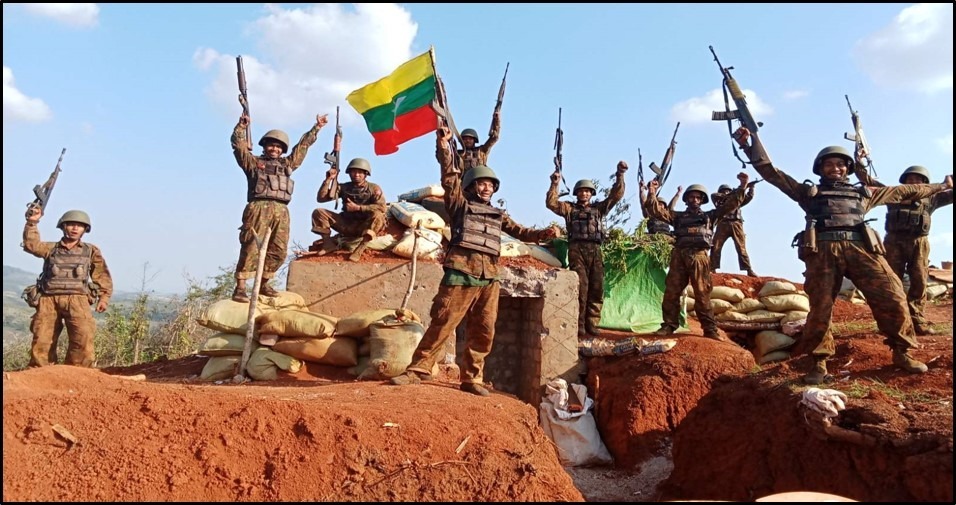
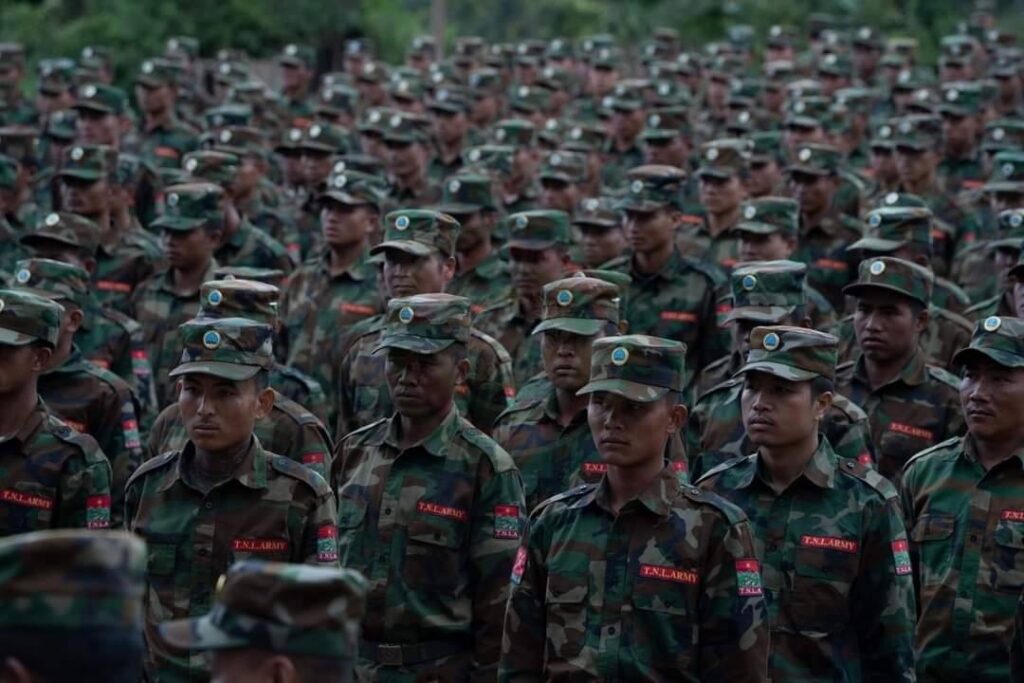
It was foreseeable that Ta’ang National Liberation Army (TNLA) would have to give up Nawnghkio Town sooner or later since a couple of months ago, as the SAC or military junta since last year August started to launch counteroffensive against the TNLA encroachment of the town.
Nawnghkio, also known as Nawngcho or Naunghkio, is a town in Kyaukme District, northern Shan State, Myanmar, serving as the principal town and administrative seat of Nawnghkio Township.
It is strategically located and connected to several major cities via road and rail, including Mandalay, Pyin Oo Lwin, Kyaukme, Hsipaw, and Lashio.
On July 17, TNLA officially admitted that it has withdrawn from Nwanghkio and so did the SAC through its news organ.
The capitulation is more due to the inability to gather enough support from the allies of Operation 1027 and not because of junta’s superior fighting ability, according the keen observers and analysts.
The inability to gather enough fighting forces to protect the town was the main shortcomings, which was linked to false priority-setting in placing the fighting forces at appropriate places in appropriate times.
In his latest piece in The Irrawaddy, Joe Kumbun bundled up three missteps in his analysis as, “This includes the incomplete neutralization of military bases, the misallocation of forces to internal conflicts with allied ethnic armed groups, and the alienation of local civilian populations and Burman PDF allies. Collectively, these missteps have significantly undermined the TNLA’s operational effectiveness.”
While this is a sound argument and quite all-encompassing in describing the setback of TNLA in Nawnghkio capitulation scenario, the real crucial factor for such failed decision is none other than the lack of holistic theoretical thinking, which in turn developed into unfavorable condition and political and military setback.
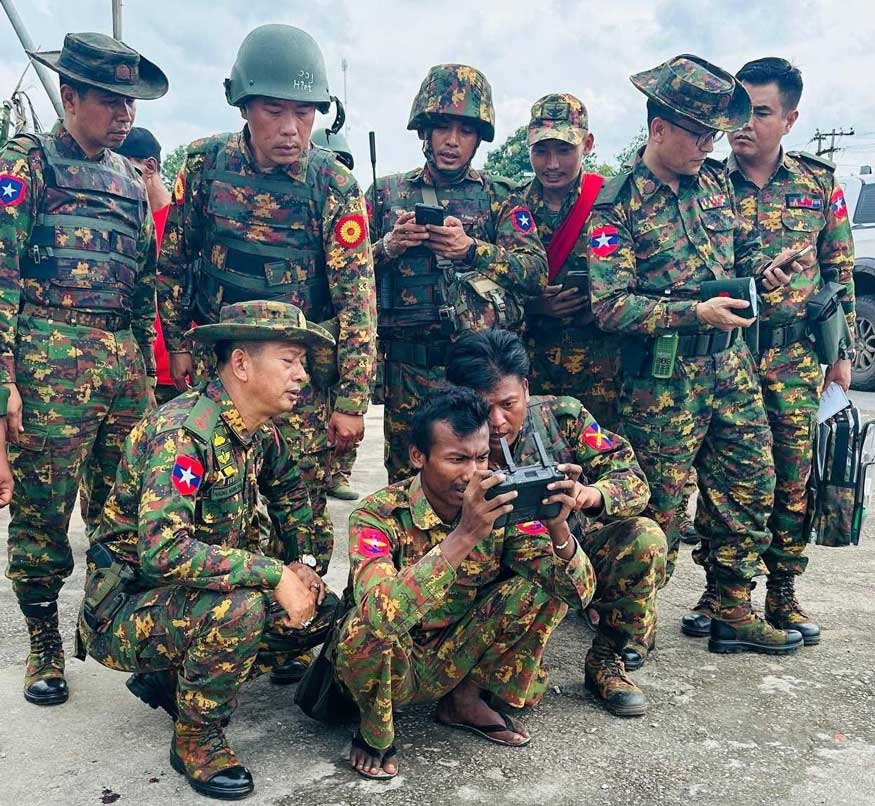
Everyone knows that TNLA leadership aspire to have a Ta’ang State which encompass nearly all of the northern Shan State, except Hsenwi Township which the MNDAA now claims to be part of its controlled areas stretching all the way up from Kunlong to Kokang Self-Administered Zone of Myanmar-China border.
The area the TNLA claimed is about 6 or 7 times expansion of it original Palaung Self-Administered Zone, which includes Namhsan and Mantong townships. And the problem is these captured areas are overlapping multi-ethnic settlement since time immemorial, where the majority Shan/Tai, Kachin in Kutkai area and many other minority ethnic groups have lived together harmoniously since British colonial days. On top of that, most expanded areas the TNLA wishes to include in its so-called Ta’ang State don’t have Palaung majority population and in most cases they are only around 10% or less, according to International Crisis Group’s report of September 2023.
Thus, it is programmed to lead to inter-ethnic conflict, which in a sense has already begun, if one looks at the frictions and armed confrontations between the Kachin Independence Army (KIA), Shan State Progress Party/Shan State Army-North (SSPP/SSA-N) and TNLA.
TNLA’s three blunders
The TNLA has experienced increasing frictions and armed conflicts with other Ethnic Resistance Organizations (EROs) in northern Shan State, particularly with the Kachin Independence Army (KIA) and the SSPP/SSA-N. These tensions have escalated in 2025, with reports of the TNLA expelling KIA and SSPP troops from areas it claims as part of its territory, leading to heightened military posturing and occasional clashes.
The TNLA has been involved in several incidents where it has expelled KIA troops from areas under its control, including the dismantling of KIA checkpoints and the detention of KIA soldiers. These actions have raised concerns about potential clashes between the two groups, although open warfare has not yet occurred, due to the KIA leadership tolerance and its disciplined ground forces following the directives.
The TNLA has had significant conflicts with the SSPP/SSA, particularly after the Operation 1027. The TNLA has forcefully transported SSPP troops out of certain areas, leading to armed confrontations. These tensions have been exacerbated by disputes over territorial control and resource allocation.
This is the first blunder in its failed policy-making, which needs to be refined into a win-win outcome for all multi-ethnic peoples residing in northern Shan State. And with it the TNLA riding roughshod on the non-Ta’ang people and trampling on other’s historical, cultural heritage and written languages added more oil to the burning fire or dire conflict situation.
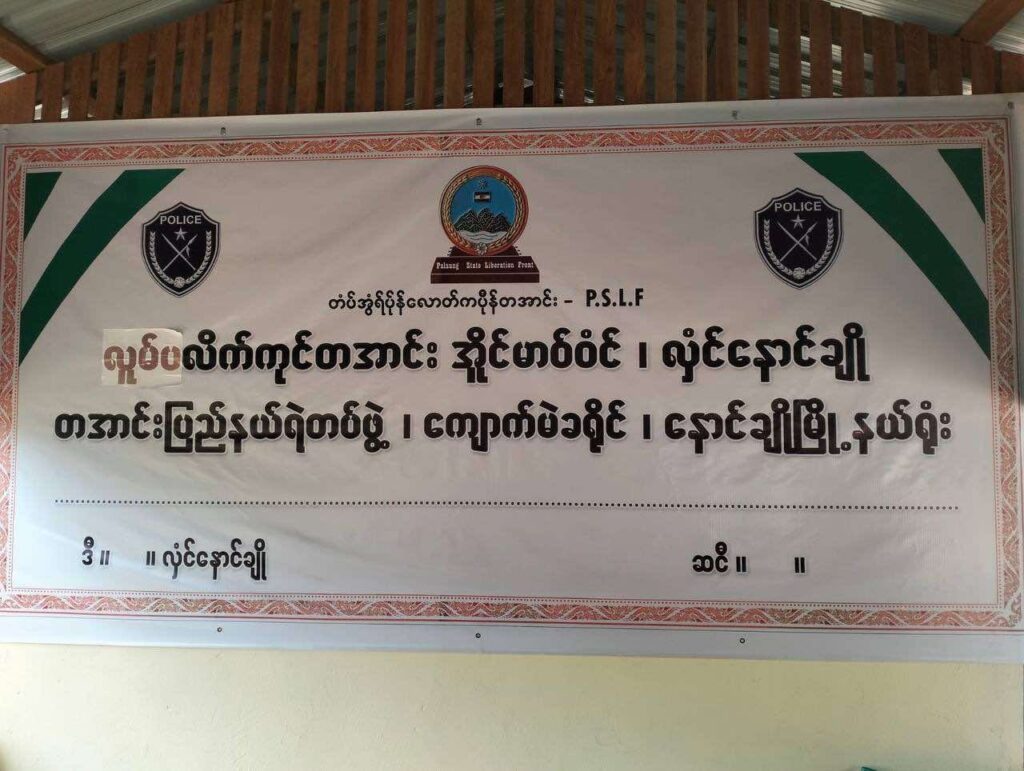
The second blunder is the TNLA mistreatment of its allies from heartland Burma or Myanmar.
The TNLA has faced significant challenges in managing its relationships with People’s Defense Forces (PDFs) and local defense forces (LDFs) following Operation 1027. After capturing several strategic locations in northern Shan State and Mandalay Region, the TNLA imposed restrictions on Burman PDF units, limiting their operational autonomy, confiscating weapons, and denying logistical access in areas such as Nawnghkio and the Lashio corridor. Leaked video footage allegedly showing the detention and abuse of Burman PDF fighters by TNLA troops has circulated on social media, triggering widespread criticism and eroding trust between the TNLA and its allies.
The third blunder is the TNLA’s governance of captured areas which has also drawn hefty criticism. In Mogoke, a ruby-rich town, the TNLA has been accused of monopolizing gemstone mining through partnerships with Chinese investors, excluding local communities. This kind of mismanagement led to public protests in Namhkam Township. Additionally, the TNLA’s occupation of public schools in Kachin-operated villages and the removal of Shan cultural symbols in Hsipaw and also Muse have alienated local populations, reducing public support for the group.
TNLA leadership mindset and feasibility
In a nutshell TNLA leadership is pursuing its ethnic interest in the form of expanded Ta’ang State realization, with territorial expansionism, at the expense of non-Ta’ang multi-ethnic groups within northern Shan State.
In implementing it, it practice racial supremacy doctrine, even though it has just a population of 300,000 to 400,000 only in comparison to some 2 million Shan/Tai population, which can’t go right without peaceful co-existence and harmonious living together in the multi-ethnic state. There isn’t any other option as there won’t be neatly demarcated ethnic enclaves in Shan State, given the overlapping demographic population pattern has been the way of life all along.
In other words, rights of self-determination for Ta’ang or Palaung “yes”, but in trying to do new political-mapping or redrawing the boundaries intensive political dialogue in a democratic setting may be needed and not retaining conquered territories from the military junta as a final accepted result. TNLA can’t act as though it is a new colonial master, as it doesn’t has the means and capacity to do so.
Thus its population transfer scheme of Ta’ang people to its less populated, captured areas; implementing increment of birthrate policy; expanding the notion of Ta’ang ethno nationalism to include the three main subgroups like Palé, Shwe, and Rumai; heightening its territorial expansionism to other ethnic ethnic areas; and so on aren’t conducive and won’t be enough to fulfill all of its leadership aspirations.
LAN’s Suggestions
Very recently, Legal Aid Network (LAN) made an assessment and plea or sort of suggestion in its 6-point analysis from the legal point of view. The 3 points worth emphasizing are as follows.
The first point writes: “In Taung Hkam and Nawnghkio battles the withdrawal (of TNLA) is due to:
(a) Ethnic allies [under National Unity Government’s (NUG) PDFs or not under it] energetic participation have diluted (weakened);
(b) Offensive attacks that captured territories such as towns and villages are administered as solely owned by TNLA and called for long-term investment;
(c) No effective local support; and
(d) Military Council heightened usage of overwhelming manpower and weaponry.”
In addition, the analysis writes: “The (a),(b),(c) could change the situation of (d) if it alters the situation politically as soon as possible.”
Third point writes: “TNLA has the rights to strive for its aspirations of separate ethnic state, but must officially accept other ethnic groups’ political rights and their historical legacies.”
Fourth point writes: “At the moment, the Ta’ang region is still within the Shan State officially and not yet been recognized as an ethnic state. As such, concerning the captured territories TNLA should consult with the main political and armed organizations on administrative issue, even though it is temporary within the Shan State.”
In short, the LAN urged the TNLA to play by the rules and curbed its hegemony stance in order to regain trust and sympathy from the fellow EROs and the people in general.
Analysis
As we can see the strategic missteps which Joe Kumbun outlined are valid arguments. However, regarding why the TNLA committed such blunders may lie with the TNLA leadership’s mindset or its world’s outlook.
To sum up, it doesn’t seems to be ready to abandon its conquered territories, as it sees to be the prize fought for and must be allowed to retain them, by hook or by crook. It also takes it that territorial expansionism to be in order and hegemony is an accepted fact in its vocabulary.
Like LAN’s appropriate suggestions, in order to win back the public sympathy and fellow EROs confidence, as time and again been urged, it may have to play by the democratic rules, besides abiding to the norms of peaceful co-existence; commitment to the common goals of uprooting the military dictatorship system and establishment of the federal democratic union; agreeing to new political mapping and creation of new federal constituent units, decentralization etc. according to the given, agreed constitutional guidelines, criteria and procedure; and last but not least, adhering and accepting the “unity in diversity” dictum.
Clearly, in order to turn the tide back to its favor, TNLA needs to do earnest soul-searching and reposition itself like during the start of Operation 1027 with body and soul. Anything less won’t work for the TNLA leadership, unless it decides to go the Kokang or Myanmar National Democratic Alliance Army (MNDAA) way and abandon the revolution altogether.



Leave a Comments