




Rare earth mining in Mong Bawk Township, an area controlled by the United Wa State Army (UWSA), has increased eightfold over the past 10 years, according to the Shan Human Rights Foundation (SHRF).
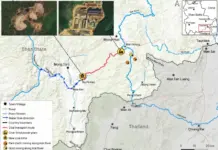
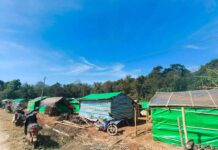
In 2015, there were only three rare earth mines in the Wa-controlled Mong Bawk area. By 2025, satellite images show at least 26 mines along the hills south of Mong Bawk town, the SHRF said in a statement released yesterday.
“The expansion of these rare earth mines has accelerated since the 2021 military coup,” said SHRF spokesperson Sai Hor Hseng. “Because the area is under UWSA control, mining has gone ahead unchecked.”

Three of the rare earth mines near the China–Myanmar border are just 3 to 4 kilometers from Mong Bawk town.
Rare earth elements are essential for producing electric vehicles (EVs), wind turbines, smartphones, computers, and other electronic devices.
According to SHRF, the mining operations in Mong Bawk are not listed among the official permits issued by Myanmar’s military council, whose latest list was published in November 2021. Instead, the group believes there may be a regional arrangement between the UWSA and China, allowing Chinese-backed companies to mine the minerals.

“Chinese companies are being allowed to mine rare earths in UWSA-controlled areas without Naypyidaw’s approval. These minerals are likely being exported directly across the border into China,” Sai Hor Hseng said. However, he added that SHRF could not confirm the specific companies involved.
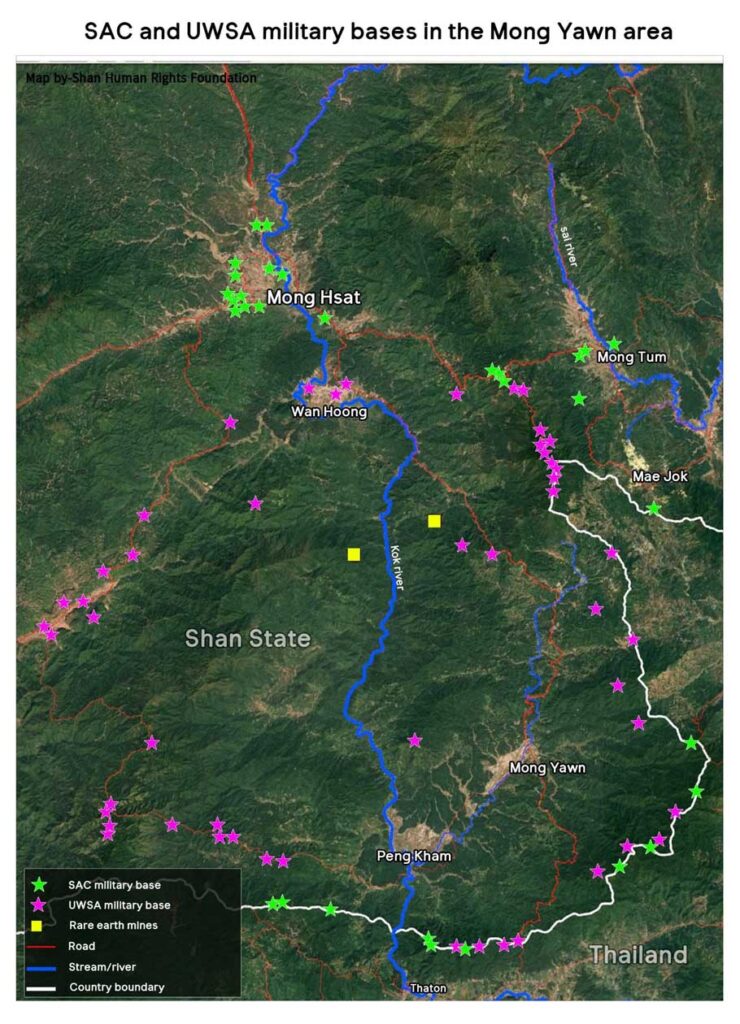
Rare earth mining is also taking place in the Mong Yawn area of Mong Hsat Township, near the Thai–Myanmar border, another territory controlled by the UWSA. Satellite images show at least two mines in Mong Yawn, around 25 kilometers from Thailand’s Chiang Mai Province. However, exports from Mong Yawn are reportedly restricted to military council-controlled checkpoints.
One mine located three kilometers south of Mong Bawk, which began operating in 2022, has been leaking waste into the Pai River, endangering the health of thousands of residents nearby, SHRF warned.
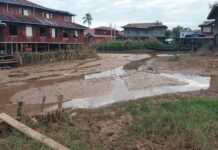
During the heavy rains brought by Typhoon Yagi in September 2024, Mong Bawk experienced severe flooding due to runoff from the mining areas.
Mong Bawk lies between two major rivers the Salween (Than Lwin) and the Mekong. Wastewater from the mines flows into the Salween River via the Kar River to the west, and into the Mekong River via the Lwai River to the east. This means while Chinese territory remains unaffected, communities downstream in Shan State could face serious health risks, SHRF said.
The mining method used, known as “in situ leaching,” involves injecting chemicals into the ground to extract rare earth minerals. This technique, already in use in Kachin State, has been widely criticized for polluting surface and groundwater and causing long-term environmental harm.
SHRF emphasized that these operations are damaging forests, contaminating water sources, and threatening the health and livelihoods of local communities.
Myanmar’s rare earth production is estimated at 31,000 metric tons in 2024, according to Statista. The country now ranks as the world’s third-largest rare earth producer, after China and the United States.






Leave a Comments