



Chinese top leaders had a closed-door meeting last month to discuss matters concerning Myanmar. China has become more concerned about the management capabilities of the military-led State Administration Council (SAC). According to the sources, the Chinese leader accepted that this was the first occasion in which they had seen the military’s weakness. The military lacks the ability to safeguard their economic interests and is ineffective in facilitating relations between the two nations.
Although the SAC governs important towns like Naypyidaw, Yangon, and Mandalay, resistance armed groups dominate the majority of the nation and can safeguard Chinese corporate interests. Nevertheless, Chinese delegates continue not to cooperate with the People’s Defense Forces (PDFs), seeing these organizations as supported by Western governments.
There is no confirmation from China about which side they are on. Nonetheless, they are playing their games.
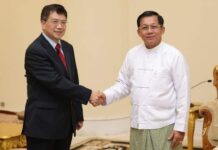
On January 16, 2025, China convened another talk between the SAC and the Kokang-Myanmar National Democratic Alliance Army (MNDAA) in Kunming due to the unsuccessful first meeting in December of the previous year.
Sources also stated that China would convene a meeting with the Ta’ang National Liberation Army (TNLA) due to concerns over their business and a lack of confidence in the SAC’s leader Min Aung Hlaing’s ability to safeguard their interests.
According to an ISP-Myanmar report, out of 23 business projects, including oil and gas pipelines, roads, railways, and wind power, 13 are currently under the control of resistance groups, specifically the MNDAA, TNLA, and PDFs, while another 10 projects are controlled by the Arakan Army (AA). Currently, only three townships remain beyond the jurisdiction of the AA.
The Kachin Independence Army (KIA) is also progressively extending its territorial control in Kachin State. Recently, it successfully captured significant townships such as Pangwa, Manze, and Zang Hawng.
Despite the fact that the MNDAA and SAC met last week, nothing changed in the present scenario. There is no meaningful agreement between them. The MNDAA continues to refuse to leave the territories it recently gained from the military.
In this regard, several Chinese academics advised that the Chinese government work with the resistance organizations. But which organizations might China collaborate with? The answer is the organizations that were able to acquire and govern the regions where Chinese firms operate.
Thus, it is important to remember that in politics, there are no permanent friends and foes. For instance, the United States of America had designated the Syrian group Hayat Tahrir Al-Sham (HTS) as a terrorist organization and issued a $10 million bounty arrest warrant for its leader, Ahmed Al-Sharaa. Nevertheless, the United States revoked the $10 million bounty in December of last year after Sharaa ousted Syrian President Bashar al-Assad, asserting that the HTS group did not pose a threat to the United States and its allies.
This should serve as a warning for the resistance groups as well; while China currently seems to support them, if the SAC can strike back and regain control of the country. China would then align itself with the SAC. So, the resistance forces must seize such opportunity given to them; otherwise, they will be left with nothing.




Leave a Comments