



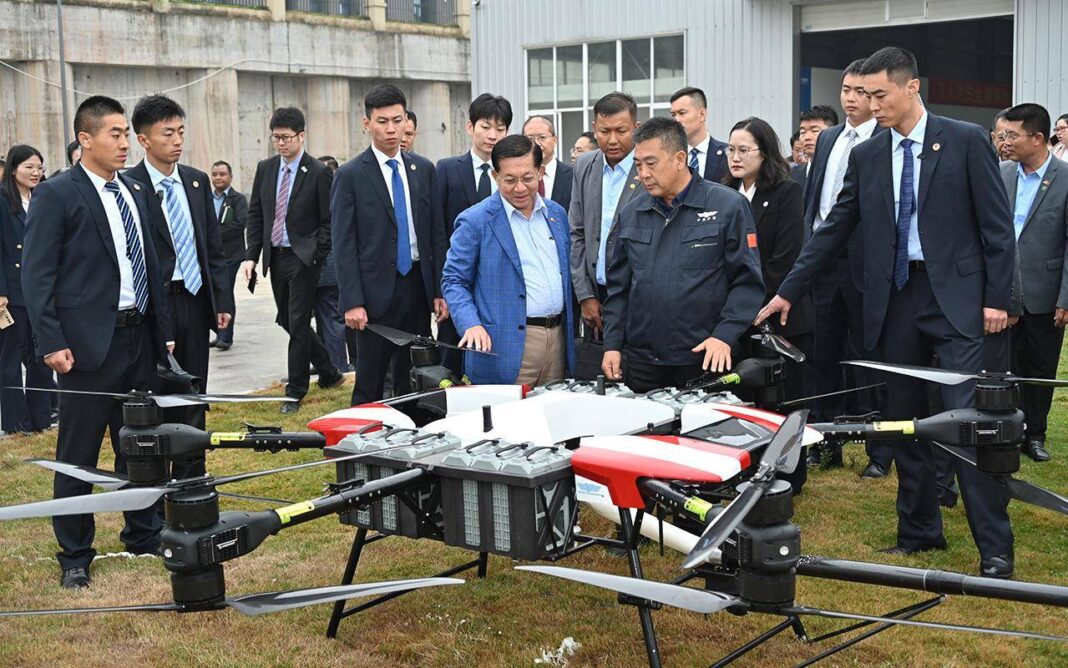
After attending summits of the Greater Mekong Subregion (GMS) and the Ayeyawady-Chao Phraya-Mekong Economic Co-operation Strategy (ACMECS) Summits in Kunming, the capital of Yunnan province, General Min Aung Hlaing head of the military junta or State Administration Council (SAC) is back home with renewed confidence with promised backing from China on Sunday, November 10.
During his visit for nearly a week starting November 5, he has met potential Chinese investors, visit industrial plants besides attending GMS and ACMECS meetings.
He portrayed the anti-junta forces as villains and his government fending them off for the good of the country to his Chinese audience. But chief among his success is the new found China’s endorsement of his military regime and coming down hard on the anti-junta forces, especially in northern Shan State and Kachin State.
According to Shan Herald Agency for News (SHAN) recent report, on November 6 during a meeting with China Prime Minister Li Qiang guaranteed to the military leader Min Aung Hlaing that China-Myanmar border gates will be fully managed by the military council.

China also reiterates its recognition of Myanmar’s sovereignty and territorial integrity, and will not accept actions that damage Myanmar’s interests based within China. The Chinese premier said that the border gates of the two countries must be under the management of the governments (Myanmar and China) and will continue to be fully managed by both.
In addition, he promised that China would help Myanmar on the international arena to achieve legitimacy.
The Chinese Prime Minister also said that he will help Myanmar’s elections to be held successfully. Myanmar’s stability and peace is important, and China will not tolerate actions to destroy Myanmar’s interests. He said that the realization of the China-Myanmar Economic Corridor (CMEC) will be accelerated.
However in this meeting, the Chinese Prime Minister did not warn or mention the war crimes committed by the military junta, including the targeted bombing of people across the country and the daily arrest and killing of people and the burning of their homes.

NUG voiced concern
On November 5, NUG Foreign Affairs Minister Daw Zin Mar Aung said putting pressure on anti-regime groups is not the answer to Myanmar’s political problems, according to The Irrawaddy report.
“To overcome the political instability and the cycle of coup after coup in Myanmar, the revolution must bring about a new system that leaves no room for the Myanmar military in the country’s politics, and that guarantees federalism for ethnic people. Just applying pressure won’t work and it won’t be good for China,” said Daw Zin Mar Aung.
The NUG request to reconsider China’s invitation to Min Aung Hlaing was replied by Beijing as not categorized as a state visit and he would only be attending a regional forum in a province.
The NUG however said this could strain bilateral relations, especially between China and the people of Myanmar. Anti-Chinese sentiment has been on the rise in Myanmar since the coup, and has grown stronger over the past few months after China made explicit threats against ethnic armed groups fighting the regime.
Anti-China rallies have been held in the US, UK and South Korea at China’s diplomatic missions for interfering in Myanmar’s internal affairs, so far.
Recent military situation
The second phase of Operation 1027 which started in June 2024 actually seems to be aiming at southward push by the Ta’ang National Liberation Army (TNLA), Myanmar National Democratic Alliance Army (MNDAA) or Kokang and assorted People’s Defense Force (PDF) and Local Defense Force (LDF) groups along the Routes of 41, 44, and 445, according to International Institute for Strategic Studies (IISS), the Myanmar Conflict Map report titled, “Is the Brotherhood headed to Mandalay?” by Morgan Michaels, published on October 24, 2024.
“These roads are the main links between northern and southern Shan State and could be used for a regime counter-offensive,” according to the report.
The TNLA has fought pitched a battle against junta forces at Taung Hkam, which is the base of four junta artillery bases threatening TNLA’s hold over Nawnghkio and the main approach to Pyin Oo Lwin and Mandalay. It also guards a key crossing over the Myitnge River along the road to Taunggyi.
Operation 1027 second phase encompassed the Mandalay PDF in the three lowland townships to the north of Mandalay City: Madaya, Singu and Thabeikkyin.
“ To the south of the city, a loose coalition of PDFs associated with the National Unity Government (NUG) is waging a synchronized offensive across Myingyan District, which includes the townships of Myingyan, Taung Tha, Natogyi and Ngazun.”
By September the MNDAA stopped its offensives due to China’s pressure and since then the junta has been reinforcing its troops to Namlan and Mongyai towns, the report writes.
During the month of September, October and until today the military situation for the SAC hasn’t be favorable and can even be seen as deteriorating.
According to People’s Spring report of November 10, 2024, just 2 days after the coup leader announced “Yan Min Naing” operation on September 3 to wrestle back the captured territories from the ethnic resistance organizations (EROs) countrywide, Arakan Army (AA) completely captured the Maung Shwe Lay naval base in Thandwe Township. AA launched an offensive on August 7 and occupied the main naval base of the military capturing it on the evening of September 5, which is known to be the main base training recruits in diving and rescue mission of the army. Therefore, Thandwe City and Thandwe Township came under the control of the AA.
On September 26, the military council issued an invitation to the revolutionary groups to lay down their weapons and participate in the multiparty election. The first to respond to the military council’s invitation was the Kachin Independence Army (KIA), by launching offensive on September 29 on junta’s militia Kachin Special Region (1) of Chipwi Town led by Zahkung Ting Ying and subsequently captured it on September 30. In addition to this, the KIA joint forces occupied Hsawlaw Town again in the early morning of October 2. Thus 3 cities were lost within a month after the coup leader announcement of counter-offensive.
Moreover, on October 19, the allied forces led by the KIA captured Panwah, a famous city, including the entire region completely on the Myanmar-China border. Panwah is also a region where China’s coveted rare earth minerals are being extracted. Panwah City and the entire region were completely captured.
In addition to this, the military council was hard-hit by the fact that the PDF captured the city of Pinlebu on October 7. In addition to the Infantry Battalions (50, 87, 301, 305) Light Infantry Battalions (16, 101, 111, 363, 368, 704), including the Police Force and the Shanni National Army (SNA) Brigade-614 were defending their positions, with about 800 forces in total. PDF battalions, Pa Ka Pha, the All Burma Student’s Democratic Front (ABSDF) joined forces with the local revolutionary forces attacked and occupied the area after more than 50 days of offensive.
A military source confirmed that fierce fighting has been going on since the morning of November 7 in the Taung Hkam area of Nwanghkio Township, Shan State. A military source said that the battle is intensifying as the TNLA joint forces are again attacking the military bases, including the Artillery Operations Coordination Headquarters (Ma Sa Kha 902) in the north of Taung Hkam Village, according to the recent SHAN report.
In the same vein, between Nwanghkio and Pyin Oo Lwin, in Banbwe and Gangaw military council and TNLA troops were engaged in fierce fighting continuously until the morning of November 8.
In Taung Hkam region, the Military Council’s Artillery Operations Coordination Headquarters (Ma Sa Kha-902), Ah Ma Ta (354), Ah Ma Ta (206), Ah Ma Ta (406) 4 artillery units are stationed. Last July 10, TNLA joint forces attacked and captured the No. 606 missile unit in the south of Nwanghkio City. The unit retreated to Taung Hkam to defend themselves together with the others. Fighting has been going on for months. In addition four infantry battalions are also deployed to reinforce the resistance.
According to Narinjara News recently updated military map showing the AA and junta control areas in Rakhine State, the junta now only controls Sittwe and Manaung, with Ann and Maungdaw townships under continuous siege and could fall anytime soon.
AA is attacking almost all military departments in Ann Township where Western Region Military Headquarters is located and bilateral battles are also being intense.
According to political analyst U Than Soe Naing of Myanmar, the Spring Revolution might intensify further, and the Arakan Army (AA) might seize control of the Western Command in Ann Township, Arakan State, in a matter of days, reported Narinjara News on November 9, 2024.
He added that the AA is anticipated to seize control of the Western Command shortly and that the strategic dynamics of the Spring Revolution could be drastically altered if they unite with the mainland of Myanmar.
“This might significantly alter the strategic landscape of the Spring Revolution.”As the Bamar People’s Liberation Army (BPLA) and the People’s Liberation Army (PLA) gear up to advance into central Myanmar, the AA will likewise proceed once the mission of dismantling the junta forces is finished. “This suggests that the Spring Revolution is expected to intensify in the upcoming months,” he stated.
Analysis
All indications are pointing towards loggerhead and nothing seems to be pointing in the direction of dialog or thawing the situation between warring parties.
MNDAA withdrawal from Operation 1027 doesn’t take away the steam from TNLA and it’s allies, as can be seen in Nwanghkio and Taung Hkam ongoing battles. The Mandalay PDF has also penetrated into Sagaing area and the NUG/PDF started operating in Myingyan Taung Tha, Natogyi and Ngazun.The Pinlebu seizure by ABSDF and PDF forces is also a testimony that the central Myanmar revolutionary tide is gaining momentum than ebbing out.
China’s endorsement of SAC and offering bad peace to the anti-junta forces may create anti-China sentiment, which will not be beneficial for China in its economic plan of Belt and Road Initiative (BRI) and CMEC.
As a result we are already starting to see anti-China rallies in the US, UK and South Korea at China’s diplomatic missions, which are not to interfere in Myanmar’s internal affairs by aiding the junta SAC and pressuring the EROs to stop fighting and to give in to the junta’s scheme of accepting surrender and participation in its election plan next year.
Another worry for China would be that the anti-China tendency could morph into physical destruction of unmovable Chinese investments within the country if the people and majority anti-junta forces think they have nothing to lose and are now considered legitimate enemies’ targets and no more reason to protect them.
On international level ASEAN’S Five-Point Consensus will become meaningless as China is pushing its own agenda to aid SAC’s plan.
The NUG and as well most EROs may likely continue with the revolution against all odds so long as the SAC is in power, as the hatred by the population is immense due to its uncountable war crimes committed and still ongoing.
But the anti-junta, ethnic-democratic loose alliance may certainly need to be more solidified as suggested by experts and well-meaning observers through military united front mode and eventual politically as well in the near future, to be effective.
In sum, whether the political atmosphere will change for the better with China’s siding the junta to implement its political agenda lopsidedly and to whose favor the military confrontation outcome may be tilted or pan out are questions that nobody can answer at the moment.




Leave a Comments