


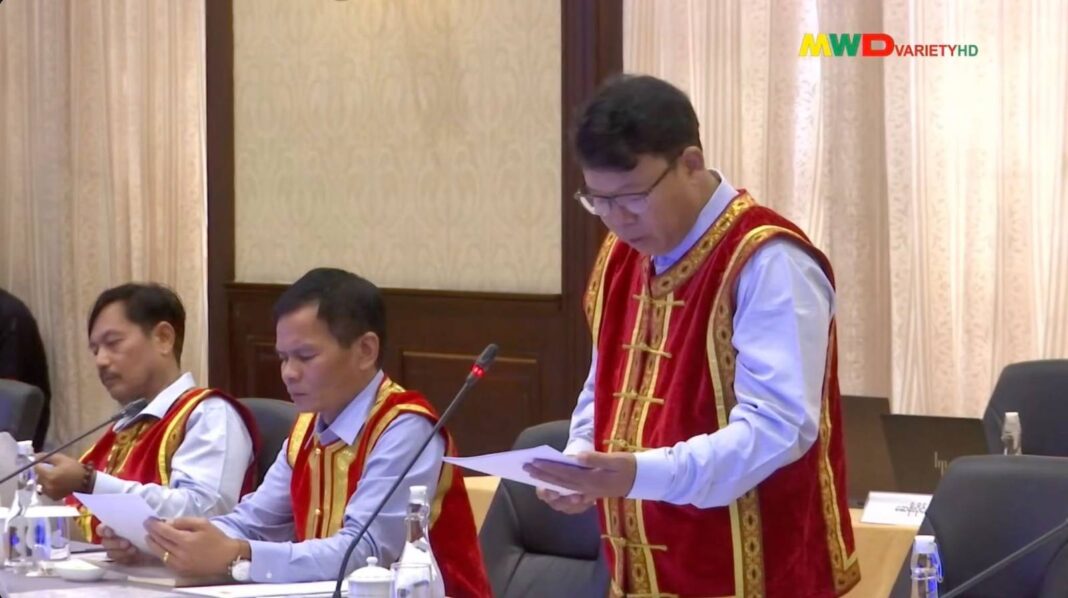
On the morning of May 4, the National Unity and Peacemaking Coordinating Committee (NSPNC) and the Shanni Nationalities Army (SNA), together with Shanni Nationalities Unity Council (SNUC), met in Naypyitaw to discuss peace. This dialogue aligned with President Min Aung Hlaing’s 100-day peace overture, an effort to reach political compromises with ethnic armed groups following his transition from military uniform to civilian attire as head of the military-dominated, so-called quasi-civilian government.
The meeting was attended by NSPNC Chairman Lt. Gen. Ya Pyae, Secretary Lt. Gen. Min Naing, and members of the Coordinating Committee. Representing the Shanni side were Shanni Nationalities Unity Council Vice Chairman Sao Sai Kam, Central Committee Member Sao Hsur Kaung Hsai, Joint Secretary Sao Hsur Wan Fah, Rotating Central Committee Member Sao Sai Lin Aung, and Central Advisor Sao Hsur Ai Sai Harn.
The SNA and the military junta discussed the legal status of Shanni ethnic areas in Kachin State and the Sagaing Region as “self-administered areas.” The meeting focused primarily on the political aspirations of the Shanni people.
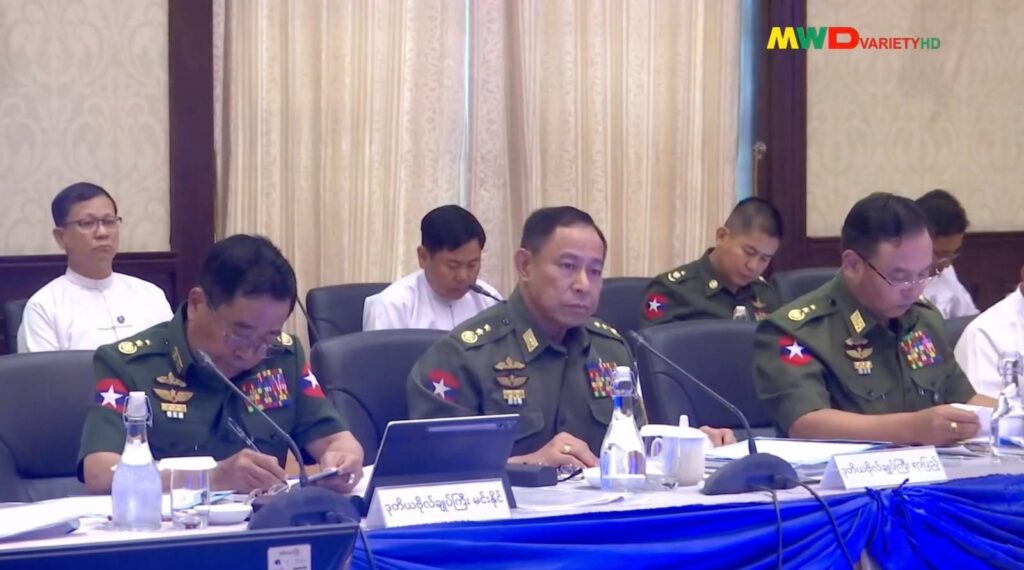
During the talks, the SNA emphasized the need for “self-administered areas” in regions inhabited by Shanni communities within Kachin State and the Sagaing Region. Lt. Gen. Ya Pyae, Chairman of the Coordination Committee, outlined the conditions for submitting issues regarding the Shanni’s historical residence, the correct usage of ethnic names in national registration, and regional recognition to parliament in accordance with the 2008 Constitution.
The SNA stated that it would continue to work with the military junta to achieve regional stability and development. This commitment underscores the SNA’s intent to build closer relations with the junta amidst the current tense situation.
The Shanni people are members of the Tai ethnic group residing in the Chindwin and Ayeyarwady River basins in northern and northwestern Myanmar. In Kachin State, they live in regions including Moe Nyin, Moe Kaung, Bhamo, Myitkyina, and Hpakant. In the Sagaing Region, they inhabit areas such as Kaw Lin, Won Tho, Homalin, Katha, Kalay, and Tamu.
UKSC Opposes Inclusion of Kuki Territory in Proposed Shanni State
The United Kuki State Council (UKSC) issued a statement on June 7 opposing the demand to include Kuki ancestral lands in the proposed Shanni Self-Administered Region, according to a June 8 report by DVB.
During talks between the military junta and Shanni representatives, the districts of Homalin, Hkamti, Kalay, and Tamu were discussed as potential additions to the Shanni State Self-Administered Region. Consequently, the UKSC responded that it would not accept the forced inclusion of Kuki historical lands, where the Kuki people have lived for generations, under the territory of another ethnic group.
The UKSC statement noted that Kuki lands were fragmented due to colonial-era “divide and rule” policies. It highlighted the “Khadawmi Operation” of 1967 as a historic injustice, during which over 40 Kuki villages were burned and more than 20,000 people were forcibly deported.
The UKSC stated it would continue to negotiate openly and politically with neighboring Shanni and Naga ethnic groups without resorting to conflict. They seek only the establishment of a “self-governing Kuki national state” within the framework of the law, in accordance with a policy of “mutual recognition.”
Background: The Shanni Struggle
The Shanni (Tai-Leng) nationalist movement is a high-stakes, militarized struggle for ethnic survival and administrative autonomy in northern Myanmar. Driven by fears of cultural assimilation and historical marginalization, Shanni actors seek to establish a distinct “Shanni State” spanning territories currently divided between the Sagaing Region and Kachin State.
To defend these claims against the dominant Kachin Independence Army (KIA) and the anti-junta National Unity Government (NUG) and its People’s Defense Force (PDF), the Shanni’s armed wing, the Shanni Nationalities Army (SNA), has entered a tactical alliance with the Myanmar military junta. This alignment has triggered a triangular conflict, causing severe civilian displacement and isolating the Shanni movement from the mainstream democratic revolution.
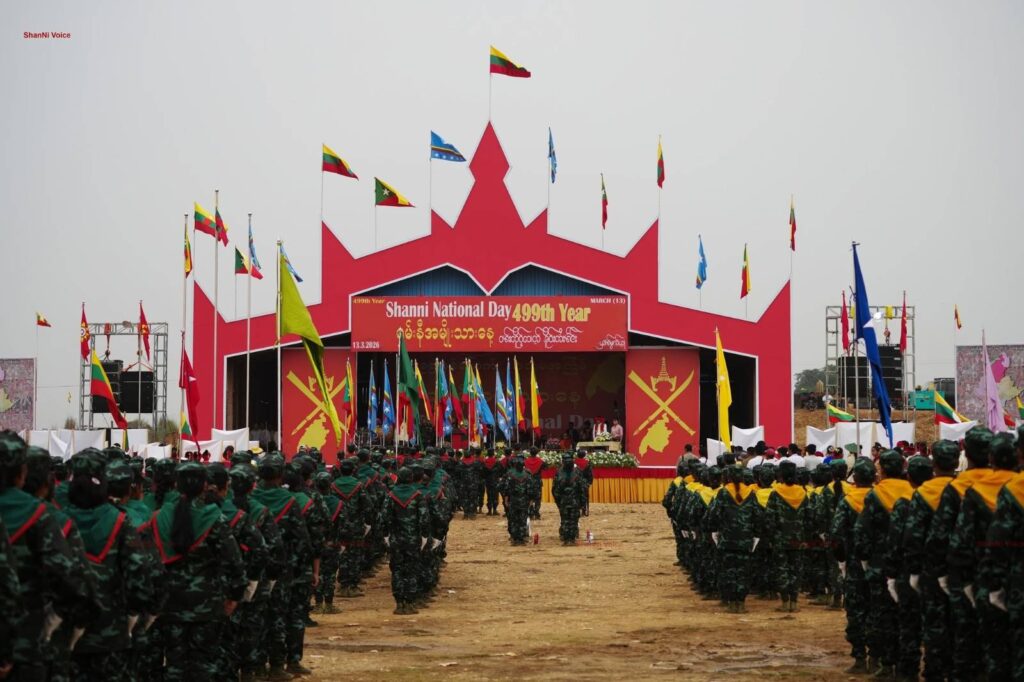
Identity and Constitutional Objectives
Ethno-Political Identity: The Shanni (“Red Shan”) are a Tai sub-group with deep historical roots in the upper Ayeyarwady and Chindwin valleys. Their grievances stem from 1948 colonial boundaries that partitioned their principalities, leaving them a minority in both Kachin State and the Sagaing Region.
Institutional Strategy:
Linguistic Unification: The Shanni Nationalities Unity Council (SNUC) is standardizing disparate Shanni scripts to preserve heritage.
Political Leverage: Unlike opposition groups, Shanni parties such as the Tai Leng (Shanni) Nationalities Development Party (TNDP) and the Shanni (Tai Leng) Solidarity Party (SSP) have participated in regional elections to secure “Ethnic Affairs Minister” portfolios, attempting to use constitutional mechanisms to gain autonomy.
Territorial Claims and Flashpoints
The proposed “Shanni State” claims eight districts, creating direct overlap with other ethnic territories:
Kachin Sector: Claims include Myitkyina, Mohnyin (the resource-rich Hpakant area), and Bhamo. The KIA views these as integral Kachin land and rejects Shanni claims.
Sagaing Sector: Claims include Hkamti, Katha, Mawlaik, Kalay, and Tamu.
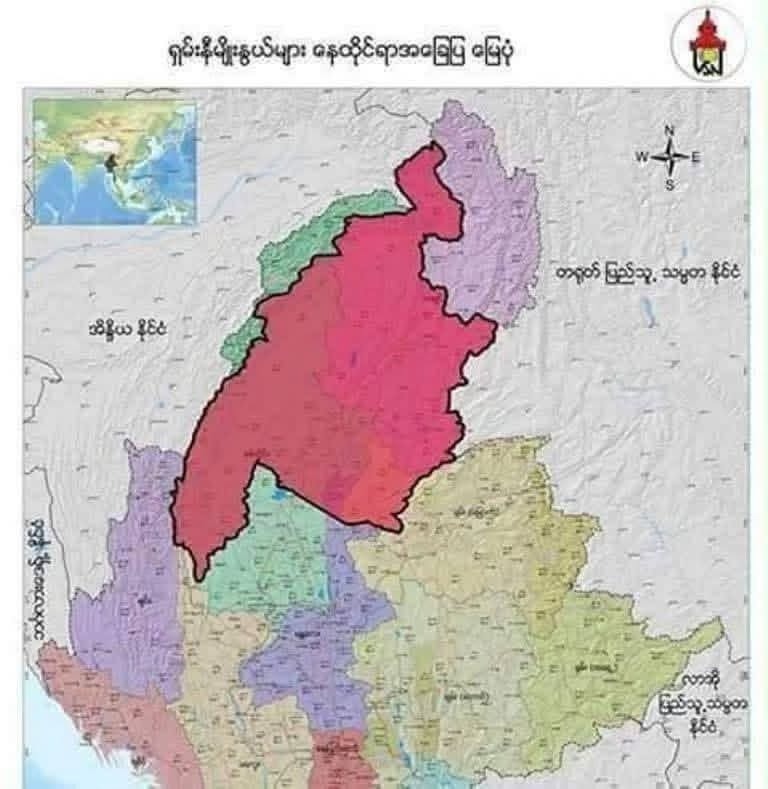
Key Flashpoints:
Kachin Overlap: High-intensity conflict over resource-rich mining hubs (Hpakant/Mohnyin).
Naga Overlap: Resistance to Naga expansion into Shanni-populated river valleys (Homalin/Hkamti).
Operational Realities: The Junta Alliance
De Facto Governance: In strongholds along the Chindwin River, the SNA acts as a local government, collecting taxes and running schools.
The Alliance: Lacking the numbers for a multi-front war, the SNA relies on the junta for airpower and heavy artillery to counter KIA and People’s Defense Force (PDF) offensives.
Civilian Cost: This alliance has intensified warfare in Shanni villages. Wartime conscription laws have driven many local youths to flee, creating internal friction.
Regional Perspectives & Strategic Isolation
National Unity Government (NUG): Views the SNA as a “Junta Proxy” and coordinates with the KIA to dismantle SNA-junta bases.
Kachin Independence Army (KIA): Rejects the SNA’s statehood proposal and actively combats the SNA to assert Kachin dominance.
Restoration Council of Shan State (RCSS): Offers cultural sympathy due to shared Tai ethnicity. While there is ideological solidarity, operational cooperation remains distant.
Shan State Progress Party (SSPP): Views the alliance as a betrayal of the ethnic cause and criticizes the SNA for collaborating with the military regime.
Shan Nationalities League for Democracy (SNLD): Offers conditional support, such as upholding cultural rights, but rejects the use of armed force or alliance with the junta.
Analysis
Given these circumstances, we must examine how the Shanni people, the SNA, and the SNUC will fare in their struggle for the right to self-determination.
Chief among the considerations is whether allying with the military junta is feasible and profitable, even as it isolates the movement from the nationwide anti-junta revolutionary wave. Second is how the looming inter-ethnic conflict between the Shanni and the Kachin, as well as the Kuki, can be diverted. Third is whether there is a way out of what appears to be a hopeless situation.
From the Shanni perspective, three strategic scenarios emerge from the alliance with the junta:
- Resistance Victory Scenario: If the anti-junta coalition successfully dismantles the regime, the Shanni movement will face political isolation. Their aspirations for a multi-district state will likely fail, and the SNA may face forced disarmament by the KIA.
- Junta Stalemate Scenario: If the military regime maintains a frozen hold over central corridors, the Shanni may be rewarded for their loyalty with a small, strictly limited Self-Administered Zone restricted to a few townships like Homalin or Hkamti.
- Permanent Balkanization Scenario: If Myanmar fractures into permanent localized fiefdoms, the Shanni will likely maintain a de facto, unrecognized armed enclave, navigating a permanent, low-intensity border war with neighboring factions.
Resolving Inter-Ethnic Conflict
Regarding the potential Kuki-Shanni conflict, a resolution may be possible if “unity in diversity” is agreed upon and the establishment of a Federal Democratic Union becomes a reality. During this transitional period, both ethnic groups should refrain from armed confrontation and instead resolve disputes through political means, even with the military junta acting as a go-between, as suggested by the Kuki.
Regarding the Kachin-Shanni conflict, the competition over area ownership should also be settled through political means and negotiation. While this process may be tedious, boring, and wearisome, the catch lies not in the negotiation process itself, but in a change of mindset and innovative thinking that can lift the process off the ground—a shift that has not yet occurred.
Identity Politics and National Identity
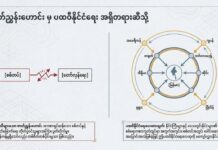
We must look closer at identity politics and link ethnic identity with a common national identity. If we adhere to “unity in diversity” and successfully link ethnic identity with a shared national identity, inter-ethnic conflict can be resolved.
In simple terms, the Kachin and Shanni can maintain their ethnic and cultural identities without reservation or external imposition, free to practice and promote them. Simultaneously, a common “national identity” involving the Kachin, Shanni, and other multi-ethnic peoples within Kachin State can be forged. This national identity would belong to everyone within the state and be identified with as a common bond.
If such an understanding can be worked out, local area demarcation and the creation of new constituent units can become a reality, provided a genuine Federal Democratic Union structure is agreed upon.
For now, this may look like a tall order and an impossible feat. However, if we keep in mind that nation-states and national identities are, as political theorists suggest, “imagined communities,” the warring parties can indeed change their mindset through innovative thinking.




Leave a Comments