




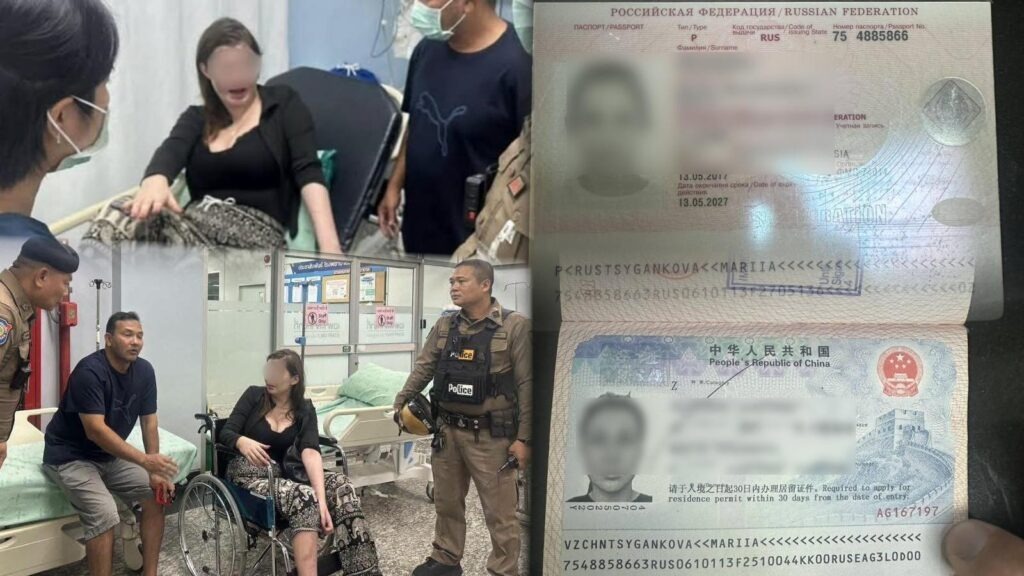
A 19-year-old Russian woman who was trafficked into an online scam operation in Tachileik has escaped across the border into Mae Sai, Thailand, according to local sources.
The young woman crossed the river from Tachileik into Mae Sai on the evening of August 9. Thai authorities subsequently transferred her to Mae Sai Hospital for medical treatment.
According to police, she initially traveled from Russia to China for employment before being brought to Myanmar. She was then moved through Yangon and Mandalay before eventually ending up in Tachileik, where she was held in a scam compound.
Based on her preliminary statements, she was physically assaulted at various locations before managing to cross the river into Thailand. Authorities said she had swollen bruises and abrasions on her hands and feet.
She remains deeply traumatized and is not yet able to provide detailed information about her employers or the specific nature of the work she was forced to perform. Initial police assessments indicate that she was lured into the operation and subjected to forced labor at an online financial scam compound.
A 20-year-old former scam-compound worker told SHAN that while Chinese and Myanmar nationals are commonly employed in cyber scam operations in eastern Shan State, with smaller numbers of Laotian and Vietnamese workers, the presence of a Russian victim is highly unusual.
“In scam operations, having Chinese and Myanmar people is standard. Laotians and Vietnamese are in the minority. But a Russian woman—that is unusual,” he said.
The former worker explained that employees who meet their performance quotas generally avoid physical abuse, while those who fail to meet targets face severe punishment, including salary deductions and beatings.
“From what we experienced, people who went in groups didn’t get beaten if they worked well. But if you couldn’t do the work properly, they would dock your pay and beat you. From what this woman has stated, it sounds very much like she was trafficked. Trafficked victims who can’t perform the work properly are subjected to arbitrary torture,” he added.
Local sources report that cyber scam operations remain active in Tachileik Township. Throughout 2026, crackdowns on scam operations have resulted in the arrests of both foreign and Myanmar nationals across Shan State.
In early February, more than 80 Vietnamese and Chinese nationals were arrested for allegedly operating online scams in the Mong Ha area of Mongyai Township. On August 7, the military regime reported that another 156 people—including Chinese, Laotian and Myanmar nationals—were arrested for alleged involvement in scam operations in Kengtung Township.










Leave a Comments