


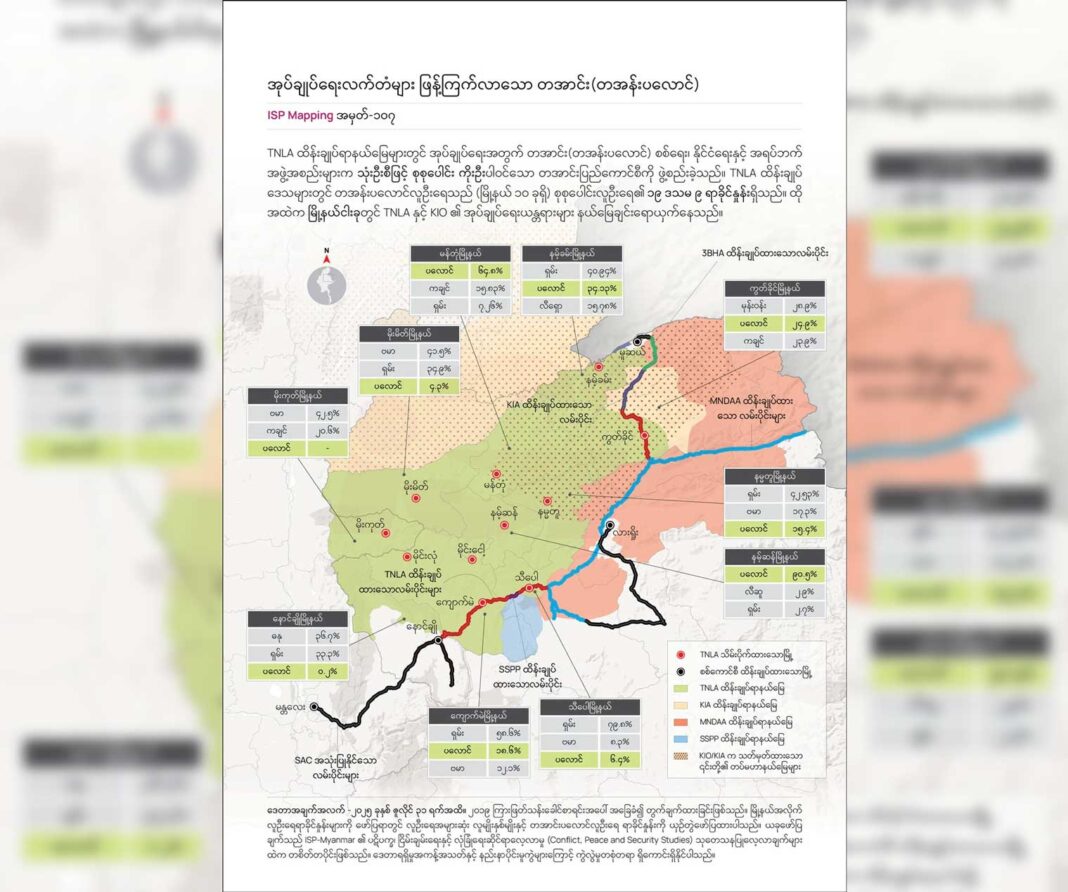
On August 12, Institute for Strategy and Policy – Myanmar (ISP-Myanmar) published an investigative report titled: “Ta’ang Land Council (TLC) and two administrative challenges,” which said that within 10 townships that Ta’ang National Liberation Army (TNLA) supposed to control the Ta’ang population is just 19.9 percent of the whole population, in which 5 townships the TNLA and Kachin Independence Organization (KIO) administrative apparatuses are overlapping.
According to ISP-Myanmar the data used in the survey are facts collected up till 2025 July 31, which is part of the “Conflict, Peace and Security Studies” and may be subject to different interpretation due to limitation of data collection and methodology differences.
“The TLC and two administrative challenges” is outlined by the ISP-Myanmar, as below:-
Period: The survey time span is during June to August 2025.
Region: The Region involved is northern Shan State and Mandalay Region territories which TNLA has control.
Actors Involved: The actors involved are PSLF/TNLA, Ta’ang National Party (TNP), Ta’ang Civil Society Organizations (CSOs) and Kachin Independence Organization/Army (KIO/KIA).
Issue: Since June 1 the TLC a new administrative machinery has been formed, with proportionate members from Palaung State Liberation Front/ Ta’ang National Liberation Army (PSLF/TNLA), that now controls 10 townships in parts of northern Shan State and Mandalay, Ta’ang Civil Society Organizations (CSOs) and political party’s representatives. TLC is designed to change systematically, the TNLA captured territories and into the highest administrative and political organ.
Development: The said area in northern Shan State is besides TLC, populated by multi-ethnic different people such as Kachin and Shan with their armed forces’ own administrative machinery. Some of the areas of Ta’ang State designation includes are under KIO’s southern region administration. In addition, the military council is waging counteroffensive against the TNLA controlled areas.
Implications: TLC first challenge is Intra/Inter Resistance Group Relations. The TLC (claimed) territories are overlapping with KIO administrative areas in 5 townships and the ongoing disputes could turned into explosive conflict anytime. The second challenge is Resistance-Society Relations facet. The TNLA controlled areas are populated with Kachin, Shan and Bamar etc. and the Ta’ang Palaung has only 19.9 percent of the whole population. Ambitious national policy such as changing Ta’ang language into official language becomes the main source of conflict. The acceptability by other (non-Ta’ang) ethnic groups or legitimacy achievement will continue to be the TLC’s challenge.
(NOTE: The unofficial translation is by the author)
Ta’ang Land Council
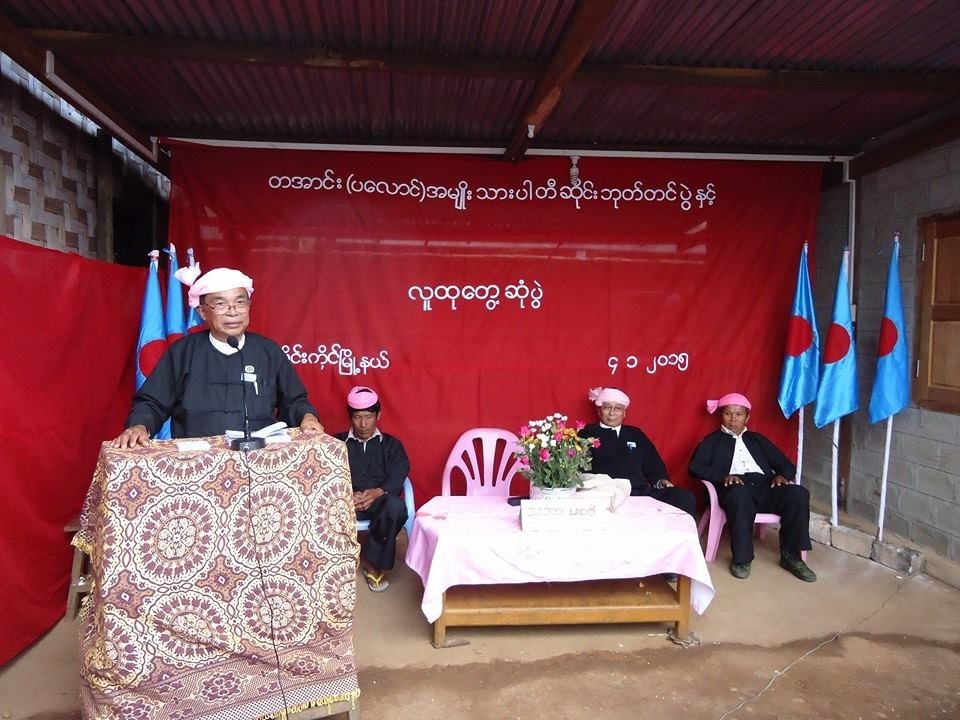
According to Ta’ang Political Consultative Committee (TPCC) June 9, 2025 announcement and CNI report, the formation of the Ta’ang Land Council (TLC) to govern the territories captured and controlled by the TNLA after fighting against the military council during Operation 1027.
The political summit of the TPCC, which includes the TNLA, TNP, and Ta’ang CSOs, was held from June 1 to 3, 2025.
Then, they accepted and approved the “Ta’ang State Revolutionary Government Plan” drafted by the Ta’ang State Constitutional Drafting Committee (TSCDC) and decided to form the “Ta’ang Land Council” as the highest political authority in the Ta’ang State during the revolutionary period. According to the plan, the TPCC, which was formed on March 24, 2021, has been transformed into the TLC to oversee and lead the executive, legislative, and judicial pillars of the Ta’ang State, the TPCC announced.
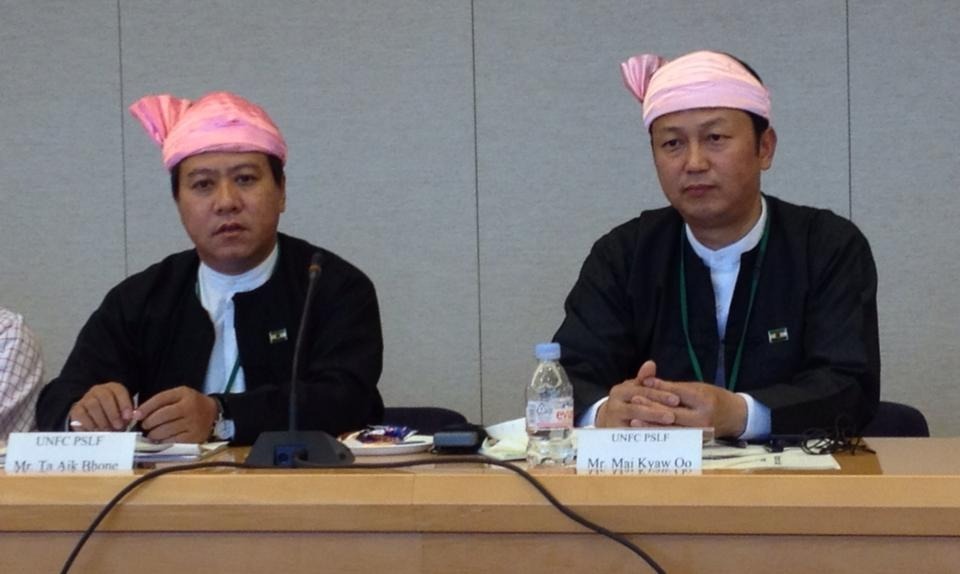
Therefore, the TLC had been made up of General Tar Aik Bone (TNLA Chairman), Lwe Moe Kham, Tar Aye Maung, General Tar Khu Lan (TNLA Vice Chairman-2), Tar Aung Pe, Tar Kyaw Tun, Lwe Moe Hlaing, Lwe Poe Kame’ Chaing, and Captain Lwe Ye (TNLA), the TPCC announced.
The TLC will make every effort to establish a Ta’ang People’s Government by 2025 as soon as possible, based on the territories captured by the TNLA and its allies in Operation 1027, with the leaders of the three groups and appropriate representatives of the people, said in the statement.
The TNLA launched Operation 1027 on 27 October 2023, with the Arakan Army (AA), Myanmar National Democratic Alliance Army (MNDAA), Karenni Nationalities Defense Force (KNDF), People’s Liberation Army (PLA), People’s Defense Forces (PDFs), Mandalay – PDF (MDY-PDF), Burma National Revolutionary Army (BNRA), and Danu People Liberation Army (DPLA) in northern Shan State and Mandalay Region.
Analysis
This timely analysis and investigative report of ISP-Myanmar may well be an eye-opener for the TNLA after its withdrawal from Nawnghkio, which actually stemmed from its failed grand strategy of putting its Ta’ang State realization aspirations on top of its originally set goals.
It is public knowledge that the TNLA mistreated allies that fought with it from Bamar heartland out of over confidence at the height of Operation 1027 military success. Moreover, its territorial expansionism implementation, at the expense of other local ethnic groups has put itself in loggerheads with the KIA, Shan State Progress Party (SSPP), and even MNDAA, which all are supposed to be its allies under the 7-member Federal Political Negotiation and Consultative Committee (FPNCC).
As the ISP-Myanmar rightly pointed out that Resistance-Society Relations facet is bound to escalate if the TNLA leadership doesn’t listen to reasons.
It is not enough to beat around the bush, blaming China for the lost of Nawnghkio and subsequently maybe also Mogok, Hsipaw and Kyaukme are going to be the targets, if the military junta can has its way.
In short, the TNLA needs to mend relationship with the Kachin and Shan population, including their armed forces and should not be indulged in false victory as its own achievement alone, as without the PDFs, LDFs from Anyar brethren, it won’t be able to capture territories. The same is also true with the Kokang or MNDAA.
True, TNLA has done its part for arming and training the PDFs and LDFs from heartland Burma. But it doesn’t has the right to manipulate them for its own narrow ambition and deviate from the original goal-setting of uprooting the military dictatorship system and installing genuine federal democratic union, according to the aspirations of the people.
But this doesn’t mean that the TNLA and Palaung Ta’ang people doesn’t has the right to demand its rights of self-determination within the bounds of democratic setting and principles to redraw boundaries and create new federal constituent units. However, this has to wait until the military dictatorship system is dismantled and federal democratic union government is in place. That’s the hard reality and realpolitik.
While the whole anti-junta ethnic-democratic loose alliance needs to do their part to become a formidable, solidified force to fight against the military junta, the TNLA will also have to do its part of changing its mindset and correct its failure, and last but not least apologize to the parties concerned, if it really is for the realization of the whole country people’s aspirations.

Leave a Comments