




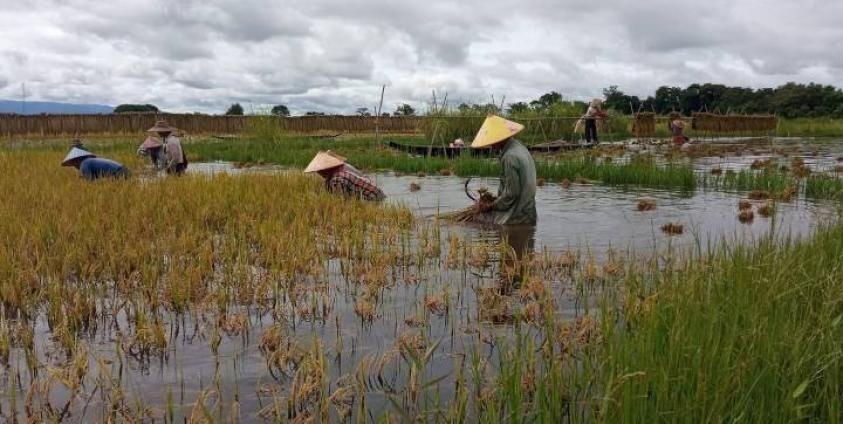
Farmers in the Pong Inn area, where the borders of Taunggyi, Hopong, and Hsihseng townships meet in southern Shan State, are facing mounting losses after consecutive years of flooding and a sharp decline in rice prices.
Last year, floods destroyed more than 7,000 acres of paddy fields. Many farmers took out loans to replant their crops this year. However, the situation has worsened again after Cyclone Wifha brought torrential rains to the region in July, submerging over 3,000 acres of summer paddy in Pong Inn, Ban Yin, and Nawng Morn village tracts in Hsihseng Township, as well as Nar Hee and Ah Thone Taw in Taunggyi Township.
The Pong Inn region, known for producing the locally famous Nawng Morn Shan rice, has long been a key rice-growing area in southern Shan State. But this year, both natural disasters and economic pressures are pushing many farmers to the brink of collapse.
“At the current paddy price, only the farmers are losing money. We can’t even recover the costs we spent,” said a local farmer from Pong Inn.
“Rice in the city sells for 120,000 kyats per 23 viss, but when they buy from us, we only get about half that.”
Currently, the paddy price stands at around 1,600 kyats per viss (approximately 1.6 kg), while farmers say they need at least 2,500 kyats per viss to break even.
Last year, when floods hit, the price of Shwe Att and Shwe Yin Aye rice—the region’s two most popular varieties—was about 250,000 kyats per 46-pound bag, but by harvest season it had dropped to 100,000 kyats, leaving many farmers with losses of more than half their investment.
Farmers estimate that the cost of growing one acre of paddy, including labor, fertilizer, and other inputs, now reaches around 1 million kyats.
Since the 2021 coup, inflation has driven up prices for fuel, fertilizer, pesticides, and seeds, while labor shortages have worsened due to young people leaving the country to escape conflict and conscription.
“Because most of the young people have gone abroad, we now have to use machines to harvest,” said a 30-year-old farmer from Pong Inn.
“Hiring machinery costs between 200,000 and 400,000 kyats per acre.”
Adding to their hardship, local farmers say they are being forced to pay “security” fees to both the Pa-O National Army (PNA) and the military council. The PNA reportedly collects 10,000 kyats per household every six months, while the military council collects 20,000 to 30,000 kyats per month under the pretext of conscription.
“Our first hope is for peace,” the farmer said.
“When fighting happens, there’s always someone collecting money for ‘security’. No one actually helps us.”
Following the coup, major border trade routes for rice exports to China were disrupted, forcing most rice exports to shift to sea routes.
In mid-2024, as domestic rice prices rose, the military council arrested several major traders and supermarket owners, accusing them of price manipulation.
The Myanmar Rice Federation announced on October 2 that between April and September 2025, the country exported over 1.2 million tons of rice and broken rice, earning about USD 408 million. The federation said it aims to export an additional 1.8 million tons in the next six months.








Leave a Comments