




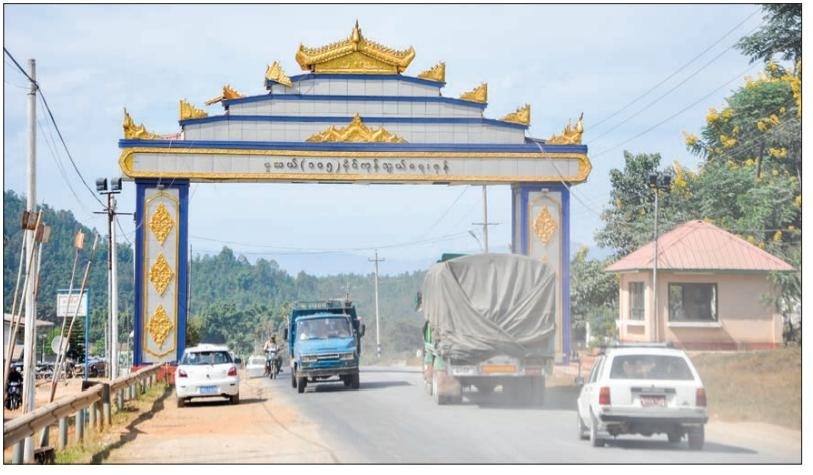
New restrictions imposed by military authorities on the transport of Chinese goods into northern Shan State are disrupting trade routes, slowing cargo operations, and driving up commodity prices, according to local traders and transport workers.
Residents and merchants say the crackdown comes at a time when many communities in northern Shan rely heavily on Chinese imports for daily necessities and consumer products.
Truck drivers and traders who spoke to SHAN said authorities have intensified inspections and seizures of Chinese goods along routes leading into Lashio and toward southern Shan State in recent days.
“They are seizing goods from every direction,” a merchant from Lashio said. “Both the Mongyai–Mongkung route and the Koonghsar–Namlan route are being checked. Some drivers try to avoid those roads by going through Namhsan, Mong Ngaw, and Monglon, but inspections are taking place there as well.”
According to local sources, Chinese goods are still reaching areas outside Lashio, but tighter controls have forced traders to move products into the city at night, often by paying bribes at checkpoints.
One truck driver said unofficial payments that previously cost around 80,000 kyats per vehicle have now risen to more than 100,000 kyats. He added that even low-cost consumer goods, including Chinese instant noodles, are being confiscated during inspections.
Drivers also say the situation is affecting domestic transport businesses.
Previously, cargo was typically transferred between Myanmar and Chinese trucks near border crossings. However, local drivers report that large Chinese trucks are now entering areas around Lashio directly, reducing work opportunities for Myanmar transport operators.
“Local drivers no longer have stable work,” one driver said. “Some are trying to sell their trucks at low prices, while others have stopped operating entirely.”
Several commodity exchange centers and bus terminals in Lashio have reportedly suspended cargo acceptance due to the restrictions. Passenger bus companies have also been warned not to transport Chinese-made goods.
The tightening measures reportedly follow a May 4 coordination meeting in Naypyidaw that included the Ministry of Border Affairs. According to local accounts, officials discussed a “100-day project” focused on regional stability, anti-drug operations, and efforts targeting online scam networks.
However, traders warn that continued restrictions on imported goods could severely disrupt supply chains across Shan State and beyond.
Residents say prices are already rising. A native of Hsenwi currently living in Yangon told SHAN that the cost of basic food items has increased sharply.
“Back home, an egg costs around 200 kyats. In Yangon, it’s now about 550 kyats,” he said.
Local traders fear that if restrictions continue, shortages and price increases could spread further into major cities, including Mandalay and Yangon.
The current measures also follow earlier reports from August 2025 that the Foreign Exchange Supervisory Committee had temporarily restricted imports of dozens of products, including food, electronics, and consumer goods, through both land borders and maritime routes.
Residents and transport workers say the latest restrictions are adding further pressure to an economy already strained by conflict, inflation, and unstable trade routes.







Leave a Comments