



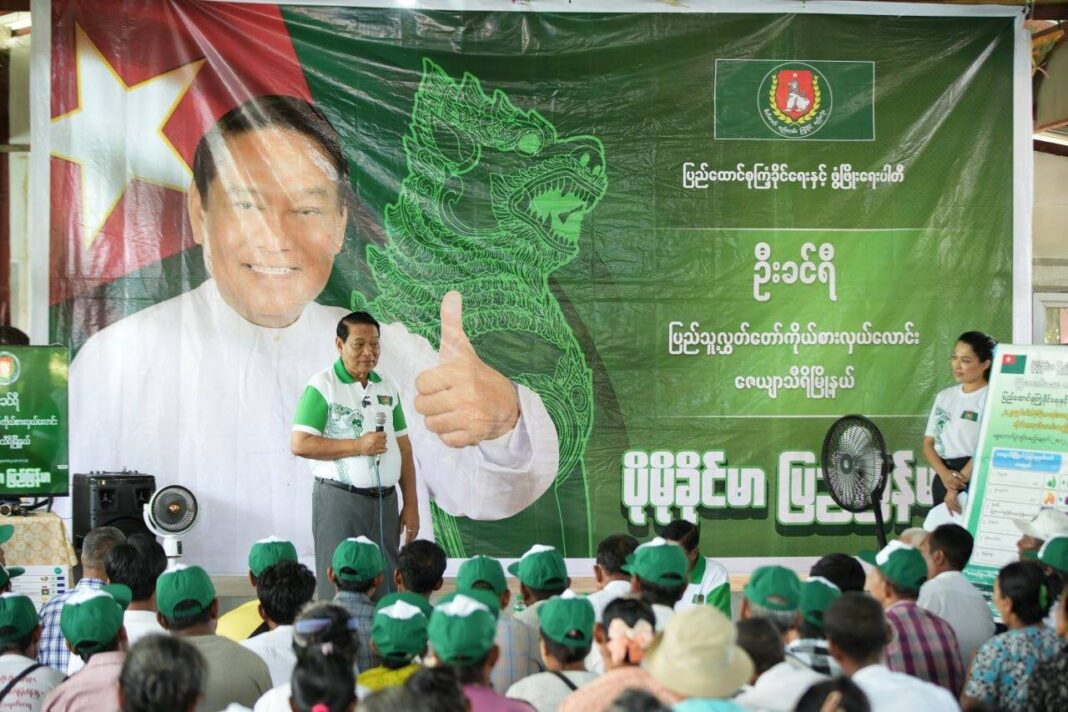
As the Myanmar military junta’s or State Security and Peace Commission’s (SSPC) planned general elections draws nearer each day, speculations of the virtue of pros and cons to hold elections become louder than ever.
However, it is appropriate to look at the Union Solidarity and Development Party (USDP) which is considered the SSPC’s or military junta proxy but now openly becoming a direct military sponsored political party to use it as a vehicle to achieve legitimacy, even in among a small circle of authoritarian ruler countries.
Historical Background – From USDA to USDP
Precisely, the USDP historical evolution can be summed up as follows:
- 2010 Formation of the Union Solidarity and Development Party (USDP) as a successor to Union Solidarity and Development Association (USDA) established as a pro-military party
- 2010 General elections USDP wins, claims of electoral fraud
- 2015 General elections USDP loses decisively to the National League for Democracy (NLD)
- 2020 General elections USDP loses again; military coup follows
- 2025 Scheduled elections expected to win amid widespread opposition disbandment
The USDP was officially formed on April 29, 2010, by Thein Sein, a former military general, and other senior military officers. It succeeded the USDA, a pro-government organization established to consolidate military power and maintain political control in Myanmar.
Initially, the USDA was instrumental in managing political affairs under military rule, often resorting to violence against political opponents. The USDP inherited the USDA’s resources, political influence, and a reputation for coercion. The party aligns itself with ultra-nationalism, militarism, and conservative ideologies.
In 2010 Elections, the USDP won a significant victory in the 2010 general elections, which were widely criticized as a sham, with many opposition parties boycotting the vote. The outcome marked the beginning of a transitional period as the military purported to shift towards a civilian government.
In 2015 Elections, In the 2015 elections, the USDP was defeated by the NLD, led by Aung San Suu Kyi. The USDP secured only 8.4% of the elected seats, highlighting a declining public support.
In 2020 Elections its aftermath, the USDP lost again in the 2020 elections, which the NLD won decisively. In January 2021, claims of widespread voter fraud by the military led to a coup d’état, effectively reinstating military rule. Key leaders, including Aung San Suu Kyi, were arrested.
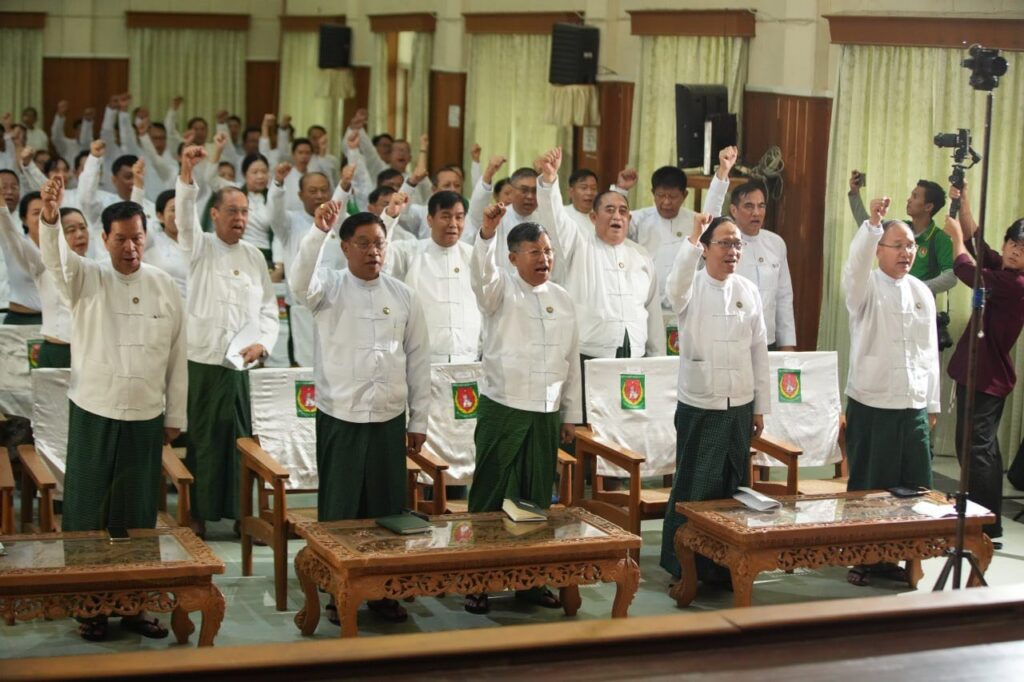
As Myanmar heads toward the 2025 elections, scheduled to start on December 28, 2025, the USDP is again positioned as the primary party expected to gain seats, following the disbandment of many opposition groups, including the NLD. The electoral framework has been criticized as undemocratic, and international observers have deemed the planned election a sham intended to legitimize military rule.
The USDP has become more entrenched in its role as a military-proxy party, with state resources and former military officials supporting its activities. The party’s leaders openly make inflammatory statements that reflect its commitment to ultra-nationalist ideologies, particularly affecting ethnic minorities in Myanmar.
Prospects for the USDP appear bolstered by a hostile environment for dissent, characterized by widespread arrests and suppression of opposition parties. Its nexus with the military ensures that it remains a dominant player in shaping Myanmar’s political landscape, albeit under duress and international scrutiny.
The USDP’s journey reflects Myanmar’s tumultuous political climate, characterized by military dominance and limited democratic processes. Its transformation from an organizational extension of military power to a principal political party illustrates the deep entrenchment of military influence in Myanmar’s governance. As elections approach in December 2025, the international community remains skeptical about the viability of a fair electoral process, casting doubts on the true nature of democracy in Myanmar.
Moreover, the military junta dropped all pretense of USDP being its proxy and openly showed that it is the military-owned political party. Recently, it transferred hundreds of its officers to join the USDP to stand for elections without even asking for permission from the USDP leadership.
In other words, the USDP and the military junta are one and it is entitled to do whatever it wants, including making use of the state revenue for election campaigns and related matters, whereas other political parties will be immediately disqualified for making use of the slightest state-owned funds or facilities in anyway.
From the existing Union Election Commission (UEC) promulgated law point of view, USDP will have to be disqualified under such allegations. But the junta acts as it is above the given law and no one could do anything about it.
International community’s opinion on the military-planned elections
Concerning international opinion, People’s Spring’s report compiled the following on November 14, 2025.
UN Secretary-General Antonio Guterres said: “I don’t think anyone believes that these (military council) elections will be free and fair. I don’t think anyone believes that these elections will provide solutions to the problems in Burma. This is the time when humanitarian assistance needs to be increased, when the violence needs to stop, and at the same time, when the political transition towards civilian rule and respect for the constitutional government is needed.” – (From a press conference at the ASEAN Summit)
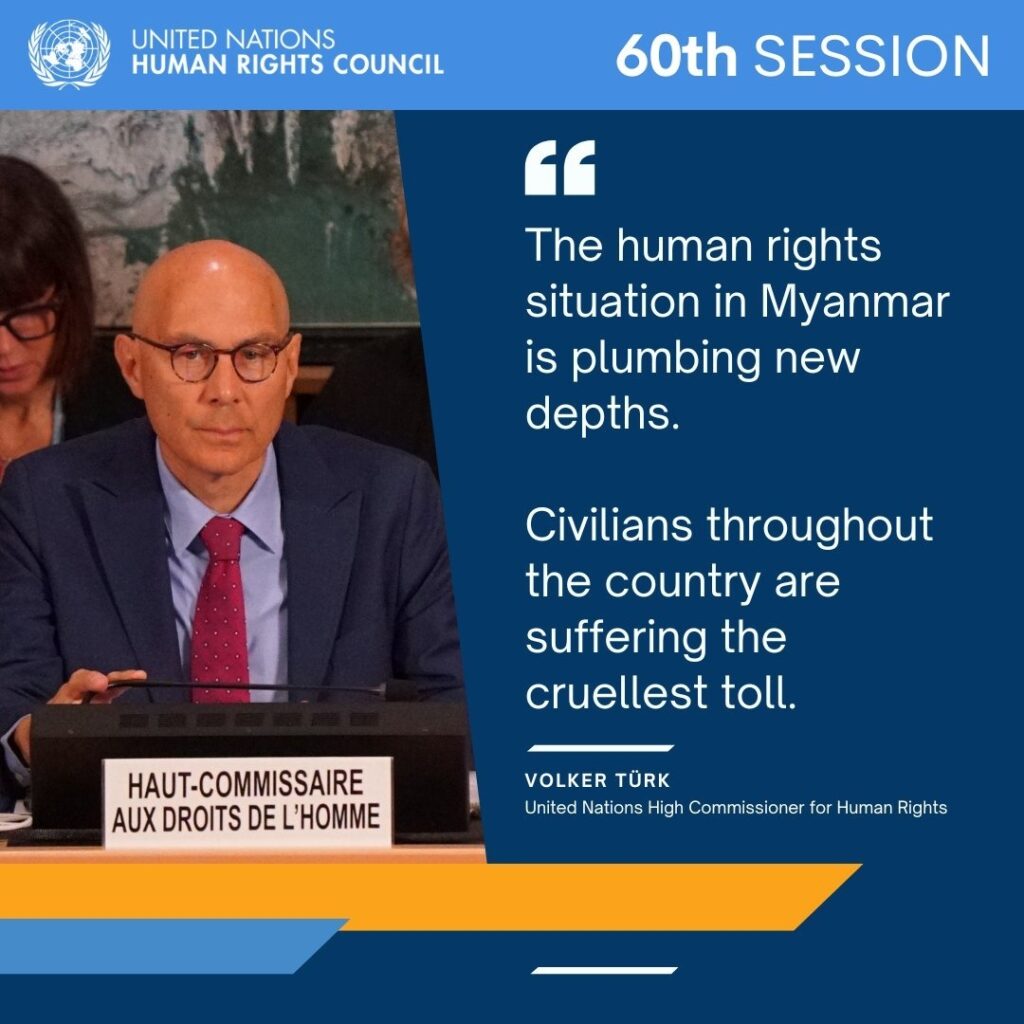
High Commissioner for Human Rights Volker Türk said: “It is unthinkable to hold elections under these conditions. Who can say that elections are free and fair? How can they hold elections in so many parts of the country that are not under anyone’s control? How can they hold elections when the military itself is involved in the conflict and has been oppressing its own people for years?” – (Interview with AFP)

Tom Andrews, the Special Rapporteur on human rights in Myanmar, has made it as clear as that these elections are a sham. “You can’t have free and fair elections when opposition political leaders are being arrested, detained, imprisoned, tortured,” he said. – (From a press conference at UN headquarters)
New Zealand Foreign Minister Stan Peters said, “I want to tell this House that I am deeply concerned about the upcoming elections for the Myanmar Military Council. The current arrangements are neither free nor fair. They are not conducive to lasting peace. There are obvious flaws in the electoral process. There is no genuine opposition party on the ballot. There are also laws that criminalize public criticism of the election. Any elections planned under these circumstances will not be credible.”- (From a New Zealand parliamentary debate)
Singapore Foreign Minister Vivian Balakrishnan said, “The immediate priority must be to reduce violence, provide humanitarian assistance and create an environment for dialogue. Peace, security and inclusiveness must be the foundation of the upcoming elections. Only then will the results be credible and reflect the will of the people of Burma.”- (From a reply to the Singapore Parliament)
According to UN News, H.E. Annalena Baerbock, in her current role as President of the 80th session of the UN General Assembly (UNGA), has not issued a specific, new individual statement solely focused on the ongoing events of Myanmar’s planned December 2025 elections.
However, her overall stance and the position of the United Nations, which she represents, are clear:
- Illegitimacy of the Vote: The international consensus, which aligns with Baerbock’s stated commitment to human rights and democratic norms, is that the elections planned by the military junta are a “sham” and a “fraud”.
- Focus on UN Principles: In her acceptance and opening speeches for the 80th session, Baerbock emphasized upholding the principles of the UN Charter and addressing the more than 120 global armed conflicts, including the one in Northern Myanmar. The planned elections violate these core principles as they exclude major opposition parties (like the NLD), involve the imprisonment of civilian leaders, and are being held amidst a raging civil war.
- Call for Dialogue and Peace: The position is that genuine peace and an inclusive political dialogue are essential before any credible election can take place. UN Secretary-General Antonio Guterres has also stated that “nobody believes those elections will contribute to solving Myanmar’s problems”.
Her statements as the UNGA President reiterate the need for the international community to work “Better Together” to uphold democratic values and human rights globally, directly applying to the situation in Myanmar.
People’s Survey on election issue
The People’s Survey was independently designed, conducted, and analyzed by a collective of researchers and volunteers from both inside Myanmar and the global Myanmar diaspora. It is not affiliated with any political organization, armed group, or government. The initiative was supported through the Platform for People Movement, a network of independent Myanmar citizens, diaspora communities, and civil society partners committed to amplifying the voices of the people of Myanmar.
In this respect, a survey titled: “People Survey: People opinion on legitimacy of elections in Myanmar 2025” has just been released recently.
The findings of Executive summary is as follows:
- “The People’s Survey was conducted from 27 October to 5 November 2025 to capture public opinion on Myanmar’s upcoming military-organized election scheduled for December 2025. A total of 3,709 participants responded, with 99% completing the survey. Respondents represented 271 of Myanmar’s 330 townships and diaspora communities across 20 countries.
- Findings reveal an overwhelming and consistent rejection of the military regime and its planned electoral process. Ninety-nine percent of respondents stated they do not accept the 2021 coup, and 98% believe the junta’s 2025 election will be unfair and illegitimate. Similarly, 98% do not believe the election will resolve Myanmar’s political or humanitarian crises. Reflecting these views, 96% declared they will not vote in the junta-led process.
- These results demonstrate a clear national consensus: the military’s so-called election is viewed as a political trap designed to legitimize its continued rule rather than to restore democracy or peace. Despite repression, surveillance, and fear, people have expressed strong moral resistance and a unified aspiration for genuine civilian governance.
- The survey offers credible, community-driven evidence of the Myanmar population’s enduring rejection of military authority and its unwavering demand for freedom, justice, and legitimate democracy.“
In conclusion, “The People’s Survey captures the clear and united voice of Myanmar’s people: they reject the coup, denounce the junta’s sham election, and refuse to lend legitimacy to military tyranny. Despite fear, censorship, and violence, citizens continue to express their collective resistance with courage and clarity. These findings reaffirm that the struggle in Myanmar is not for an election under dictatorship, but for genuine freedom, justice, and a future defined by the people themselves.”
SSPC multifaceted strategy
The military junta in Myanmar is engaging in a multifaceted strategy as it approaches the planned general elections on December 28, 2025. Its actions are primarily aimed at solidifying its power, projecting legitimacy, and suppressing dissent, particularly from anti-junta groups.
Military and political strategies, such as intensifying military operations to suppress anti-junta movements and maintain control over key regions are employed. Despite being seen as losing ground, the junta aims to consolidate control in strategic areas to facilitate the elections.
The regime is also conducting airstrikes and ground operations against various ethnic armed organizations and local resistance groups, which threaten its authority. More than 7,000 airstrikes have been reported since the onset of the coup, targeting schools, hospitals, and civilian areas to instill fear and compliance.
Legislative manipulation, such as enacting new laws to control the political landscape further. The “Law on the Prevention of Disruption and Interference with Elections” imposes severe penalties for dissent, including capital punishment for acts deemed disruptive.
Moreover, the regime has dissolved numerous political parties, notably those opposed to the junta, while relaxing criteria only for military-aligned parties, ensuring a biased electoral environment.
According to phased elections as a propaganda tool, the elections will unfold in phases, allowing the junta to deploy military resources selectively and manipulate outcomes in favor of approved party candidates, primarily from the military-backed USDP.
With regards to controlled voting areas, voting will take place primarily in regions under military control, strategically excluding areas governed by resistance groups, thus framing the elections as a controlled exercise in democracy.
On suppression of dissent, in the lead-up to the elections, the junta has arrested approximately 100 individuals, including minors, for failing to comply with electoral laws or for speaking out against the regime. This crackdown serves as a warning to potential dissenters.
Concerning propaganda campaigns, the junta is utilizing state-controlled media to disseminate its narrative about the elections, framing them as a return to stability and order, while dismissing international condemnation as interference in Myanmar’s internal affairs.
Analysis
To sum up, it is clear that the USDP isn’t a military’s proxy anymore but undoubtedly becomes directly the military’s own political party, like the head and tail of a coin, one side the military and the other the political party.
Concerning the future speculation of Myanmar’s political landscape, the upcoming elections as engineered by the military junta, are expected to align closely with the dynamics observed during the 2010 elections. Despite growing local and international skepticism regarding their legitimacy, these elections represent a pivotal moment for the junta to solidify its power.
The junta’s electoral strategy aims to create an illusion of legitimacy while maintaining strict control over the political sphere. This tactical maneuvering suggests that the military is less interested in genuine reform and more focused on solidifying its grip on power. Such elections are unlikely to usher in meaningful change but rather reinforce military authority.
The local population, having witnessed the junta’s brutal repression post-2020 elections, is likely to remain disillusioned. The potential for civil unrest and resistance movements will persist. Activism may become more fragmented and covert due to the heightened risks, but the ongoing discontent could still manifest in significant opposition.
While countries like China, India, and Russia, along with some ASEAN nations may offer tacit support or recognition of the junta’s legitimacy, the broader international community—including the UN—is expected to push back against the elections and the junta’s authority. This could lead to increased diplomatic isolation for Myanmar, further exacerbating socioeconomic challenges.
Last but not least, if the junta’s strategy succeeds in staging a manipulated electoral process, it will likely result in a continuation of military rule under the guise of democracy. The economic hardships, compounded by international sanctions and local dissent, may lead to a more fragmented society, rife with conflict.
In such a scenario, the prospect of stability seems bleak, with the possibility of increased militarization and wider unrest looming on the horizon. Ultimately, Myanmar may find itself caught in a cycle of repression and resistance, with little hope for positive transformation unless there is a significant shift in both local and international dynamics.



Leave a Comments