




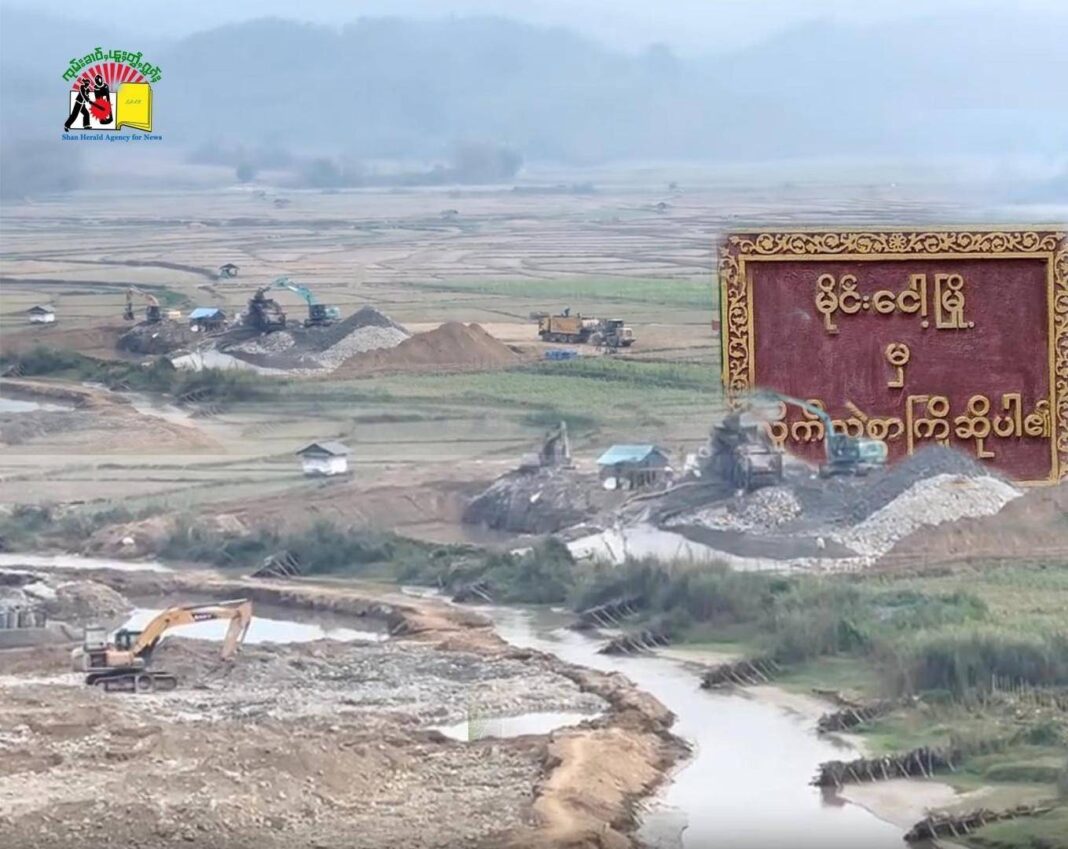
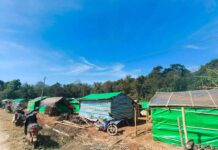
Large-scale gold mining using heavy machinery is rapidly destroying farmland along the Nam Jing stream in Mong Ngaw, Kyaukme Township in northern Shan State, according to local residents.
Villagers say once-productive paddy fields have been reduced to vast mounds of earth as mining operations expand across agricultural land between Koon Kok and Man Peng villages. The extraction, carried out with backhoes and other heavy equipment, is reportedly continuing around the clock.
“The piles of earth they’ve left behind look like Loi Sam Sit Mountain. You can’t even see the paddy fields along the stream anymore. Our family’s fields are gone as well. We don’t know what kind of suffering awaits Mong Ngaw in the future,” said Nang Kham*, a local resident.
Mining activity often continues late into the night, sometimes until 1:00 a.m., with constant noise from machinery.
“Now, no matter which direction you look, you see backhoes. At night, you can hear the constant pounding and digging,” she added.
Residents say gold mining in the area began after the 2021 military coup but has intensified significantly following “Operation 1027,” particularly after the arrival of the Myanmar National Democratic Alliance Army (MNDAA).
Local sources allege that the MNDAA and Chinese business interests are directly involved in the mining operations, while the Shan State Progress Party (SSPP) and the Ta’ang National Liberation Army (TNLA) are granting permission and collecting taxes. Mong Ngaw, located about 32 miles from Kyaukme, was captured by TNLA forces in January 2024 during the first phase of Operation 1027.
“Anyone with a gun is a king. If they tell you to do something, people cannot refuse,” said Sai Hla Kyaw*, another resident.
Although mining operators have purchased farmland for tens of millions of kyats—often promising to restore the land—residents say the damage is irreversible. Excavation brings layers of sand and gravel to the surface, rendering the soil infertile.
“When sand and gravel are brought to the surface, those fields won’t be usable for five years, or even ten,” Nang Kham said.
Locals also describe a chain reaction of land sales, as upstream mining disrupts natural water flows and leaves downstream farmers unable to continue cultivation.
“Once one person at the head of the stream sells, those downstream are forced to sell too. The miners take the gold and leave—but what water will we have left to farm?” she said.
SHAN reached out to the TNLA and SSPP for comment but had not received a response at the time of publication.
Amid ongoing conflict and limited economic opportunities, many young people have already left Mong Ngaw, leaving behind mostly elderly residents. Communities fear that continued environmental degradation will make long-term survival in the area impossible.
“In the next five to ten years, the environment will be ruined. Locals won’t be able to make a living and will have to migrate abroad. Gradually, the local population will disappear,” Sai Hla Kyaw warned.
Residents also expressed concern that their ancestral villages could eventually be taken over by outside investors and other groups, as land degradation and economic pressure force communities to abandon their homes.
They further accused armed groups operating in the area of prioritizing profit over the protection of local communities.
“Every armed group seems to turn a blind eye for the sake of profit. For them, buying ammunition has become a higher priority than protecting people,” Sai Hla Kyaw said.
Local observers note that large-scale gold mining has expanded in areas controlled by the Brotherhood Alliance, particularly after Operation 1027. Similar cases of environmental damage linked to mining have also been reported in other parts of Shan State in recent months.



Leave a Comments