

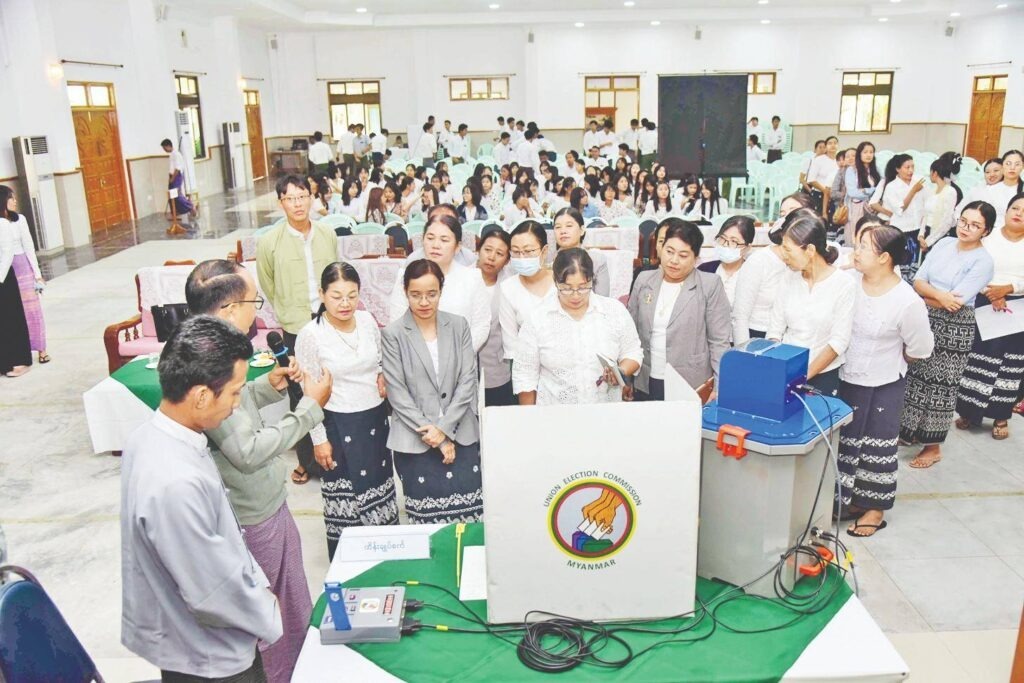
Political parties permitted to participate in Myanmar’s military-staged vote are increasingly nominating female candidates, amid low public interest and growing difficulty in recruiting individuals willing to take part in a process widely rejected by pro-democracy forces.
Data released by the junta-appointed Union Election Commission (UEC), which operates under military control, show a noticeable rise in female candidates compared with previous general elections held before the 2021 coup. According to the UEC, 309 women are listed as candidates for the Pyithu Hluttaw (Lower House), 190 for the Amyotha Hluttaw (Upper House), and 704 for regional and state legislatures, bringing the total number of confirmed female candidates to 1,183. By comparison, 3,752 male candidates have been approved.
A female politician from northern Shan State said the increase does not necessarily reflect greater political inclusion, but instead highlights a shortage of candidates willing to participate in a process organized by the military regime.
“The fact that the number of women has increased also shows that women’s participation was lower before. At the same time, political parties are struggling to find candidates, so they are selecting whoever is available. Some nominees have little or no political experience,” she said.
She added that many individuals with long-standing political involvement have withdrawn from formal politics or shifted to other fields since the coup, contributing to a decline in experienced political figures willing to run.
UEC data show that 799 women contested the 2015 general election and 908 ran in the 2020 election under the former National League for Democracy (NLD) government, both of which were conducted before the military seized power. In 2020, the Shan Nationalities League for Democracy (SNLD) recorded the highest female participation rate, at 28 percent.
A Shan State politician said that gender alone does not determine meaningful representation.
“Whether a candidate is a woman or a man, what matters is political capacity and responsibility. Without raising political standards, representation will not benefit the people or the country,” he said.
The military regime has announced it will begin the first phase of its planned voting process on December 28, followed by additional phases in January 2026, under a system combining First-Past-the-Post and Proportional Representation.
Daw Sandar Min, a former NLD member and current independent candidate, said increased female participation may also reflect political awakening driven by years of conflict, as well as inspiration from female political figures such as Daw Aung San Suu Kyi.
“With Daw Aung San Suu Kyi as a starting point, women began to see leadership as possible. The visibility of women in senior political roles globally may also be encouraging more women to step forward,” she said.
Political analysts say the regime may be highlighting female participation to project an image of inclusivity, despite the absence of broad public support and a lack of international recognition for the process.
The National Unity Government (NUG) has reiterated its rejection of the military-staged vote, describing it as illegitimate, while pro-democracy forces have pledged to oppose or disrupt the process.



Leave a Comments