



“That day, I thought we were going to die from the gunfire.”
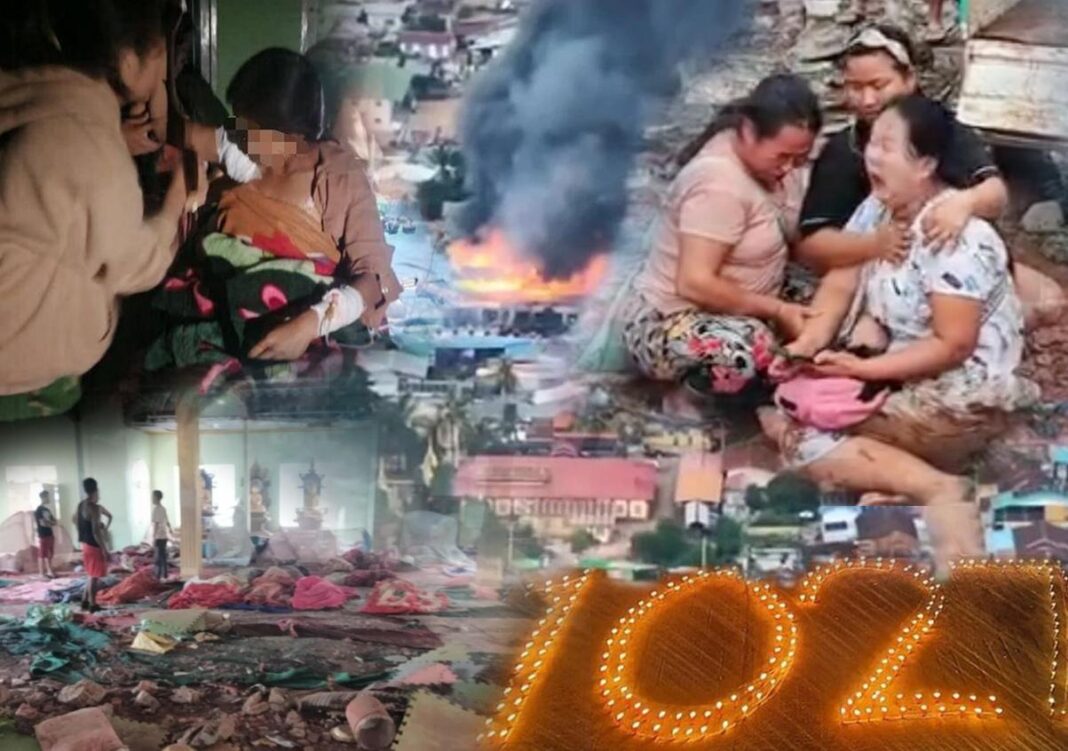
When a heavy shell landed in front of *Nang Lao Kham’s house, it was raining. At that moment, she had her 7-month-old son strapped to her back and was carrying her daughter in her arms. The incident took place in July 2025 during the military’s counter-offensive in northern Shan State.
Nang Lao Kham recounted what she faced during the clashes between the Military Commission and the TNLA in July 2025. Her family lives in Nawng Ping village, Kyaukme Township. For them, war is no longer an event but a recurring pattern. She has been displaced three times during the “Operation 1027” conflict.
“Operation 1027,” which began on October 27, 2023, saw major fighting between the military junta and the Three Brotherhood Alliance—the Kokang Army (MNDAA), the Ta’ang (Palaung) National Liberation Army (TNLA), and the Arakan Army (AA)—along the Union Highway, the Myanmar–China trade route in northern Shan State.
*Nang Lao Kham’s village has faced “Operation 1027” three times: in October 2023, November 2024, and July 2025. The first time she fled, she carried her eldest daughter, who was about eight months old. When she fled for the third time, she had her second child, a 7-month-old son, which heightened her fear and anxiety.
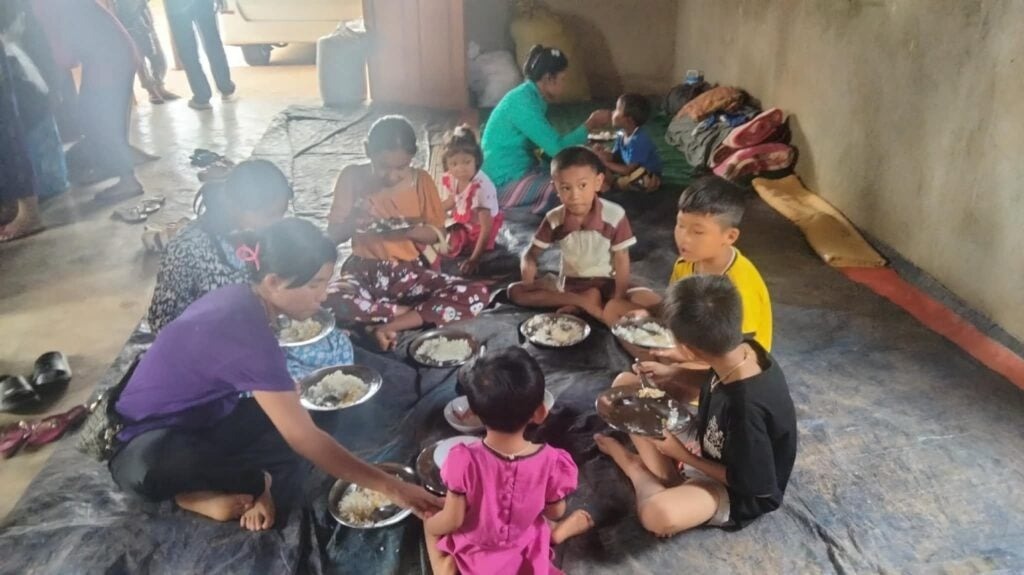
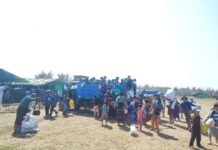
During the displacements, her family took shelter in the home of an acquaintance in a village about 22 miles from Nawng Ping. On October 1, 2025, the military regime regained control of Kyaukme town. Because IDPs from “Operation 1027” have no dedicated camps, they take temporary shelter in friends’ homes or monasteries, forcing them to return as soon as the fighting subsides. For this reason, her family returned home once the shelling quieted.
“When we returned, it was like a ghost town. Houses were damaged by heavy shelling and gunfire. Some were so badly burned they couldn’t be lived in,” she said. She added that clothes and belongings were scattered everywhere by thieves, and her house had been ransacked and damaged by heavy weapons. Holding her child, she could no longer hold back her tears.
“Even now, the upstairs of our house—hit by a heavy weapon—is covered only with a plastic sheet. When it rains, it leaks, and everything gets wet,” she explained.
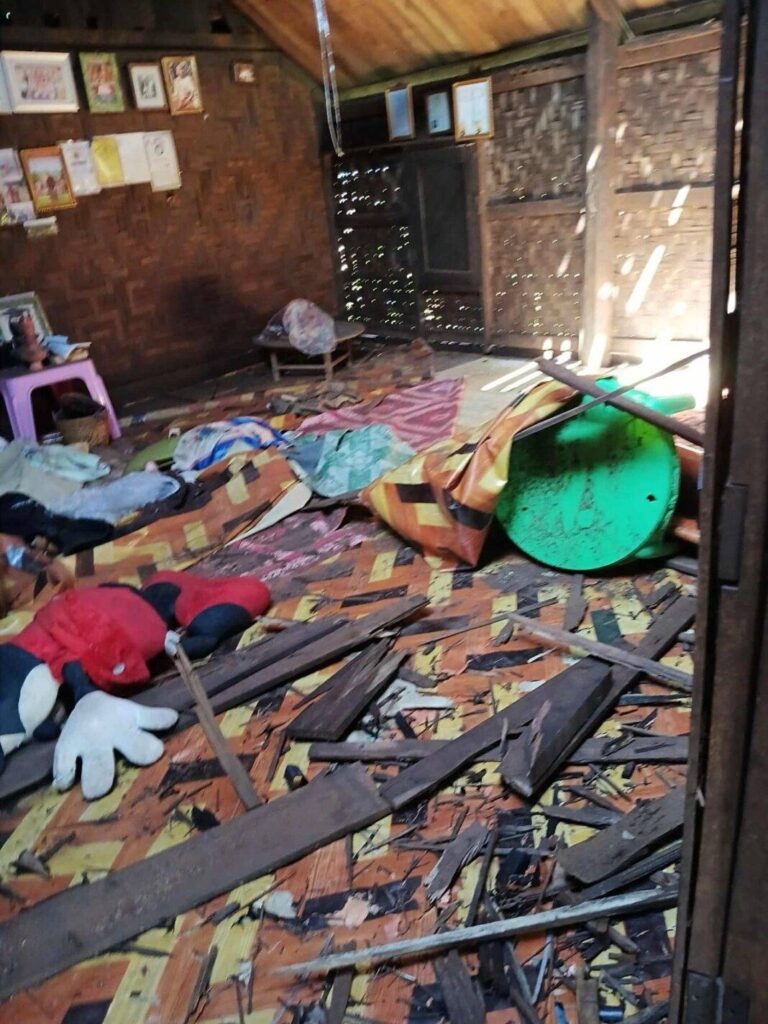
On October 4, military aircraft bombed Zei Kon Huong village in TNLA-controlled Namhsan Township, killing two children, injuring nine others, and destroying numerous homes. Among the destroyed homes was that of 70-year-old Daw Saw.
“Now, I don’t even have a plate to eat from. I’ve lost everything. I’m eating and sleeping at someone else’s house,” she said, her voice trembling as she looked at the ruins of her home. She expressed deep sadness at the destruction of the house she had lived in for more than 70 years and said she has no funds to rebuild.
After the displacement, residents returned home despite the dangers of landmines and unexploded ordnance (UXO). Just one week after returning, Nang Hom of Nawng Ping village stepped on a landmine while preparing a seedbed for mustard greens in her yard, resulting in the amputation of her leg.
“The mine exploded near their fence. The sound was very loud—we were all terrified. Now she has lost one leg,” a female neighbor recounted. Nang Hom, now unable to work, is struggling to afford treatment and to meet her basic needs. Her family’s home was also burned down by heavy weapons.
“Since she lost a leg, she can’t work. They urgently need help. Even though we are terrified of stepping outside, we had no choice but to return,” the neighbor said.
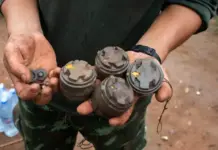
Although the military regime controls Kyaukme town, they have not cleared the landmines or UXO. According to residents, mines are being found everywhere.
“Since we came back, we’ve been finding mines every day—four or five a day. No one has come to clear them. If we call, we even have to pay money for them to remove it,” said Nang Lao Kham.
A February 26, 2025 report by the Landmine and Cluster Munition Monitor stated that Shan State has the highest landmine and UXO casualties in the country. The majority of victims are civilians.
Refugees often rush home as soon as fighting pauses, but there is no system to protect them from mines nor adequate medical care for the injured.
On October 25, 2025, a male IDP and a 15-year-old girl displaced from Kyaukme stepped on a tripwire mine while returning to their village, Nam Man, to retrieve rice. The girl died instantly.
“We went because we heard cars and motorbikes could pass. I sustained minor injuries from shrapnel, but the girl died immediately. I don’t want anyone else to go there,” said the injured man.
Locals say the use of new mines has significantly increased since the military coup, and mine deployment during “Operation 1027” in northern Shan State is higher than ever. Residents say neither the military nor the Brotherhood Alliance is addressing the landmine issue.
Even after returning home, civilians live in ongoing fear—not knowing when fighting might resume and afraid to walk for fear of mines.
“We are afraid of everything. Our hearts race whenever we think the sound of heavy weapons might return. At night we can’t sleep. And we fear the mines constantly,” said Nang Lao Kham.
An activist working on women’s issues in Hsipaw said the psychological and physical security of women has deteriorated since the start of “Operation 1027,” and many young women’s lives have been destroyed by the impacts of war. Women, children, and the elderly are bearing the brunt of the conflict amid soaring prices, limited job opportunities, and lack of access to education.
The activist said underage girls are turning to harmful coping mechanisms—becoming mistresses or sex workers for men with power and money, or working in KTVs and massage parlors.
“With this conflict came gambling dens, ‘Kyar Pyant’ scam gangs, and KTVs. It hurts to see underage girls working in massage parlors, and we can’t do anything to help them,” she said.
Women’s affairs activists and aid workers in the conflict areas have also become IDPs.
“We used to help IDPs. Now we ourselves are displaced, and no one can help us. But we do what we can within our reach,” one activist explained.
Women’s rights activists in northern Shan State also point out that armed groups and military troops are not only launching heavy airstrikes but are also arresting and using women as human shields during clashes.
According to Lway Poe Pheing, spokesperson for the Ta’ang Women’s Organization (TWO), women and children are never safe when the military launches air and ground offensives with large reinforcements.
“Casualties among women and children are increasing with these airstrikes. And when schools are targeted, there is no security,” she said.
Nang Kham Mai, spokesperson for the Shan Women’s Action Network (SWAN), said the increasing airstrikes and shelling have created an extremely dangerous environment for women and children. Pregnant mothers and newborns are losing their lives because they cannot reach hospitals while fleeing.
“Some pregnant mothers have to give birth on the way to the hospital and die because they cannot reach a clinic,” she told SHAN.
“Operation 1027” has now entered its second year. SHAN’s records show that the military regime’s intense counter-offensives—carried out with daily airstrikes after suffering major losses—have resulted in more than a thousand civilian deaths and over a thousand injuries in the past two years. Nearly half of those killed were women and children.
The majority of casualties occurred in Laukkai, Hsenwi, Namkham, Kutkai, Lashio, Kyaukme, Hsipaw, Nawnghkio, Namtu, Manton, Namhsan, and Pang Hseng. According to UNOCHA’s October 10, 2024 update, nearly 500,000 people in northern Shan State have fled to safer areas due to the fighting.
Many IDPs hiding in forests and mountains face severe food shortages. Women and children are the most affected and have almost no protection. The situation worsened after the regime’s Foreign Exchange Supervisory Committee temporarily banned the import of consumer goods through border gates on August 23, restricting food, medicine, and women’s sanitary products. Prices of basic necessities have since skyrocketed.
“The closure means food, medicine, and children’s supplies are unavailable. This is extremely dangerous for pregnant mothers and young children,” said SWAN’s Nang Kham Mai.
Women’s rights groups are calling for an immediate end to airstrikes targeting civilians and for proper healthcare for pregnant women and children, including access to routine vaccinations.
“For SWAN, the bombing of civilians is absolutely unacceptable. This is not a military action—it is a war crime. Bombing schools, clinics, markets, and villages is an attack on civilian spaces and violates International Humanitarian Law and International Human Rights Law,” said Nang Kham Mai.
Major General Ta Phone Kyaw, Secretary-General of the TNLA, wrote on his Facebook page that those responsible for repeated bombings of civilians will one day face accountability.
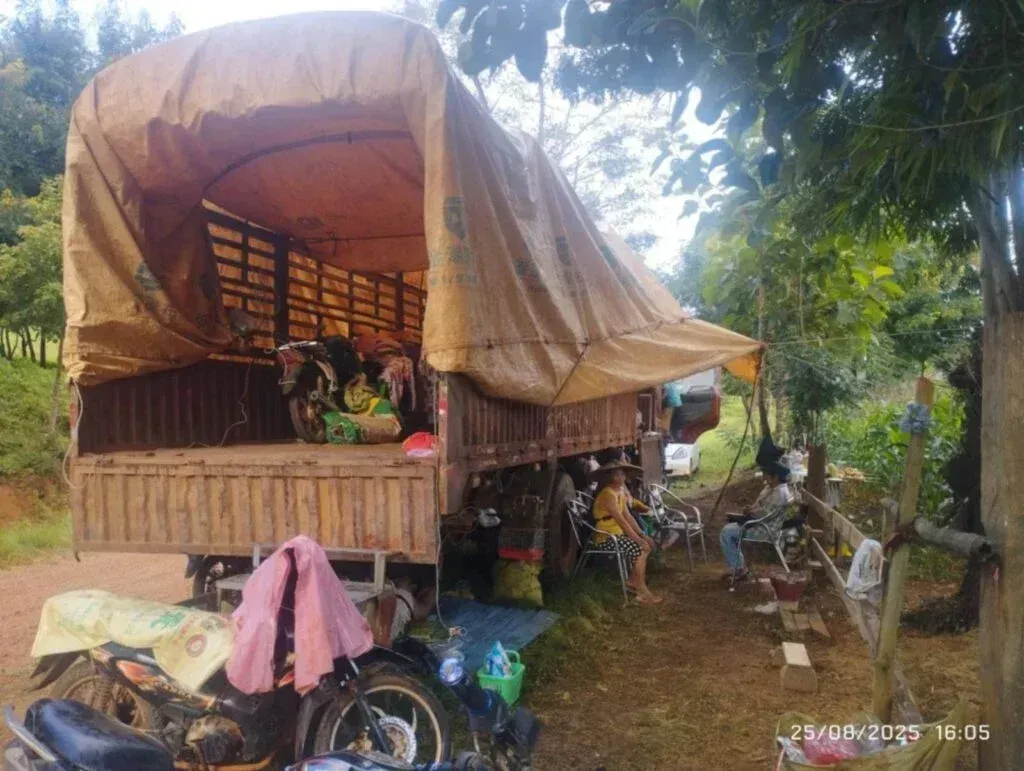
People in northern Shan State now fear a possible third wave of “Operation 1027.”
“We can’t say the fighting won’t return. We came back because rent is too expensive and we don’t want to burden others. But we still fear the mines,” said Nang Mo, an IDP in Hsipaw.
She added that while the military dictatorship must one day be eliminated, it should not be through military conflict, because civilians continue to pay the price.
“I want them to find a way that harms fewer people—to look at the people’s faces. I don’t want anyone else to suffer or experience war again. We lost our home and are trying to gather strength to rebuild our lives,” she said.
*Names marked with an asterisk have been changed for security reasons.
This article was originally published in SHAN’s Burmese section. Written by Nang Seng Nom, translated into English by Eugene.


Leave a Comments