



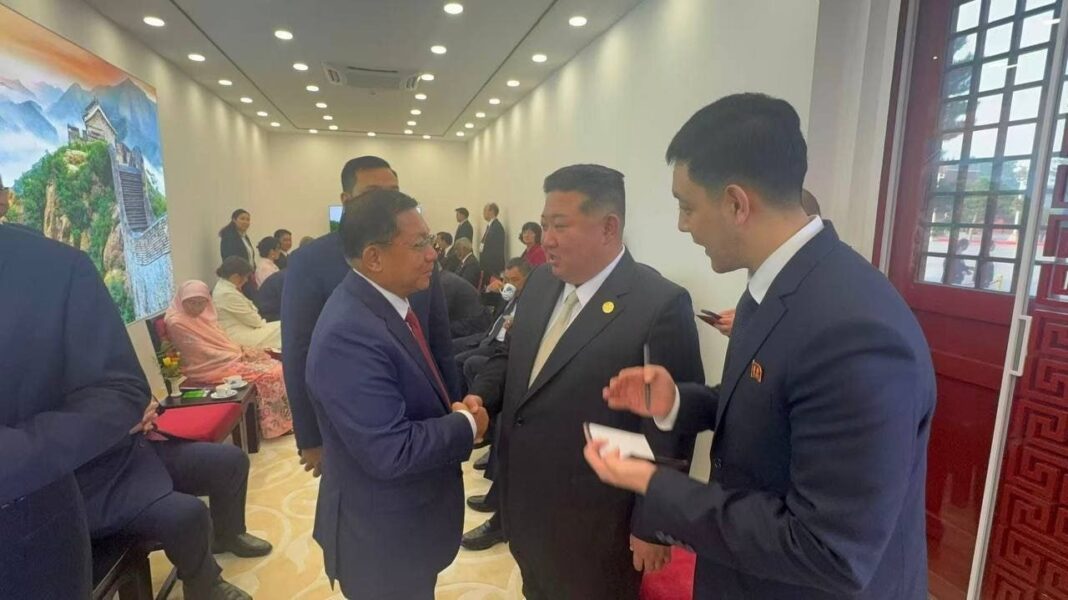
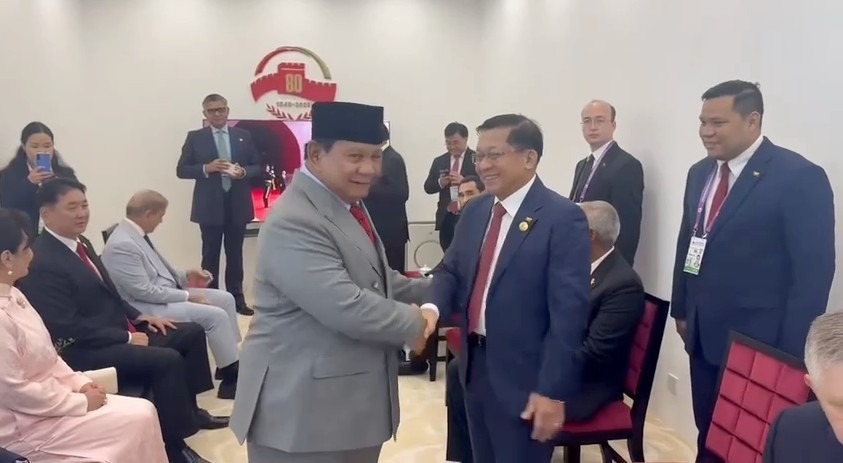
Military junta’s leader Gen. Min Aung Hlaing was invited by China’s President Xi Jinping to attend the Shanghai Cooperation Organization (SCO) Summit in Tianjin and the commemoration of the 80th anniversary of the victory of the Chinese People’s War of Resistance Against Japanese Aggression and the World Anti-Fascist War.
The junta now styled itself as State Security and Peace Commission (SSPC) formerly known as State Administration Council (SAC) after the military coup in 2021.
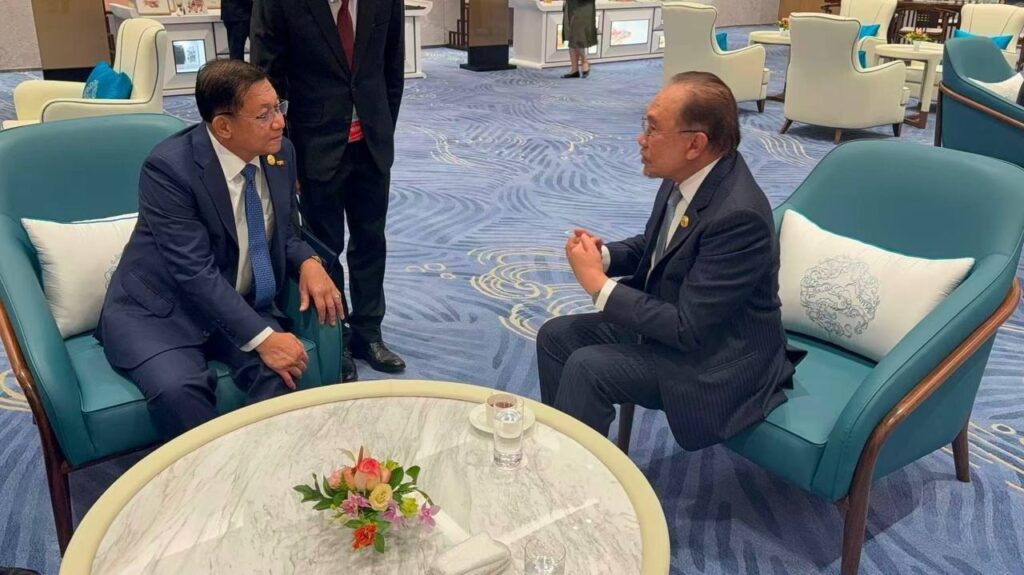
Accordingly, on August 30, 2025, he met with Chinese President Xi Jinping at the Tianjin Guest House, where Xi emphasized strengthening the China-Myanmar “pauk-phaw” (fraternal) friendship and advancing strategic cooperation. On the same day, Prime Minister Narendra Modi of India also held a bilateral meeting with Min Aung Hlaing on the sidelines of the SCO Summit.
On August 31, 2025, Min Aung Hlaing began with a working trip to Tianjin, where he attended a welcome dinner marking the SCO Summit.
On September 1, 2025 the SCO Summit was held, in Tianjin, during which Min Aung Hlaing participated in official meetings and discussions. He also met with officials from Wuhan University to discuss technological cooperation, including satellite technology and human resource development.
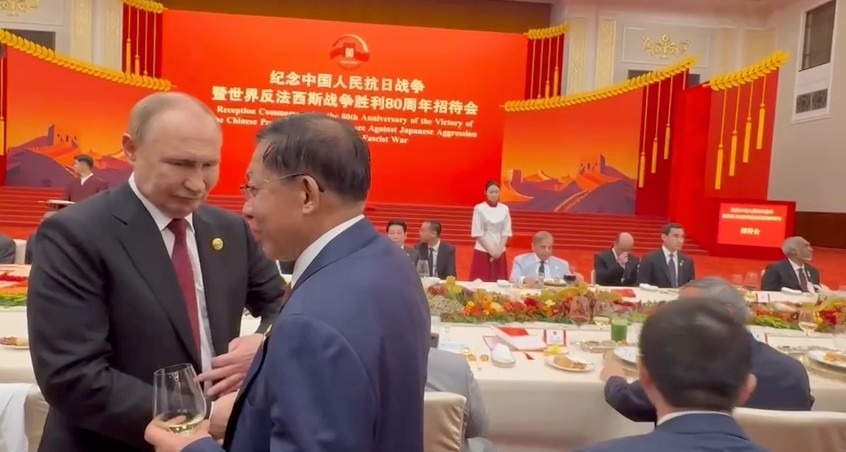
On September 3, 2025, following the SCO events, Min Aung Hlaing traveled to Beijing to attend China’s Victory Day military parade, commemorating the 80th anniversary of the end of World War II in Asia. He was among 26 foreign leaders invited by President Xi Jinping, including Russian President Vladimir Putin and North Korean leader Kim Jong-un, underscoring Beijing’s outreach to nations with close strategic ties.
This visit marked a rare overseas trip for Min Aung Hlaing since the 2021 military coup in Myanmar and highlighted China’s diplomatic support for the junta, particularly ahead of Myanmar’s planned general election on December 28, 2025.
Traveling from Tianjin to Beijing to join Wednesday’s military parade marking the 80th anniversary of China’s WWII victory over Japan, junta spokesman Major-General Zaw Min Tun highlighted Min Aung Hlaing’s meetings with Chinese leader Xi Jinping and India’s Narendra Modi.
He said the trip reflected growing “international recognition” for the junta, with China endorsing its election plan while pledging continued support for Myanmar’s “peace and development.”
Junta media said Xi and Min Aung Hlaing met in Tianjin on August 30 to discuss cooperation in Myanmar’s peace process, regional diplomacy, and Chinese Belt and Road infrastructure projects, including the China-Myanmar Economic Corridor (CMEC), according to The Irrawaddy report of September 3, 2025.
Ministry of Foreign Affairs People’s Republic of China report
According to Ministry of Foreign Affairs People’s Republic of China report of August 30, 2025, during the afternoon meeting between President Xi Jinping met at the Tianjin Guest House with Myanmar’s Acting President Min Aung Hlaing, he noted that “(t)he China-Myanmar pauk-phaw friendship, rooted in the hearts of the two peoples, is as strong and relevant as ever. The two sides should seize the opportunity of the 75th anniversary of their diplomatic relations to deepen strategic cooperation, accelerate the building of their community with a shared future, and bring greater benefits to people in both countries.”
“President Xi stressed that China supports Myanmar in following a development path suited to its realities, in safeguarding its sovereignty, security and development interests, in rebuilding after the earthquake, and in delivering a better life to its people. China also supports Myanmar in unifying all domestic political forces as much as possible and restoring stability and development. The two sides should advance key projects of the China-Myanmar Economic Corridor and promote economic and trade cooperation. Joint efforts should be made to combat cross-border crimes, maintain peace and tranquility in the China-Myanmar border region, and ensure the safety and security of Chinese personnel, institutions, and projects in Myanmar. The two sides should carry forward the spirit of the Five Principles of Peaceful Coexistence and jointly safeguard the U.N.-centered international system.”
“Acting President Min Aung Hlaing said that Myanmar and China share a deep pauk-phaw friendship and a common pursuit of peace and stability, and both countries made significant contributions to the victory of the World Anti-Fascist War. China has always been a good neighbor and a good friend to Myanmar, providing long-term assistance to Myanmar’s economic and social development, supporting its post-disaster rehabilitation efforts, and playing a constructive role in facilitating peace and stability in northern Myanmar. Myanmar will steadfastly uphold the one-China policy. Myanmar will work with China to pursue high-quality Belt and Road cooperation, and expand cooperation in such areas as trade, investment, energy, and infrastructure, so as to create a better life for people in both countries. As a dialogue partner of the SCO, Myanmar will actively contribute to the development of the organization.”
“The two sides signed multiple bilateral cooperation agreements in the fields of customs, news media, and others.”
What has Min Aung Hlaing achieve
During his visit to China in late August and early September 2025, Senior General Min Aung Hlaing, Myanmar’s military leader, achieved several key diplomatic and strategic outcomes, primarily centered on strengthening bilateral ties with China and gaining international legitimacy amid ongoing domestic and international challenges.
Key Achievements of Min Aung Hlaing’s visit are: high-level diplomatic recognition; advancement of Myanmar’s SCO membership bid; enhanced bilateral cooperation; participation in prestigious international events; and regional diplomacy and networking.
Min Aung Hlaing was able to hold direct meeting with Chinese President Xi Jinping on August 30, 2025, in Tianjin. Xi reaffirmed China’s support for Myanmar’s sovereignty and stability, including expressed backing for Myanmar’s planned general election scheduled for December 28, 2025. This high-level engagement granted Min Aung Hlaing significant international visibility and legitimacy, especially given the isolation of his regime by Western countries.
China publicly endorsed Myanmar’s application for full membership in the Shanghai Cooperation Organization (SCO) during the summit. While formal admission requires consensus among all member states and is not immediate, China’s strong support marks a major step forward. The issue was discussed during the SCO Summit on September 1, 2025, and is expected to remain on the agenda for future meetings.
The visit included discussions on deepening cooperation in infrastructure, trade, and technology. Notably, Min Aung Hlaing met with officials from Wuhan University to explore collaboration in satellite technology and human resource development, indicating progress in strategic and technological partnerships.
Min Aung Hlaing attended China’s 80th-anniversary commemoration of the victory in the War of Resistance Against Japanese Aggression on September 3, 2025, in Beijing. His presence alongside leaders like Vladimir Putin and Kim Jong-un elevated his international standing and signaled China’s willingness to treat the Myanmar junta as a legitimate political actor.
On the sidelines of the SCO Summit, Min Aung Hlaing held a bilateral meeting with Indian Prime Minister Narendra Modi, reflecting ongoing regional engagement. India, like China, has maintained pragmatic ties with Myanmar’s military government, particularly concerning border security and counterinsurgency efforts.
While no binding agreements on major infrastructure or security were announced, the visit significantly bolstered Min Aung Hlaing’s diplomatic position. It reinforced China’s role as Myanmar’s most powerful ally and provided much-needed international visibility for the junta. The support for Myanmar’s SCO membership and China’s endorsement of the upcoming election are likely to be leveraged domestically by the military regime to assert political legitimacy. However, full SCO accession remains a longer-term prospect dependent on broader consensus among member states.
Junta’s likely counteroffensive moves
With China’s political and diplomatic support, Min Aung Hlaing’s military regime is likely to pursue a multifaceted strategy to counter anti-junta opposition groups, though direct Chinese military involvement remains highly unlikely. Instead, China’s backing enables the junta to sustain its operations through indirect means. Junta’s counteroffensive may likely unfold practically on the ground along the line mentioned below:
In enhancing border security and intelligence cooperation, China may go about to counter ethnic armed organizations (EAOs) gains, especially in northern Shan State, with intelligence sharing and border control support to the military junta.
Regarding targeted military reinforcements and logistics, while China officially maintains a policy of non-interference, it will continue to supply the junta with arms, spare parts, and dual-use technology, such as supplying artillery, drones, and armored vehicles. These are critical for the junta’s artillery-heavy tactics and aerial bombardments, especially in mountainous regions.
On Logistical corridors with Chinese backing, the regime may prioritize securing key roads like the Muse-Mandalay highway, a vital trade and military supply route. Control of this corridor allows faster troop and equipment movement into conflict zones.
Concerning focus on strategic strongholds and urban centers, rather than attempting to reclaim all lost territory, the junta—with Chinese encouragement—is likely to consolidate control over major cities (e.g., Mandalay, Lashio, Naypyidaw) and administrative centers.
Moreover, with the use Chinese-supported infrastructure projects (e.g., roads, energy grids) junta will maintain supply lines and project power; and prioritize areas of strategic interest to China, such as Muse (a major border trade hub), to ensure economic and political stability in regions critical to bilateral trade.
On leveraging pro-junta ethnic militias, the junta relies heavily on allied ethnic militias, some of which operate with tacit Chinese tolerance or even coordination. For example, groups like the Myanmar National Democratic Alliance Army (MNDAA) previously fought against the junta but have shown signs of shifting allegiance under Chinese pressure.
Furthermore, China has hosted ceasefire talks (e.g., in Kunming) to broker temporary truces among EAOs, which can isolate anti-junta forces and create windows for the military to regroup.
On information warfare and legitimacy building facet, China’s diplomatic support helps the junta counter its international isolation, where the junta uses its participation in events like the SCO Summit and China’s Victory Day parade to project an image of legitimacy.
Moreover, state media in both countries highlight bilateral cooperation, framing the junta as a stable partner for regional development and security.
Concerning economic and humanitarian leverage China’s investments in infrastructure (e.g., the China-Myanmar Economic Corridor) give it influence over local populations, where development projects can be used to win local support or coerce communities into rejecting opposition control. Apart from that the junta may restrict access to aid or trade in areas held by anti-junta forces, increasing pressure on civilians and weakening rebel support bases.
In a nutshell, with China’s backing, Min Aung Hlaing’s strategy may focus on survival, stabilization, and selective counterattacks—particularly in areas of strategic and economic importance. The regime may not be aiming for a total military victory but rather a managed consolidation of power, enabled by Chinese diplomatic cover, border security cooperation, and continued arms supply. Success will depend on maintaining internal cohesion, exploiting divisions among anti-junta opposition groups, and aligning military actions with China’s regional stability interests.
Analysis
Looking at all the available facts and development on the ground, Burma maybe in for a long stalemate, as the junta or the anti-junta groups won’t be able to achieve absolute victory over one another.
It is true that China and the junta are making use of all available means to lend the junta legitimacy credentials as a de facto and de jure ruler of Burma or Myanmar. But the UNGA and also the UN Credentials Committee won’t be lending legitimacy to the military junta regime anytime soon, even with China, Russia and India endorsement, if the past four years of experience were of any indication.
As such, the place of UN Ambassador for Myanmar will remain as it is, with some “quiet gentleman’s agreement”, which is expected to refrain from using high-level sessions to denounce the military regime. Therefore, the restriction, if any, is not a formal one imposed by the committee but rather an informal understanding to maintain a low profile during high-level sessions. This deferral means the committee has not formally recognized the military junta’s appointee, nor has it explicitly endorsed the National Unity Government (NUG) representative, but it has also not removed Kyaw Moe Tun from his position, who openly backs the NUG from day one.
In other words, China and Russia endorsement of military junta won’t change the situation in UN in any way.
Regarding the external help for anti-junta ethnic-democratic loose alliance there isn’t much indication, that the West, particularly the EU and US will get involve anytime soon, as it is a back-burner for them and no country is going to risk taking on China regarding Myanmar issue. Thus, it will remain as it is for the foreseeable future.
The military junta may be able to go on selective counteroffensive in different areas of the country, especially in strategic areas of economic importance. But it won’t be aiming at total annihilation victory on anti-junta forces. Instead it will make use of Chinese backing to consolidate its power gradually.
As for the anti-junta loose alliance, it will depend on how fast and effective it can solidify its unity with a proper future blue print and political agenda for international and domestic consumption to turn the tide in its favor.
China on its part is unlikely to send troops or conduct airstrikes. Its support remains political, economic, and intelligence-based. Its main concern will continue to be no large-scale conflict near its border and has pressured both sides to avoid fighting in border towns, which constrains the junta’s freedom of action in northern Shan State.
In sum, its going to be a foreseeable stalemate, as the anti-junta groups can revert back to guerrilla warfare tactics anytime they choose to do so. In the meantime, both the junta and anti-junta groups will try to outwit each other with whatever they have in store to come out on top, if possible.


Leave a Comments