




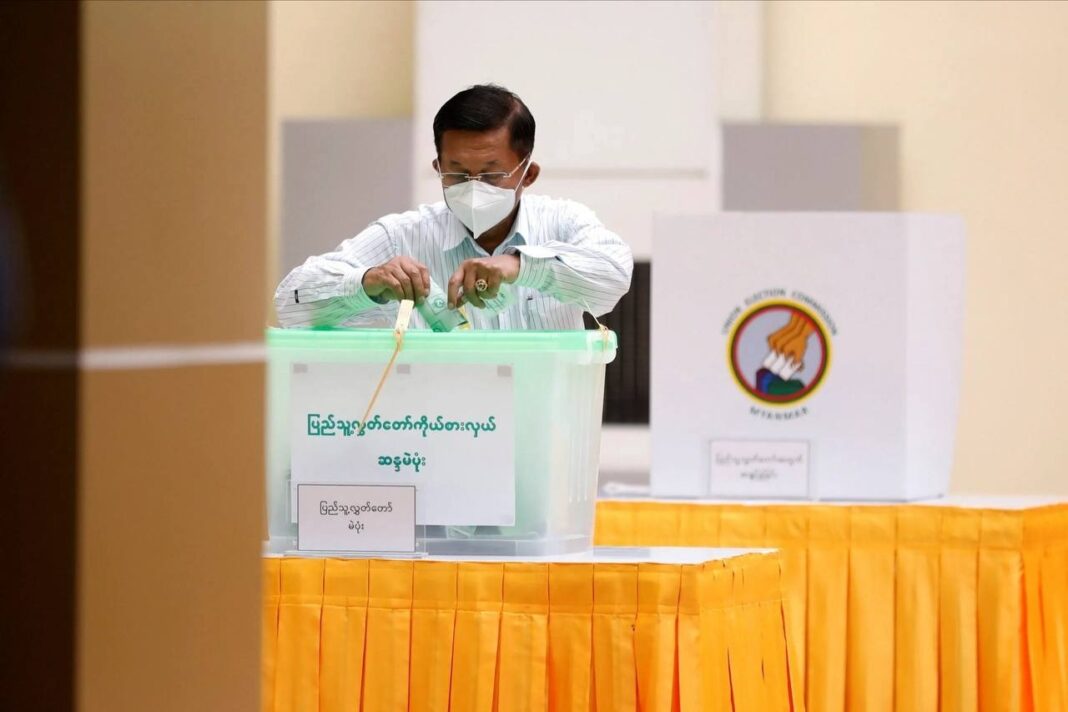
The military council in Taunggyi, southern Shan State, has reportedly stepped up security checks in preparation for the upcoming January 2026 elections.
On July 31, military leader Min Aung Hlaing revoked a previous order that had delegated authority to the Commander-in-Chief of the Armed Forces and reorganized the National Security and Peacekeeping Commission.
Following this restructuring, the military council announced on August 4 that it would deploy the Personal Security Monitoring System (PSMS) to track and apprehend deserters, police absconders, and other targeted individuals in Taunggyi, according to the Taunggyi General Administration Department.
The council is also compiling voter lists by neighborhood and conducting monthly inspections of registered visitors and overnight guests, a Taunggyi administrator confirmed.
“The military is taking what it calls necessary actions. They have been instructed to register all individuals over 18 years old. Security checks have intensified as the election approaches, serving as a pre-emptive measure. Since the council took power, there has been no progress, and the situation has deteriorated,” the administrator said.
Those found staying in Taunggyi without being listed on a guest register face arrest by military strategic and district commanders. Both hosts and guests may be fined between 30,000 and 70,000 kyats (approximately USD 7–16) before being released, he added.
The PSMS technology will be used to verify vehicles, police identification, and photo and video files to identify deserters, police absconders, and alleged “terrorists.”
Locals have expressed concern over these measures. A woman enrolled in a computer course in Taunggyi said, “During monthly guest list checks in my rented room, I fear arrest even if I am innocent. With PSMS technology, the risk increases. I avoid going out and worry about being caught and extorted. If that happened, my family wouldn’t even know. Attending classes feels unsafe.”
A local man in his 20s told SHAN, “Inspections have become very strict. We can be arrested anytime without cause and extorted for money. It’s especially worrying for young people, who now avoid traveling.”
The directive requires that visitors to hotels, motels, and guesthouses be screened through PSMS and reported to the relevant police station. Entry and exit points in Taunggyi, as well as bus terminals and buses, must also undergo PSMS screening, with results forwarded to authorities.
Hotel and bus operators who fail to comply face legal action under existing laws. Since early 2025, several arrests have been made using PSMS technology. On July 2, Thet Htar Thuzar, 29, was detained at the Nam Pan Tak checkpoint in Kalaw Township on suspicion of collecting funds for the People’s Defense Force (PDF). On May 25, a Taunggyi University of Technology student was arrested under anti-terrorism laws for alleged links to the PDF.
PSMS — the Person Scrutinization and Monitoring System — integrates AI, facial recognition, CCTV analysis, and biometric data to identify individuals. The military council has registered members of the civil disobedience movement (CDM) and political activists nationwide with e-IDs in a centralized National Database system, applying PSMS checks at domestic checkpoints and border crossings.









Leave a Comments